
NO ROOM FOR PURITY: EXCESS AND COLLISION IN THE DE LA TORRE BROTHERS’ PRACTICE
Reading time: 11 minutes
[short reading]
Since the 1980s, Einar and Jamex de la Torre have built a body of work that refuses to resolve its own contradictions. Glass merges with resin, Aztec cosmologies collide with Catholic iconography, and border culture sits alongside pop-culture debris—all without settling into a single visual identity or a fixed reading of Chicano or Mexican American art. Two exhibitions currently on view in the United States make that refusal newly visible: Collidoscope, a thirty-year retrospective at the Wichita Art Museum, and Psychopomp, a new body of work at Ruiz-Healy Art in New York.
Seen together, the two shows work almost like a grammar lesson. The museum’s retrospective spreads the artists’ visual language across entire rooms, revealing its underlying syntax through accumulation and repetition. The gallery isolates individual sculptures, letting their formal and iconographic density unfold piece by piece. This essay reads both exhibitions as two sides of the same practice—one built, from the start, on the idea that contradiction is not a problem to solve but a material to work with.
There is little room for purity in the world imagined by the de la Torre Brothers. Their sculptures delight in excess, collision, and accumulation. Glass merges with resin, devotional objects sit beside plastic trinkets, Aztec cosmologies run into Catholic iconography, and popular culture slips into art history without asking permission. Einar and Jamex de la Torre don’t resolve these contradictions—they amplify them, building lavish visual ecosystems where symbols migrate freely across geographies, historical periods, and systems of belief. Their works don’t simply represent cultural hybridity; they emerge from an ongoing act of translation, in which disparate visual traditions land in relationships that feel both unexpected and strangely inevitable.
This resistance to fixed categories has remained one of the defining features of their collaborative practice. Since the 1980s, the artists have developed a distinctive artistic language that draws equally from Mexican folk traditions, Chicano visual culture, religious imagery, consumerism, mythology, and the everyday material landscape of the U.S.–Mexico border. Yet to read their work primarily through questions of identity would be to overlook one of its defining impulses: an insatiable appetite for juxtaposition.
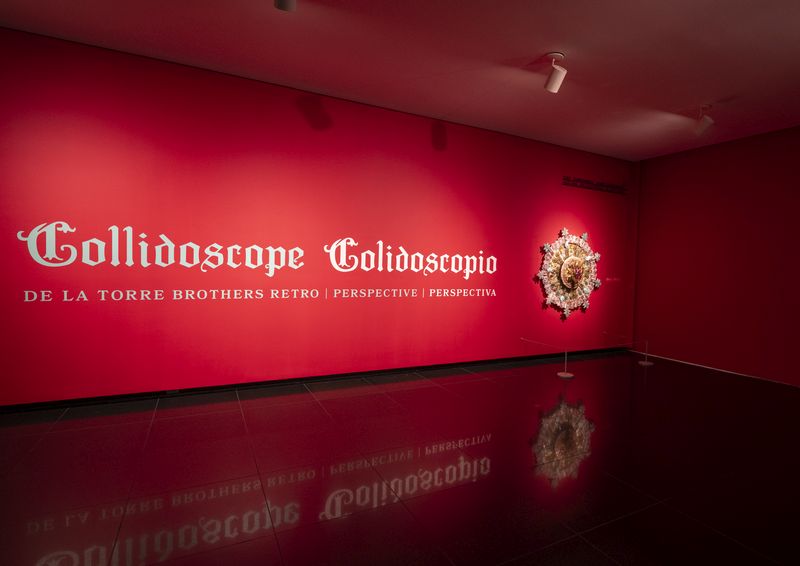
This expansive approach finds a particularly revealing moment in two U.S. exhibitions running at the same time but pulling in different directions. Collidoscope: de la Torre Brothers Retro-Perspective, at the Wichita Art Museum, surveys more than thirty years of production. Psychopomp, at Ruiz-Healy Art in New York, turns instead into a new body of work that distills many of the concerns that have long driven the pair’s practice.
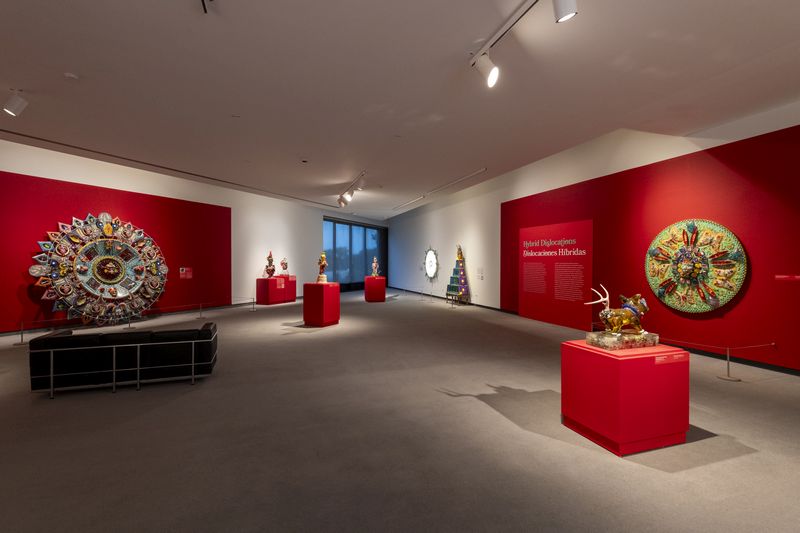
Seen back-to-back, the two shows reveal how much context shapes perception. At Wichita, the works unfold collectively, surrounding the viewer in a visual cosmos where excess is itself the experience. At Ruiz-Healy, the experience becomes more intimate. Freed from the retrospective’s monumental rhythm, each sculpture asks for a different kind of attention, letting its formal intricacy, material intelligence, and iconographic density unfold piece by piece. In other words: the retrospective reveals the syntax of the artists’ language; the gallery allows us to decipher the grammar of each work.
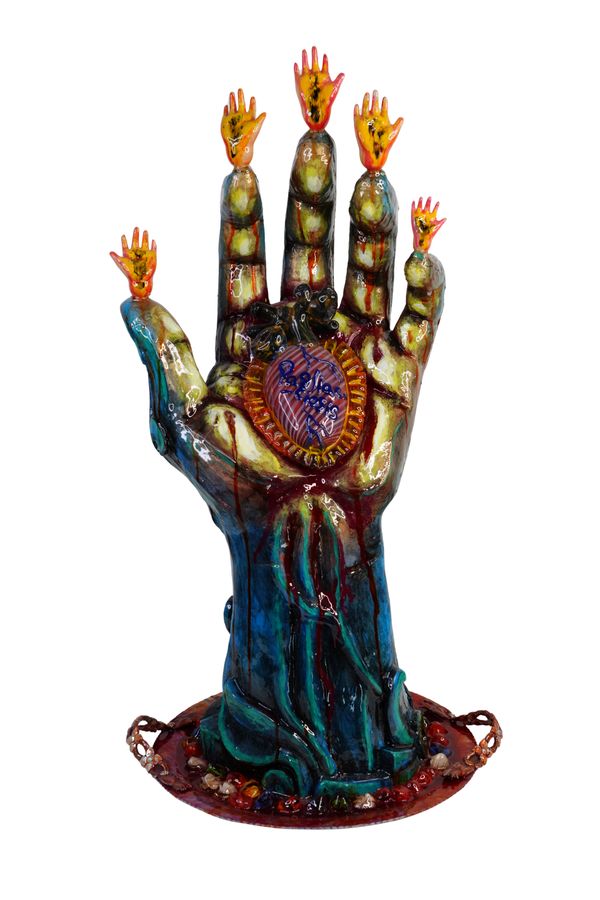
Collaboration is the material condition of this duo’s practice. Einar and Jamex have resisted the figure of the solitary artist in favor of one in which authorship is continually renegotiated. Their sculptures are not simply the result of shared labor, but of a sustained conversation—one that moves fluidly between technical experimentation, visual research, cultural memory, and irreverent humor.
Born in Guadalajara and raised in Southern California after their family relocated in the early 1970s, the pair lived cultural translation as an everyday condition. Moving between languages and social codes was less about choosing one identity than about inhabiting several at once. Throughout their career, they have resisted the taxonomies that usually come attached to border art—»Chicano artists,» even «Mexican American artists» only partially account for a practice built to outrun disciplinary, aesthetic, and cultural boundaries.
«Glass artists» is another label often used to historicize their work—and the one their practice most persistently complicates. Glass remains the medium’s center of gravity, and in Psychopomp it carries the weight of the show. But even here, it functions less as a technical showcase than as one material among many in a wider ecology: resin, found objects, lenticular prints, plastic toys, religious artifacts, antique souvenirs, even digital manipulation. What emerges is a material collage in which every object arrives carrying its own cultural history.
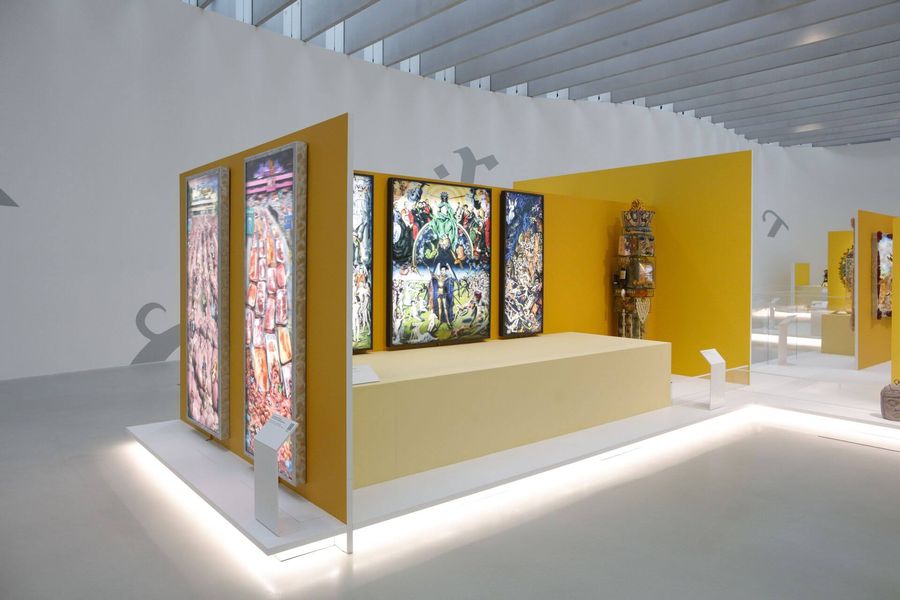
This disregard for artistic hierarchies is what makes Collidoscope more than a retrospective. Instead of a linear evolution, the exhibition shows the remarkable consistency of a visual language built through accumulation, repetition, and transformation. Across works separated by decades, familiar motifs reappear as mutable forms, their meaning shaped by the materials and contexts around them.
Walking through Collidoscope, what becomes immediately apparent is not the evolution of a style but the persistence of a way of thinking. Although the exhibition spans more than three decades, it sidesteps the conventional retrospective logic of artistic development as a march toward maturity. Symbols, materials, and formal strategies keep resurfacing instead, each return functioning as its own act of reinvention.
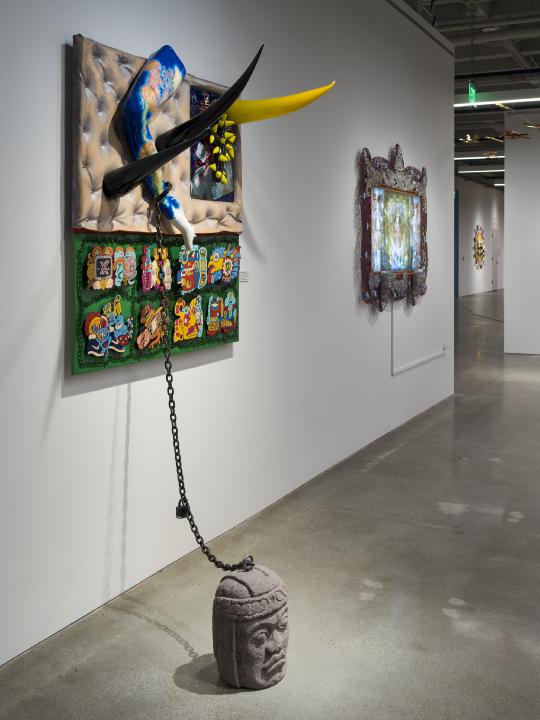
Collidoscope favors accumulation over isolation. Monumental mandalas, hybrid figures, lenticular prints, and sculptural assemblages establish visual correspondences across rooms, encouraging viewers to move through the exhibition much as they would navigate one of the artists’ own compositions—from one unexpected association to another.
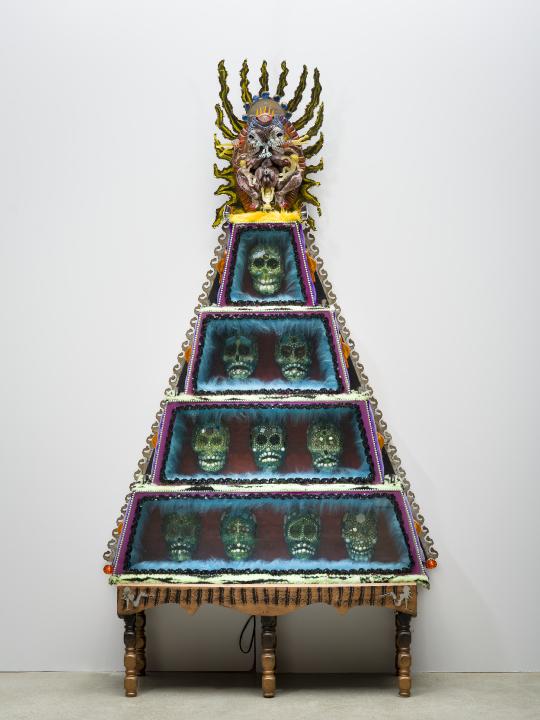
An early work like Baja Kali already contains many of the principles that still animate the duo’s practice. Built as a tiered assemblage of skulls, truck lights, faux fur, and references to both Coatlicue and the Hindu goddess Kali, the sculpture refuses any single cultural genealogy. Its scale was, in fact, dictated by the border itself: at the time, the brothers were shuttling work and materials between Mexico and the United States, and the size of any piece was limited by what could fit in the trunk of a car—or, as it happened, in the back of their VW van. Baja Kali is exactly that: the largest sculpture they could make and still drive across. It lets these references sit in productive tension rather than folding them into one narrative, anticipating the additive logic that would come to define their later work.
For all their visual exuberance, the works are never chaotic. Their accumulations obey carefully calibrated compositional logics that vary from piece to piece. In the mandalas, symmetry and radial organization hold together an astonishing diversity of materials and references, while other sculptures rely on stacked assemblages, balance, or narrative sequencing. Excess, in other words, is always choreographed. It is precisely this tension between abundance and formal control that gives their work its outstanding visual coherence.
The exhibition makes this internal order visible. Its layout encourages the eye to move from one work to another, tracing recurring forms, colors, and motifs across decades of production. The effect is cumulative: a visual vocabulary that expands through variation rather than rupture.
Seen as a whole, Collidoscope reveals a practice that continues to evolve without abandoning its conceptual core. And it’s precisely because the retrospective leans into that cumulative force that Psychopomp lands as such a compelling counterpoint. Where the museum invites viewers to grasp the breadth of the artists’ imagination, the gallery makes room to linger inside the internal logic of individual works.
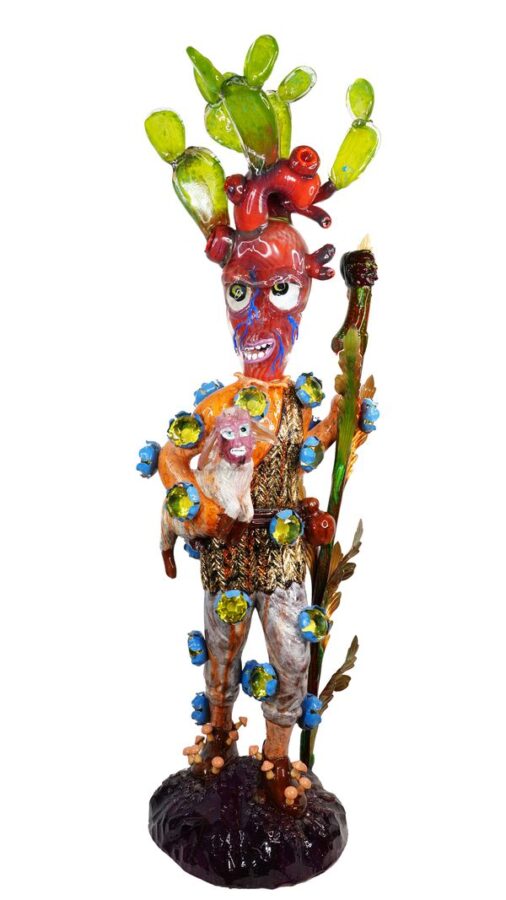
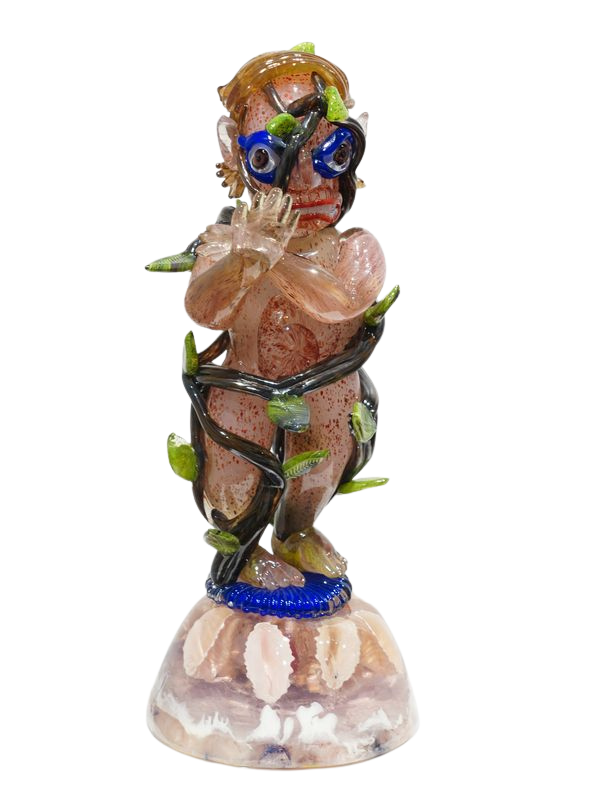
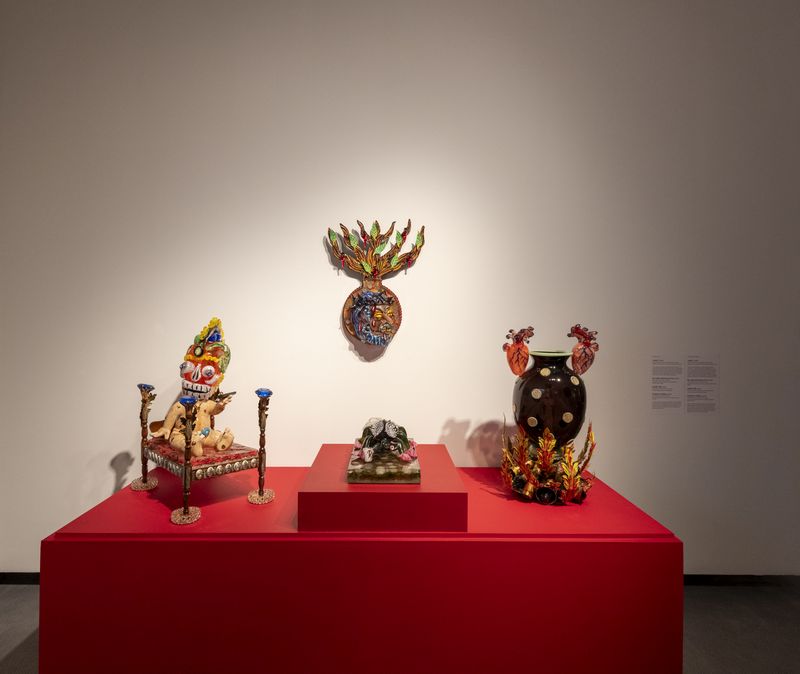
Installed with generous intervals between pieces, Psychopomp resists spectacle without losing its zest. Each sculpture gets its own room to breathe, and viewers can follow the intricate negotiations between blown glass, found objects, resin, and iconographic fragments at close range. Details that might dissolve into the retrospective’s abundance come into sharp focus here.
The show borrows its title from the psychopomp, the spiritual guide who accompanies souls across the threshold between worlds. Einar and Jamex don’t treat this as a fixed mythological reference—they turn it into a distinctly borderland figure. Their Coyote de Almas evokes both the nahual of Mesoamerican cosmologies and the «coyote» who guides migrants across the U.S.-Mexico border, collapsing spiritual passage and geopolitical displacement into a single, deeply ambivalent image.
Whereas Coyote de Almas is about passage, Lorax Salute is about the ecological cost of human excess. Borrowing from Dr. Seuss’s unlikely environmental prophet, the artists transform the familiar character into something at once humorous and unsettling. The once-playful guardian of the forest reappears as an increasingly grotesque figure, its exaggerated features registering exhaustion and indignation rather than whimsy. As is often the case in this duo’s work, satire becomes a vehicle for confronting uncomfortable realities: environmental collapse is never illustrated literally, only conjured through distortion, irony, and visual excess, so the piece can hold laughter and unease at once.
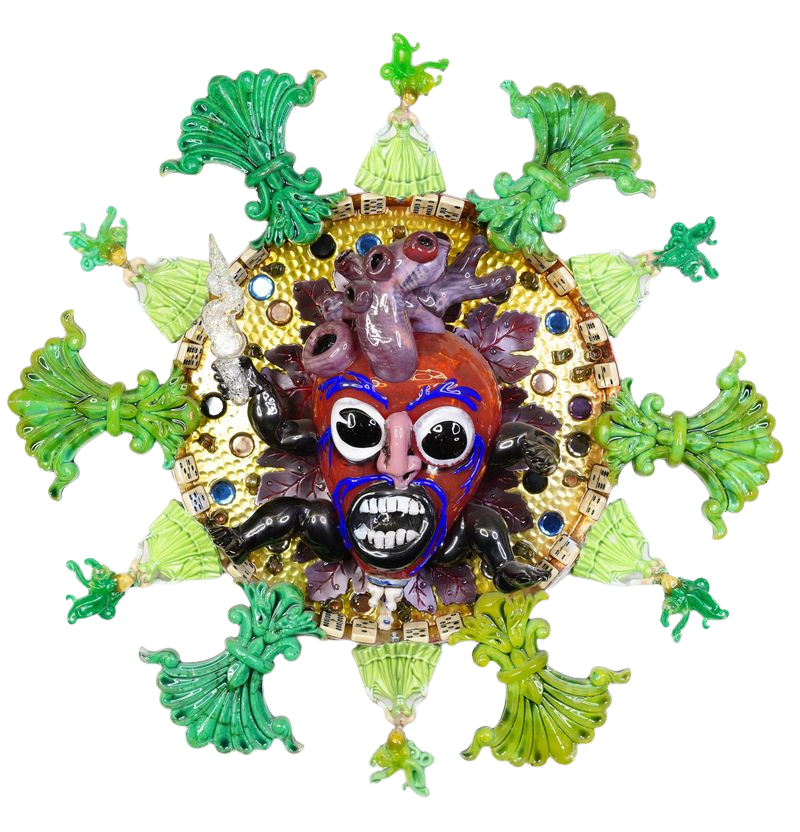
Brave Heart distills a different intensity—the centrifugal logic of their mandala compositions condensed into a single, pulsating image. Radiating from a grimacing heart with limbs and a raised blade, the work braids together the Aztec Sun Stone, devotional iconography, and pop culture into one tightly orchestrated composition where violence, protection, sacrifice, and resilience all coexist. It shows off one of the artists’ defining strengths: the ability to transform an accumulation of heterogeneous references into an image that feels simultaneously irreverent and archetypal.
Throughout Psychopomp, mythology is never treated as a distant inheritance but as a living vocabulary through which contemporary anxieties—migration, ecological crisis, consumerism, and cultural displacement—can be reimagined. Their hybrid beings inhabit a world where sacred and profane, ancestral and contemporary, handcrafted and mass-produced stop being opposites and start being interdependent.
What Collidoscope and Psychopomp reveal, together, isn’t just the breadth of Einar and Jamex’s practice but its capacity to keep expanding without losing its footing. Their sculptures are built from collisions—between cultures, histories, materials, beliefs, visual traditions—yet those collisions never end in fragmentation. They generate connection instead, turning contradiction into a fertile force rather than a conflict to resolve.


Collidoscope: de la Torre Brothers Retro-Perspective
Wichita Art Museum, Wichita, Kansas
May 30 – September 6, 2026
de la Torre Brothers: Psychopomp
Ruiz-Healy Art, New York
May 12 – August 14, 2026
Collidoscope is curated by Selene Preciado and organized jointly by the Smithsonian’s National Museum of the American Latino and The Cheech Marin Center for Chicano Art & Culture of the Riverside Art Museum. Since debuting at The Cheech in 2022, it has traveled to the Art Museum of South Texas, the Stanlee & Gerald Rubin Center for the Visual Arts, the Philbrook Museum of Art, the Corning Museum of Glass, the Crocker Art Museum, The Mint Museum, and the Cafesjian Art Trust Museum in the Twin Cities.

También te puede interesar

DE LA TORRE BROTHERS: UNA RETRO-PERSPECTIVE
Brothers Jamex and Einar de la Torre revel in artistic freedom, defying categorization and embracing a multidisciplinary approach that spans glass, resin, lenticular printing, and material culture. Their work fuses ancient iconography with contemporary...

THE ARMORY SHOW PONE EL FOCO EN EL ARTE LATINX Y LATINOAMERICANO
Por primera vez en su historia, The Armory Show pone especial énfasis en el arte Latinx y latinoamericano con la incorporación de tres curadores que han venido dedicando sus prácticas a estas categorías rubricadas...
KATI HORNA: IN MOTION
En la obra de Horna se ejemplifica el comienzo de la época moderna marcada por la emancipación femenina y del movimiento surrealista que inspiraría al mundo de las artes durante todo el siglo 20.