

DE LA TORRE BROTHERS: UNA RETRO-PERSPECTIVE
Brothers Jamex and Einar de la Torre revel in artistic freedom, defying categorization and embracing a multidisciplinary approach that spans glass, resin, lenticular printing, and material culture. Their work fuses ancient iconography with contemporary consumer symbols, humor, and irony, reflecting their transnational experiences between Mexico and the United States. Through this interplay of cultures and identities, they challenge traditional notions of art and beauty.
Their traveling exhibition, Collidoscope: de la Torre Brothers Retro-Perspective, currently on view at the Crocker Art Museum and organized in collaboration with the National Museum of the American Latino, presents three decades of their work. Much like looking through a kaleidoscope, their ever-evolving practice weaves together time, religion, tradition, and personal experience to expand perceptions of cultural identity.

DEFYING LABELS AND EMBRACING HYBRIDITY
The de la Torre brothers resist being confined to any singular artistic identity. «To be pegged to an identity can be limiting,» says Jamex. «We’ve been labeled as California artists, Mexican artists, glass artists, Chicano artists—and that’s all fine with us.»
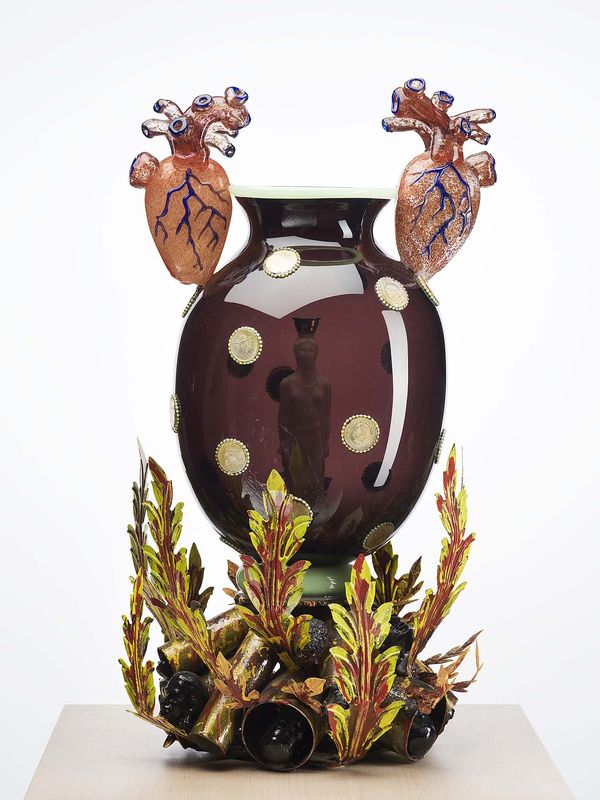
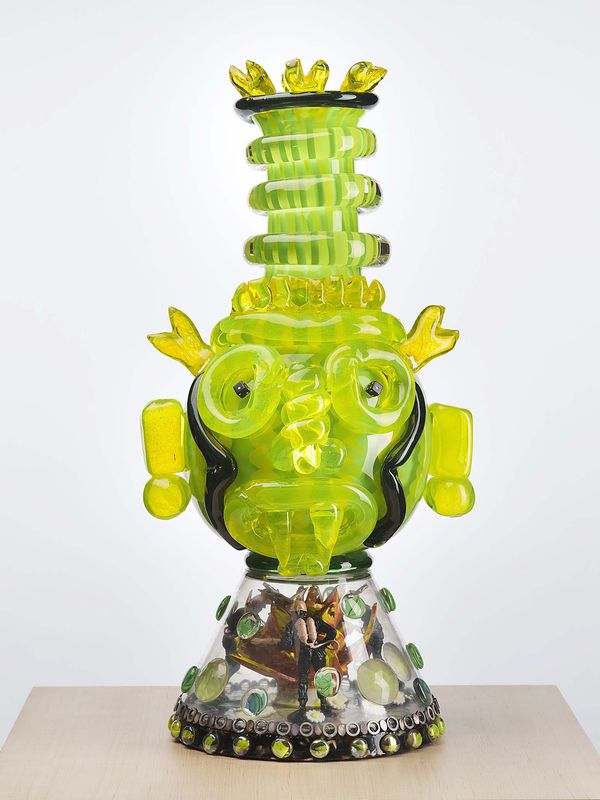
Instead of subscribing to rigid definitions, their work embodies an expansive approach: they are conceptual artists and skilled craftsmen, Mexican and American, glassblowers and resin casters, Photoshop experts and lenticular printmakers. Their insistence on creative freedom results in work that is unapologetically baroque, maximalist, and unafraid to blur the lines between high and low art.
A BORDER-SPANNING PERSPECTIVE
Born in Guadalajara, Mexico, Einar and Jamex emigrated to Dana Point, California, in 1972, an experience that profoundly shaped their worldview. «We grew up on both sides,» recalls Jamex. «That greatly informs the way we think and collaborate.» The cultural shock of transitioning from an all-boys Catholic school in Mexico to the vibrant, free-spirited landscape of 1970s Southern California influenced their artistic sensibilities.
Their work often juxtaposes indigenous iconography—such as the ubiquitous Aztec calendar—with modern symbols of consumer and pop culture. «We enjoy looking at one culture from the other’s point of view,» says Einar. Their transnational background allows them to critique and investigate society from both sides of the U.S.-Mexico border, a perspective shared by many immigrants and borderland residents.

FROM CRAFTSMANSHIP TO CONCEPTUAL ART
Artistic thinking came naturally to the brothers. «As a kid, I always had modeling clay,» recalls Jamex. «I was always making things in three dimensions.» Their father, an architect, instilled in them a love for constructing objects. In high school, Jamex worked for a local lampworker, Cam Curtis, learning the intricate process of shaping glass. After Curtis retired, the brothers took over the business, producing mass quantities of glass figurines out of their garage—a formative experience in mastering their craft.
While attending Long Beach City College, they were exposed to various artistic disciplines, from bronze casting to ceramics. It was here that they began glassblowing, a medium that demands teamwork and synchrony, mirroring their collaborative process. Despite the labor-intensive nature of glassmaking, their small business allowed them to sustain themselves financially while refining their artistic voice. «Everyone has to purchase their freedom,» says Einar. «For us, selling small pieces to crystal shops in L.A. gave us the freedom to develop our artistic practice.»
RASQUACHISMO AND EARLY WORKS
Launching their artistic careers in the midst of the 1980s recession, the brothers debuted their work at San Francisco’s Galería de la Raza, followed by a museum show in Arizona. This early period was characterized by rasquachismo, a Chicano art movement that embraces everyday materials others might dismiss as kitsch or lowbrow.
«Rasquachismo is a joyous expression of freedom,» says Jamex. «It’s about using tacky or mundane materials to create something bold and in-your-face.»
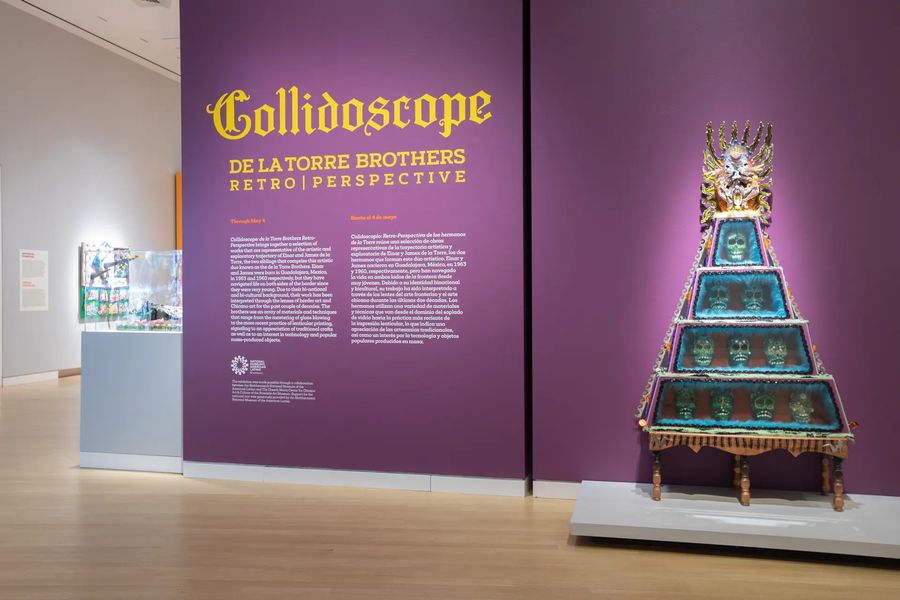
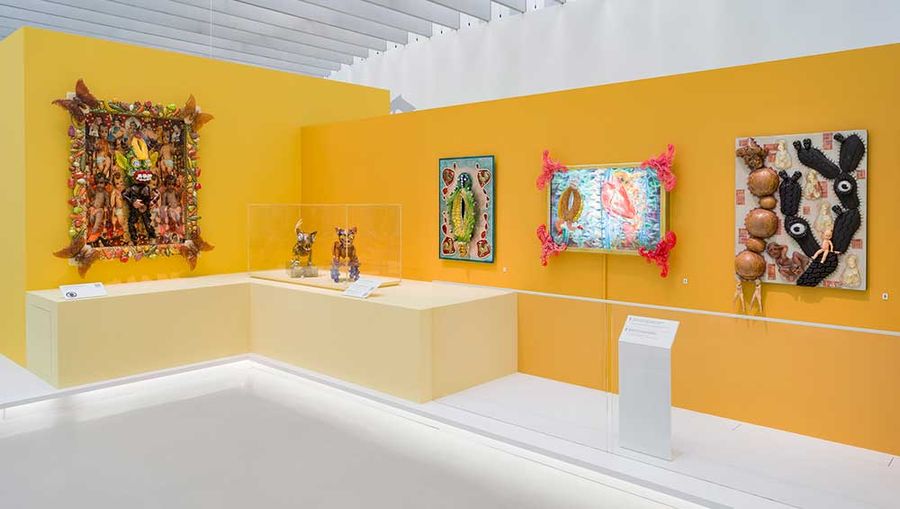
An early piece featured in Collidoscope, Baja Kali exemplifies the de la Torre brothers’ signature maximalist style, intricate collage techniques, and fusion of cultural iconography—elements that continue to define their work today.
The work takes the form of a four-tiered pyramid, each level housing a diorama with Day of the Dead masks. But these skulls are more than a nod to Día de los Muertos—they also reference the tzompantli, the Aztec skull racks of Tenochtitlán, an awe-inspiring display of stacked skulls.
The middle section of the piece features truck lights on the sides and fake fur in the front, a direct homage to the vibrantly adorned public buses of their childhood in Guadalajara, which were often decorated with Nivea bottles, lights, and doll heads on the gear shifts.
«With Baja Kali, we draw a direct analogy to Coatlicue, the Aztec goddess whose severed head is replaced by two serpents. The double-headed effigy atop the piece embodies this duality—she nurtures and births humanity while also consuming it. Much like Kali in the Hindu pantheon, she represents creation, sustenance, and destruction—the eternal cycle of life,» they explain.
EXPLORING MEDIA: GLASS, LENTICULARS, AND MIXED MATERIALS
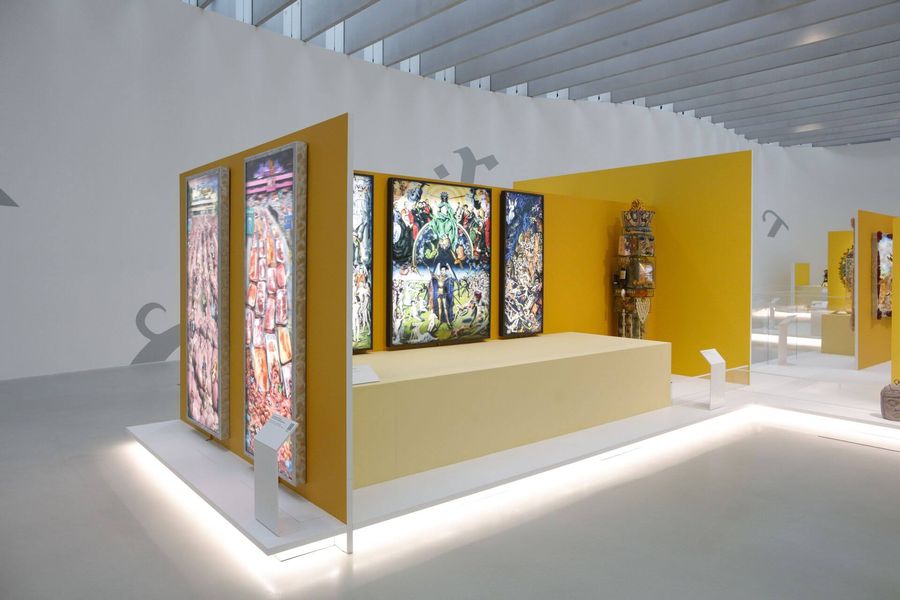
The Collidoscope exhibition, on view at the Crocker Art Museum from February 7 through May 4, 2025, showcases 42 mixed-media works, including blown-glass sculptures, installations, and lenticular prints. Co-organized by the Smithsonian’s National Museum of the American Latino and The Cheech Marin Center for Chicano Art & Culture, the show highlights the brothers’ exploration of material and media.
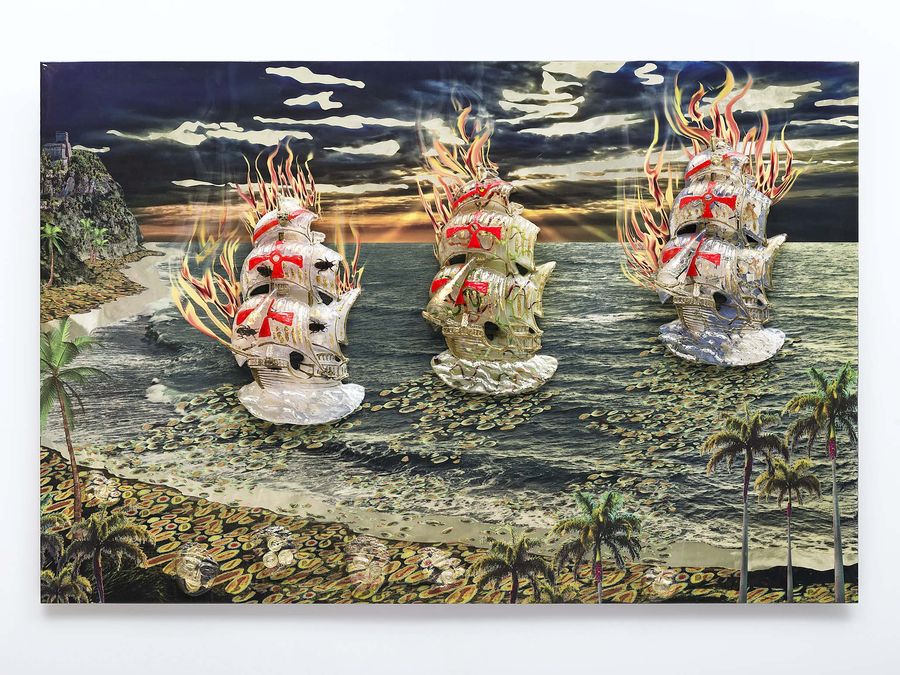
Despite their mastery of glass, the de la Torre brothers reject the notion that they are purely «glass artists.» «Glass is just one component in our three-dimensional collages,» says Einar. Their work incorporates an array of materials—resin, lenticular printing, found objects—all layered to create visually complex compositions infused with humor and cultural critique.
Their discovery of lenticular printing was serendipitous. «We stumbled upon a lenticular Disney poster and immediately thought, ‘How do we do this?’,» says Einar. Lenticular prints use optical illusions to create shifting images, allowing the brothers to embed multiple layers of meaning in their work. Their mixed-media approach ensures that each piece is textured, dynamic, and rich in both form and concept.
COLLABORATION AS AN ARTISTIC PHILOSOPHY
Creating art together has been a constant in their lives. As Jamex notes, «Art history overemphasizes the lone creator—that’s a myth. No one works in isolation.» The brothers see collaboration not just in their own process but as an intrinsic part of artistic creation. Conversations with colleagues, friends, and mentors shape their work, and their own collaborative process is fluid and intuitive.
«Creativity doesn’t happen with the parking brake on,» says Einar. «Sometimes you have to surrender control and trust the other person, even if they erase or undo something you did.» Their working method mirrors the way they build their pieces—layering, refining, and balancing elements until, as Jamex puts it, «things make absolute sense.»

BALANCING CONCEPT AND CRAFT
The de la Torre brothers challenge the traditional divide between conceptual artists and craftspeople. «In the art world, there’s often a false distinction between those who ‘think’ and those who ‘make,’» says Einar. «We do both.» Whether glassblowing, casting resin, or creating lenticular prints, they remain hands-on in their practice, valuing technical skill as much as intellectual inquiry.
Despite their maximalist aesthetic, they remain conscious of the material reality of artmaking. «You’re producing objects in a world already full of objects,» Jamex reflects. «You have to justify your footprint. You must feel like you have something to say—because otherwise, why say it at all?»
A VIBRANT LEGACY
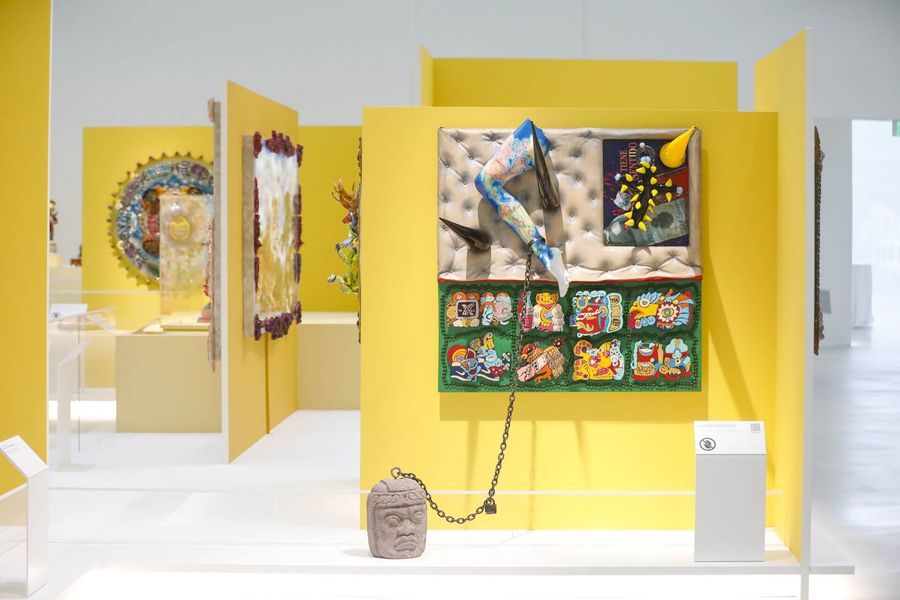
One of the works featured is Bolívar’s Burden, a wall relief that critiques the failed dream of a united Latin America, arguing that economic interests, rather than shared identity, have ultimately shaped regional cohesion. “We’re talking about how class and race are used to divide people,” they explain.
The piece features a shackled Olmec head—an ancestral legacy weighed down like a ball and chain—while a mannequin leg, imprinted with a map of the Americas and clad in soccer cleats, wryly suggests that fútbol may be the only true unifying force across the continent.
Through their work, the de la Torre brothers continue to push artistic boundaries, embracing hybridity, material experimentation, and cultural critique. With Collidoscope, they invite audiences into their kaleidoscopic world—one where tradition and modernity, humor and critique, craft and concept collide in dazzling, unexpected ways.
Collidoscope: de la Torre Brothers Retro-Perspective is a collaboration between the Smithsonian’s National Museum of the American Latino and The Cheech Marin Center for Chicano Art & Culture of the Riverside Art Museum (The Cheech). The exhibition is curated by Selene Preciado.
Before its installation at the Crocker, Collidoscope was presented at institutions across the country, including the Art Museum of South Texas, the Stanlee & Gerald Rubin Center for the Visual Arts, the Philbrook Museum of Art, and the Corning Museum of Glass. The exhibition will next travel to The Mint Museum in North Carolina.

También te puede interesar
NO ROOM FOR PURITY: EXCESS AND COLLISION IN THE DE LA TORRE BROTHERS’ PRACTICE
Two concurrent U.S. exhibitions—a museum retrospective in Wichita and a gallery debut in New York—offer contrasting entry points into three decades of work by Einar and Jamex de la Torre, whose sculptures resist fixed...

OTRO MUNDO: EL GRUPO DE PINTURA TRASCENDENTAL, 1938-1945
Sólo recientemente se ha reexaminado más ampliamente la producción artística del grupo, y es la naturaleza espiritual de su abstracción lo que parece resonar en estos tiempos difíciles, incluso rencorosos. Hay una especie de...