
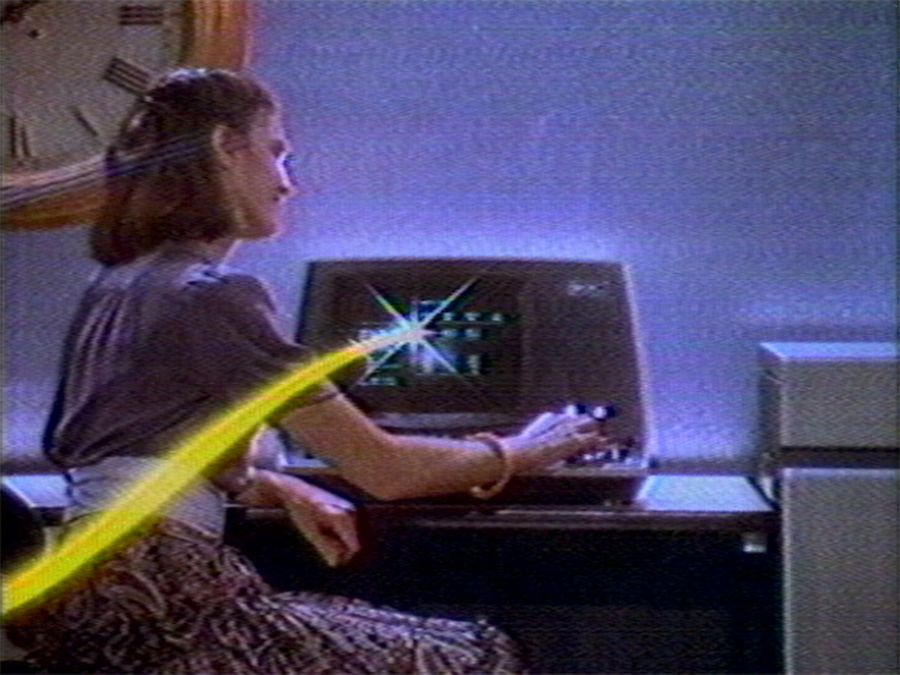
RADICAL SOFTWARE: WOMEN, ART & COMPUTING 1960–1991
Kunsthalle Wien presents Radical Software: Women, Art & Computing 1960–1991, a landmark exhibition that foregrounds the pioneering role of women in the early history of digital art. Bringing together over one hundred works by fifty artists, the show draws from public and private collections across Europe and the United States.
Organized in collaboration with Mudam Luxembourg – Musée d’Art Moderne Grand-Duc Jean, this is the first major survey of early digital art viewed through a feminist lens. The exhibition highlights women who used computers as medium, tool, or subject, as well as artists whose practices were inherently computational. Works on view span painting, sculpture, installation, film, performance, and an array of computer-generated drawings and texts.
A primarily analogue exhibition about digital practices, Radical Software focuses on the decades preceding the advent of the World Wide Web and the exponential rise of digital culture. The title references the magazine Radical Software, founded in 1970 by Beryl Korot, Phyllis (Gershuny) Segura, and Ira Schneider. Embracing the term «software» as a metaphor for social change, the publication proposed a decentralized, user-empowered model of access to information—a vision that prefigured the internet by two decades.
Spanning from the 1960s to the early 1990s, the exhibition traces a history that begins with artists, writers, and filmmakers experimenting with mainframe and minicomputers alongside scientists and engineers and continues through the microcomputer revolution that ushered in the era of personal computing. As computers migrated from laboratories into homes, women engaged deeply with the technology—yet their contributions have often been sidelined. Situated against the backdrop of second-wave feminism, Radical Software restores visibility to these artists, reframing digital art’s origins through their work.
As curator and Kunsthalle Wien Artistic Director Michelle Cotton writes in the exhibition catalogue:
The history of artists’ experiments with technology is also, to an extent, a history of misuse. If the computer was intended as a machine for calculating, for thinking—as its Latin root suggests (putare, meaning to think or to prune)—then its misuse in art history is no exception. Whether in drawing or film, text or performance, artists shifted the parameters, exploiting the machine’s capacity for randomisation and locating its proclivity for the surreal, the chaotic and the disorderly… If the computer represented a more scientific, rational, efficient, productive and ‘smart’ future, then art history reveals how it was co-opted for absurd and wildly eccentric projects, often edged with scepticism and critique.

Among the works featured in Radical Software are several by artists whose engagement with computing in the late 20th century feels strikingly prescient today. Rather than a definitive list, this selection offers a glimpse into the diverse ways in which pioneering women artists fused digital tools with conceptual, corporeal, and political concerns—often long before such approaches gained institutional recognition.
Charlotte Johannesson (b. 1943, Malmö), originally trained as a weaver, famously traded one of her tapestries for an Apple II computer in 1978, captivated by the structural kinship she perceived between loom and screen. “There was a great synchronicity between the two… the pixel grid resembled the loom’s weave,” she noted. Alongside her partner, Sture Johannesson, she established Scandinavia’s first digital arts lab, Digitalteatern, in Malmö, where she taught herself programming and created pixel-based reinterpretations of mass media imagery. Her digital prints and tapestries appear in the exhibition’s Software section.
Agnes Denes (b. 1931), primarily known for working with environmental, ecological issues and philosophical concepts, is an early adopter of the computer to engage with scientific and technological subjects.
Denes’ work Hamlet Fragmented – Wittgenstein’s ‘Pain’ (1971) uses algorithmic processes to manipulate texts by Shakespeare and Wittgenstein. In Wittgenstein’s text the word ‘pain’ was replaced with ‘pleasure’, while all connectives, articles and prepositions were removed from Shakespeare’s text. The resultant concrete poetry divorces its physical properties from its original meaning opening up new spaces for speculation.
Denes explains: «The technical part may be the least interesting … What’s important is the result, done by the mind. Using word reversals, a new personality is born: TECHNOLOGY CHANGING PERSONALITY.»
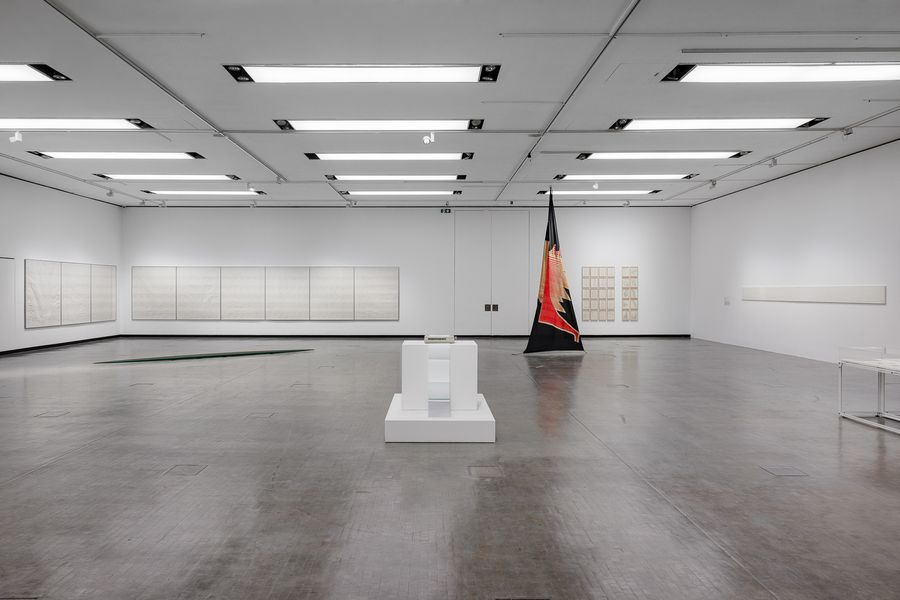
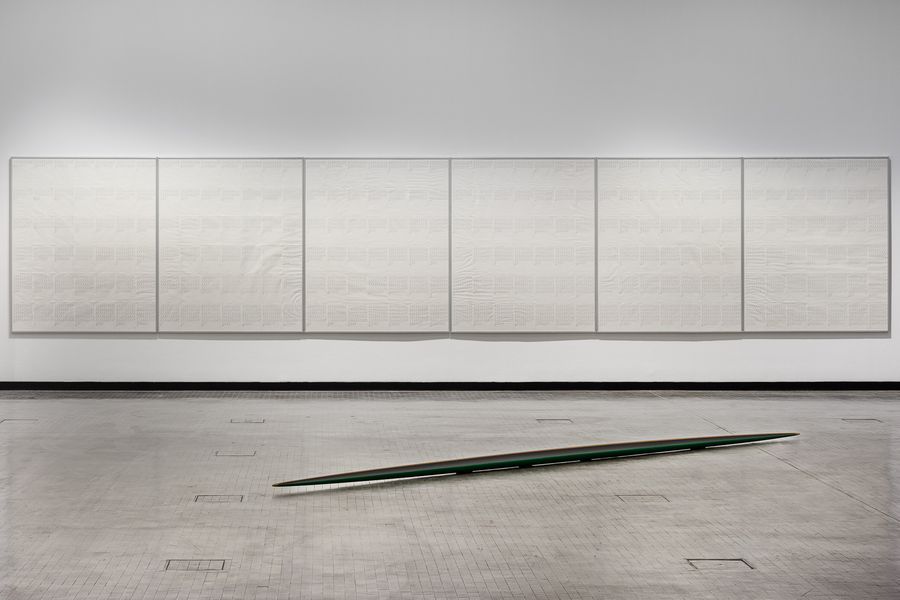
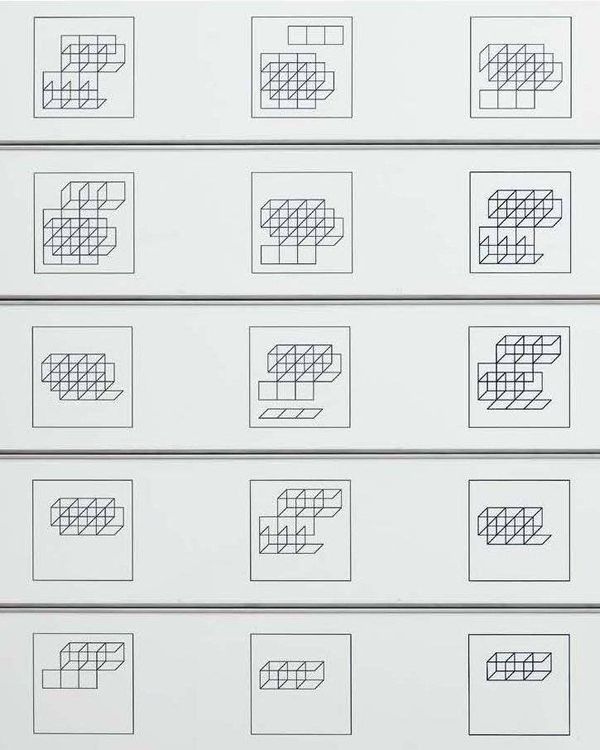
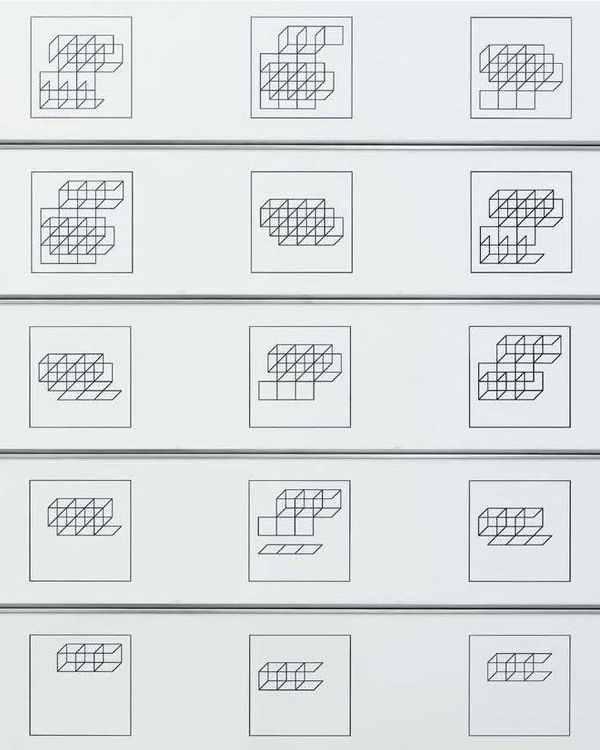
Elena Asins, 3 in 3 Perspective Scale 33 newplan (details), 1989, Private Collection, Courtesy KOW, Berlin
For Isa Genzken (b. 1948, Germany), computation became a sculptural tool. Between 1975 and 1985, she collaborated with physicist Ralph Krotz to generate mathematically precise designs for her Ellipsoids and Hyperbolos. These full-scale drawings, plotted via computer and passed to a cabinetmaker, formed the basis for wooden sculptures first exhibited in 1979—merging minimalist aesthetics with scientific exactitude.
Elena Asins (b. 1940, Madrid – d. 2015, Azpirotz) encountered computing through the seminars of the Centro de Cálculo at the Universidad de Madrid, a groundbreaking initiative that introduced IBM systems to artistic experimentation. Her piece 3 in 3 Perspective Scale 33 newplan (1989) methodically explores variations of the Necker cube, articulating a visual system of infinite permutation and formal evolution.
Dance, mathematics, and dictatorship intersect in M3x3 (1973), a seminal work by Brazilian artist Analívia Cordeiro. Using a PDP-11 computer, she choreographed a grid of dancers by plotting six vectors per body—legs, arms, torso, and head. The result is a movement language that feels at once mechanical and deeply political, a reflection of Brazil’s media saturation and the dehumanizing effects of military rule. “People were transformed into objects without identity,” she recalls. “On the one hand by media; on the other, by the dictatorship.”
In the early 1970s I was inspired by early twentieth-century art movements such as the Bauhaus, Constructivism and Futurism. They were looking at the technologies of the machine age and using new tools to make new forms of art but also reflecting on how machines were affecting society. I thought the computer age could be the next stage for creating a new form of art.
Artist Rebecca Allen interviewed for the publication Radical Software: Women, Art & Computing 1960–1991
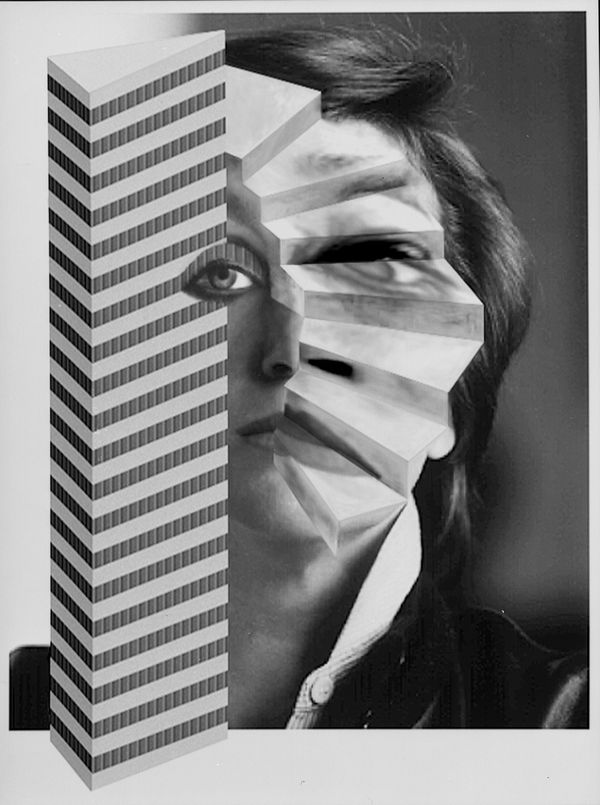
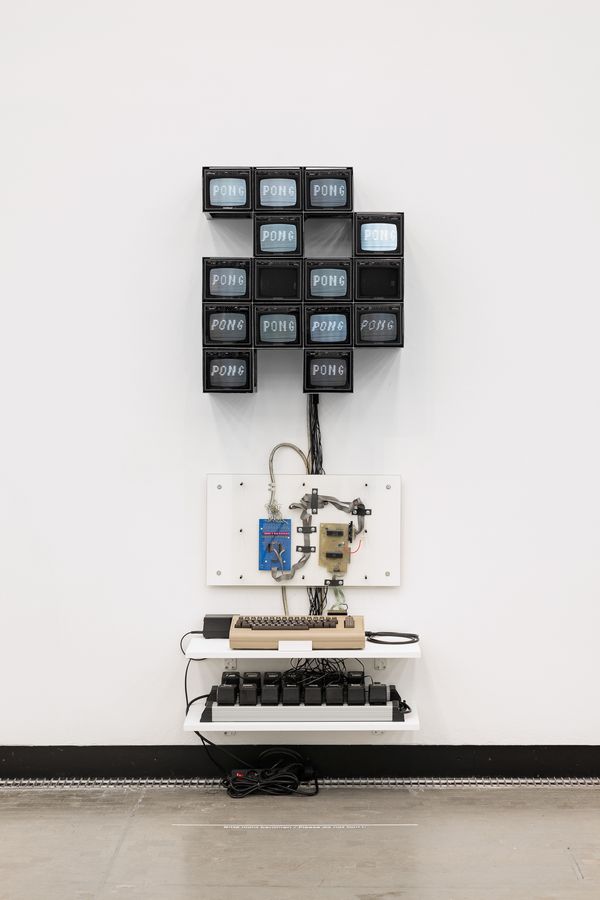
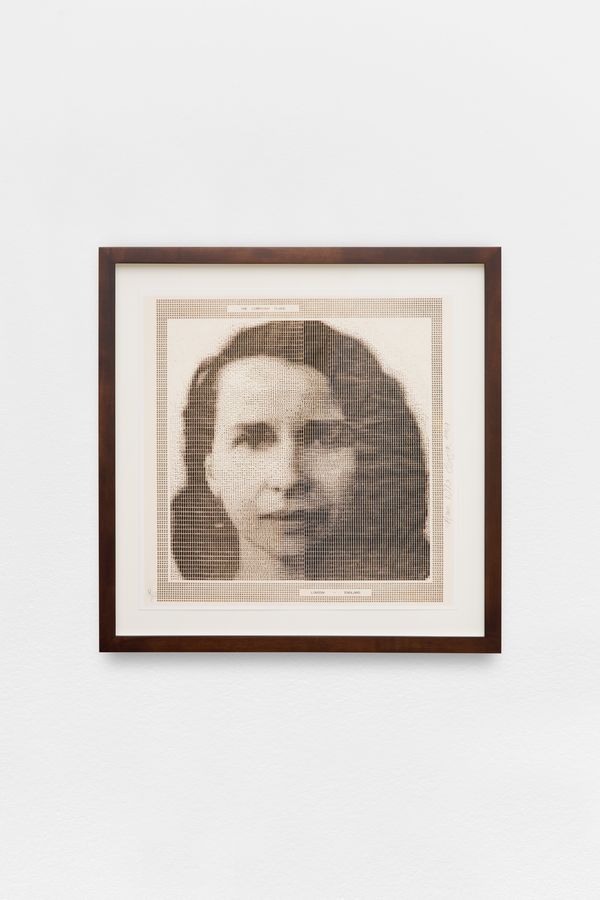
VALIE EXPORT’s return to Austria in 1989 marked a turning point in her artistic practice. Already recognized for her radical performances and feminist interventions, she began to integrate digital tools into her visual language. Her computer-assisted photographs juxtapose the body with urban space, gender with architecture. “I wanted to connect representations of the city using both digital and analogue photography,” she explains. “Drawing on the computer wasn’t new—but I wanted to combine it with my body and the city.”
Her 1989 ‘digital photographs’—Selbstportrait mit Stiege und Hochhaus and Stand Up. Sit Down—are presented alongside Concrete Computer DisPlay (1988/1990), a text-based installation restored specifically for this exhibition. Originally conceived as a large-scale, computer-controlled piece, it transforms a grid of monitors into a textual architecture—part diagram, part digital poem.
For Anna Bella Geiger (b. 1933, Rio de Janeiro), computing was one of many experimental avenues she explored during a pivotal period in London. Self-Portrait (1969) emerged from her contact with early computer artists while raising a family in Brazil. “I met some people who were beginning to experiment with computers and invited me to take part in their research—an unexplored field at the time,” she recalls. “People’s ideas and perceptions of art were shifting, and I felt the urge to experiment with unfamiliar media, like video using a Super 8 camera, for instance.”
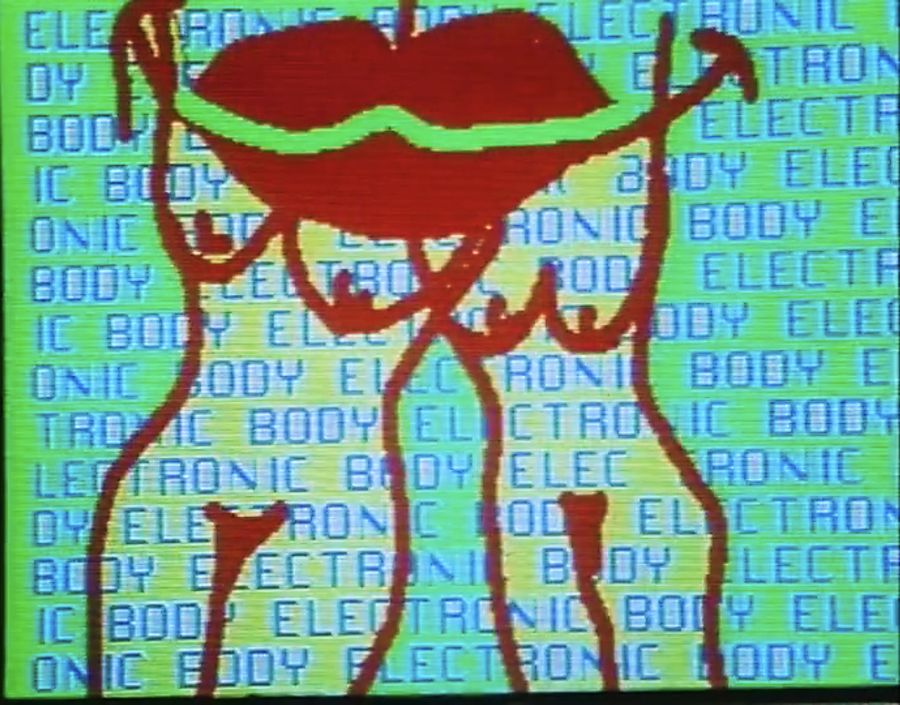
A distinctly queer feminist perspective animates the experimental video No No Nooky T.V. (1987) by Barbara Hammer (b. 1939, Los Angeles – d. 2019, New York). Created with a 16 mm camera and an Amiga computer, the work questions the heteronormative constructs of sexuality. The film uses digital graphics, excerpts from films (including Hammer’s own Multiple Orgasm, 1976) and texts on desire or sexual intercourse to create a unique narrative via the computer.
Punning on the Spanish word amiga (female friend), the artist presents the computer as a potentially liberating tool for women, and an object of erotism, connecting computing and lesbian sexuality. “Radical content deserves radical form,” Hammer declared in 1993. This ethos runs throughout the piece, which reimagines desire and intimacy amid the technological and social transformations of the 1980s.
A companion to No No Nooky T.V., Hammer’s T.V. Tart (1988) continues this audiovisual experimentation. The film layers 16 mm footage with Amiga-generated graphics to critique consumerism, particularly the pervasiveness of sugar in advertising and diets. With words like “sugar,” “candy,” and “slave” floating over psychedelic animations, Hammer links the seductions of media spectacle to bodily consumption. A collage of pop, soul, and electronic music—punctuated by canned applause—heightens the sensory overload and satirical edge of the work.
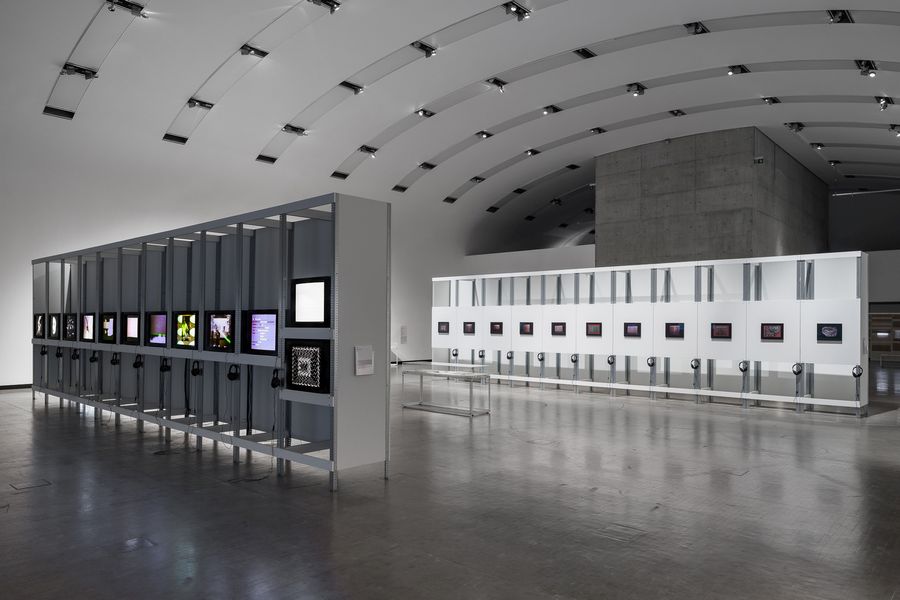
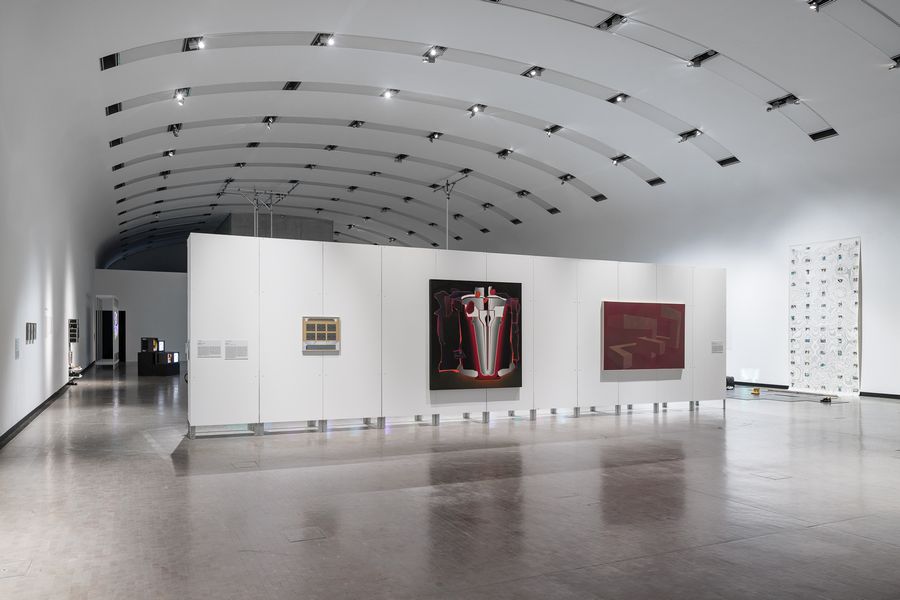
Radical Software: Women, Art & Computing 1960–1991 also responds to contemporary debates around how technology intersects with questions of identity and equality. The exhibition draws on a renewed interest in post-internet cyberfeminist discourse, which foregrounds the crucial role women have played in the development of digital technologies and critiques the entanglement of technology with systems of power.
A historical timeline anchors this trajectory within both the scientific and social legacies of computing, tracing its origins to the 17th century when the word “computer” referred to a person performing mathematical calculations. The timeline progresses through Ada Lovelace’s groundbreaking algorithm in 1843 and culminates with the computational work of women in the 20th century, including the hundreds of female mathematicians employed by NASA in the 1950s and 1960s
Power is no longer measured in land, labour or capital, but by access to information and the means to disseminate it… Our species will survive neither by totally rejecting nor unconditionally embracing technology – but by humanising it; by allowing people access to the informational tools they need to shape and reassert control over their lives.
Artists Beryl Korot, Phyllis (Gershuny) Segura and Ira Schneider in Radical Software Vol. 1, No. 1, 1970
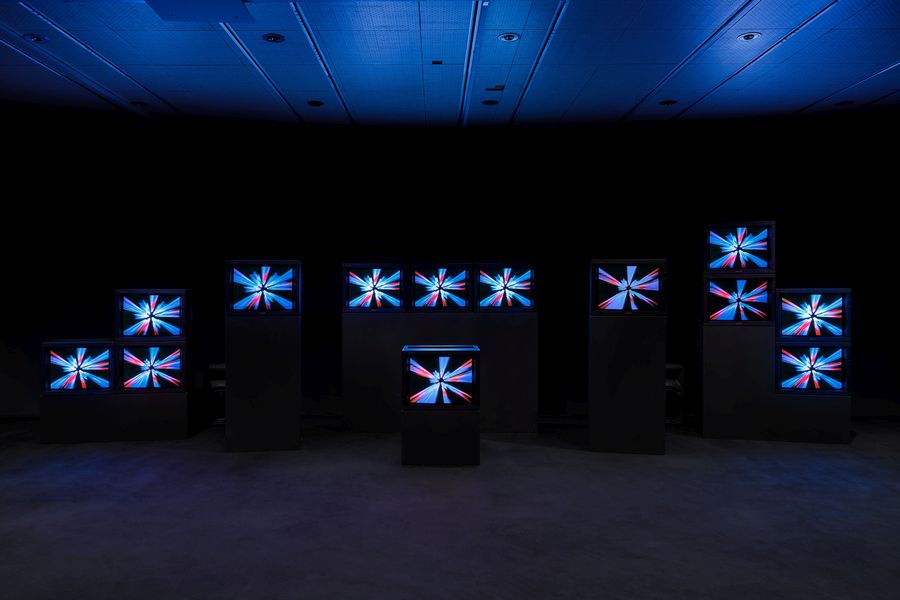
RADICAL SOFTWARE: WOMEN, ART & COMPUTING 1960–1991
Kunsthalle Wien, Museumsplatz 1, Vienna
28 February–25 May 2025
Artists
Rebecca Allen (b. 1953, Detroit)
Elena Asins (b. 1940, Madrid – d. 2015, Navarra)
Colette Stuebe Bangert (b. 1934, Columbus) & Charles Jeffries Bangert (b. 1938, Fargo – d.
2019, Lawrence)
Gretchen Bender (b. 1951, Seaford, Delaware – d. 2004, New York City)
Gudrun Bielz (b. 1954, Linz) & Ruth Schnell (b. 1956, Feldkirch)
Dara Birnbaum (b. 1946, New York City)
Inge Borchardt (b. 1935, Szczecin, formerly Stettin)
Barbara Buckner (b. 1950, Chicago)
Doris Chase (b. 1923 – d. 2008, Seattle)
Analívia Cordeiro (b. 1954, São Paulo)
Betty Danon (b. 1927, Istanbul – d. 2002, Milan)
Hanne Darboven (b. 1941, Munich – d. 2009, Hamburg)
Bia Davou (b. 1932 – d. 1996, Athens)
Agnes Denes (b. 1938, Budapest)
VALIE EXPORT (b. 1940, Linz)
Anna Bella Geiger (1933, Rio de Janeiro)
Isa Genzken (b. 1948, Bad Oldesloe)
Dominique Gonzalez-Foerster (b. 1965, Strasbourg)
Lily Greenham (b. 1924, Vienna – d. 2001, London)
Samia Halaby (b. 1936, Jerusalem)
Barbara Hammer (b. 1939, Los Angeles – d. 2019, New York City)
Lynn Hershman Leeson (b. 1941, Cleveland)
Grace C. Hertlein (b. 1924, Chicago – d. 2015, Chico)
Channa Horwitz (b. 1932 – d. 2013, Los Angeles)
Irma Hünerfauth (b. 1907, Donaueschingen – d. 1998, Kreuth)
Charlotte Johannesson (b. 1943, Malmö)
Alison Knowles (b. 1933, New York City)
Beryl Korot (b. 1945, New York City)
Katalin Ladik (b. 1942, Novi Sad)
Ruth Leavitt (b. 1944, St. Paul, Minnesota – d. 2025, Baltimore)
Liliane Lijn (b. 1939, New York)
Vera Molnár (b. 1924, Budapest – d. 2023, Paris)
Monique Nahas (b. 1940, Paris) & Hervé Huitric (b. 1945, Paris)
Katherine Nash (b. 1910 – 1982, Minneapolis)
Sonya Rapoport (b. 1923, Brookline – d. 2015, Berkeley)
Deborah Remington (b. 1930, Haddonfield – d. 2010, Moorestown)
Sylvia Roubaud (b. 1941, Munich)
Miriam Schapiro (b. 1923, Toronto – d. 2015, Hampton Bays)
Lillian Schwartz (b. 1927, Cincinnati, Ohio – d. 2024, New York City)
Sonia Sheridan (b. 1925, Newark – d. 2021, Hanover)
Nina Sobell (b. 1947, Patchogue)
Barbara T. Smith (b. 1931, Pasadena)
Tamiko Thiel (b. 1957, Oakland)
Rosemarie Trockel (b. 1952, Schwerte)
Joan Truckenbrod (b. 1945, Greensboro)
Anne-Mie Van Kerckhoven (b. 1951, Antwerp)
Ulla Wiggen (b. 1942, Stockholm)

También te puede interesar
¡feminismos!
En el contexto actual de regresión de los derechos, el proyecto "¡Feminismos!", que se presenta en el Centro de Cultura Contemporánea de Barcelona (CCCB) hasta el 1° de diciembre de 2019, quiere reivindicar la...
Words/matter:latin American Art And Language at The Blanton
A partir de una investigación y rescate de obras de esa colección, la exposición "Words/Matter: Latin American Art and Language at the Blanton", que se presenta en el Blanton Museum of Art de la...
Transmissions:art in Eastern Europe And Latin America, 1960–1980
El Museo de Arte Moderno (MoMA) presenta Transmissions: Art in Eastern Europe and Latin America, 1960–1980 [Transmisiones: Arte en Europa del Este y América Latina, 1960-1980], una exposición que se centra en los paralelismos y…