
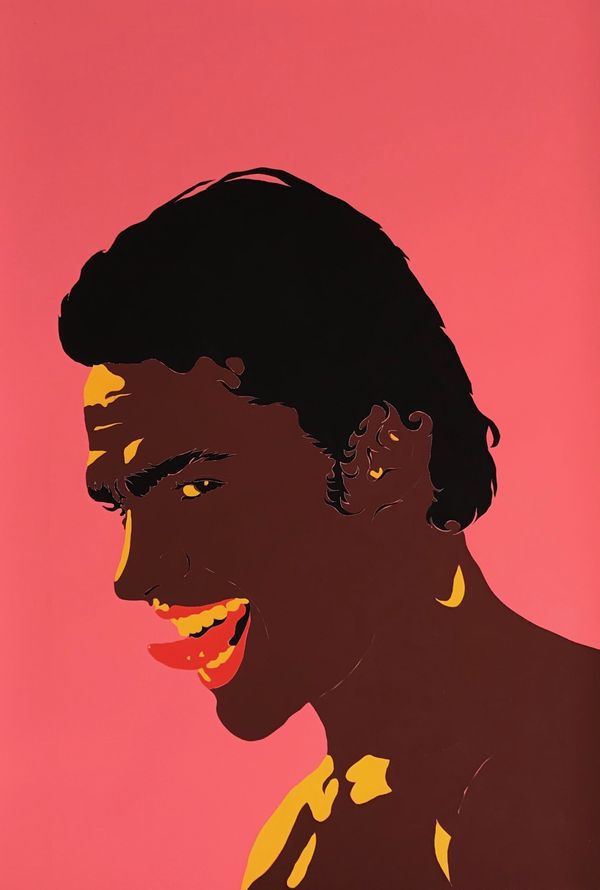
AGAINST «SEX AND THE CITY»: FÉLIX GONZÁLEZ-TORRES, BORIS TORRES, CARLOS MOTTA AND RAÚL DE NIEVES AGAINST THE MYTH OF NEW YORK
Reading time: 26 minutes
[short reading]
For decades, New York has functioned as a machine for producing images, desires, and possibilities for generations of Latin American migrants, including queer artists such as Félix González-Torres, Boris Torres, Carlos Motta, and Raúl de Nieves. For them, the city was not a “promised land,” but an ambiguous space: a place where certain desires could finally become visible, but also where exclusion, precariousness, and constant negotiation with identity, the body, and belonging became part of everyday life. In contrast to the glamorous and aspirational imagery popularized by the series Sex and the City, the queer and racialized experience reveals a tremendously complex city, rife with social, economic, and political tensions.
However, this essay avoids reducing New York to a mere apparatus of cultural exploitation. The city also emerges as the laboratory that made possible works and artistic trajectories that would have struggled to find the same conditions for production, circulation, and legitimization in Cuba, Ecuador, Colombia, or Mexico. In the works of these artists, Latin America never disappears: it reappears as memory, materiality, and conflict, in constant dialogue with the migrant experience. González-Torres, Motta, Torres, and De Nieves thus construct a Latin queer genealogy that transforms New York while simultaneously being absorbed by its cultural institutions, raising uncomfortable questions about belonging, appropriation, and mutual dependence between the city and the artists who redefine it.
New York is not only a city, is also a factory of images, desires, and opportunities. Throughout the twentieth century it received significant waves of Latin American migration, among them the queer Latino artists discussed here: Félix González-Torres, Boris Torres, Carlos Motta, and Raúl de Nieves, figures who arrived in that city under different circumstances and in search of answers to different questions.
For many Latin American migrants, New York was the place where desires that could barely be whispered in their home countries found a language in which to exist. Not exactly a promised land—something closer to a crack in the Latin American moral order: a territory where shame could be transformed into celebration, where anonymity offered refuge, and where that feeling of not quite belonging anywhere ultimately became a form of freedom.
For more than a century, New York City has generated an insistent self-narrative as a land of limitless possibilities, that concrete jungle where dreams are made of in the voice of Alicia Keys. In this context the series Sex and the City appears, where Carrie Bradshaw and her friends experience the best that Manhattan has to offer during their single years, presenting a superficial, white, and deeply aspirational vision. The recurring motifs of the series are marked by endless brunches, wealthy professional men, yellow taxis, Manolos, and Dior dresses. It functions as a device that, far from depicting the city, invents and romanticizes it.
But that imaginary operates through systematic exclusion.
For queer and racialized migrants, New York is less a space of self-fulfillment than a territory of constant friction. Desires are truncated, doors close, visas expire, rents rise, identities are questioned at every corner. It is a city where negotiation is continuous—with the language, with the body, with the law, with the family left behind, with affection and with solitude.
And yet, it is worth resisting the temptation of easy judgment—of seeing the “North” merely as a space of exploitation. It would be reductive to claim that these four artists made their work in spite of New York, as if the city were only an obstacle. Could they have made it elsewhere? Is there sufficient infrastructure in Havana, Quito, Bogotá, or Michoacán to provoke and sustain works like theirs? Do the museums, grants, galleries, nocturnal communities, archives, schools, and markets necessary to open these dialogues exist there?
Cuba, Ecuador, Colombia, and Mexico do not disappear from the artists’ place of enunciation; on the contrary, they return in every work both in its materiality and its concept. The queer migrant subject always carries the weight of the motherland—sometimes heavy—and brings it into dialogue with the host city, fashioning an identity that neither there nor here could have evolved in the same way.
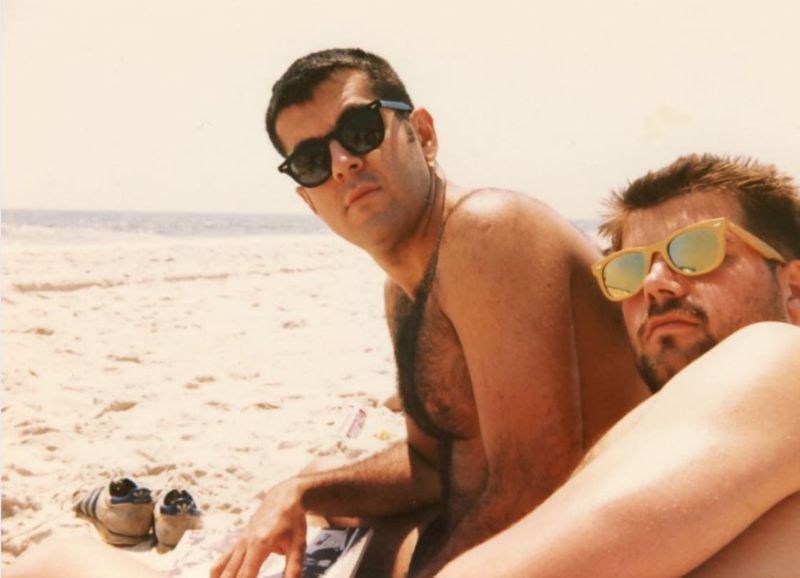
Félix González-Torres: Visual Poetry of Love and Death
Much has been written about Félix González-Torres, yet never enough. I will offer a brief biographical account before turning to his work. He was born in Guáimaro, Cuba, in 1957. When he was thirteen, as panic seized Cuba in the wake of Fidel Castro’s revolution, he was sent first to Madrid and then to Puerto Rico. He never returned to his country, yet Cuba surfaces in his work in transversal ways. He moved to Manhattan in 1979 to study photography at the Pratt Institute and the International Center of Photography. That same year he joined Group Material, the Marxist collective of cultural activism. He died on January 9, 1996, from AIDS-related complications, at the age of thirty-eight.
His work is a moral fist against the sanitized image of New York City.
At twenty-five, at Boy Bar in the East Village, Félix met Ross Laycock, twenty-three years old—a sommelier and student of both biochemistry and English literature who would become his partner. In the artist’s words, his boyfriend was “a Renaissance man. And gorgeous too, really gorgeous. Fucking hot! But intimidating, the first time around”[1]
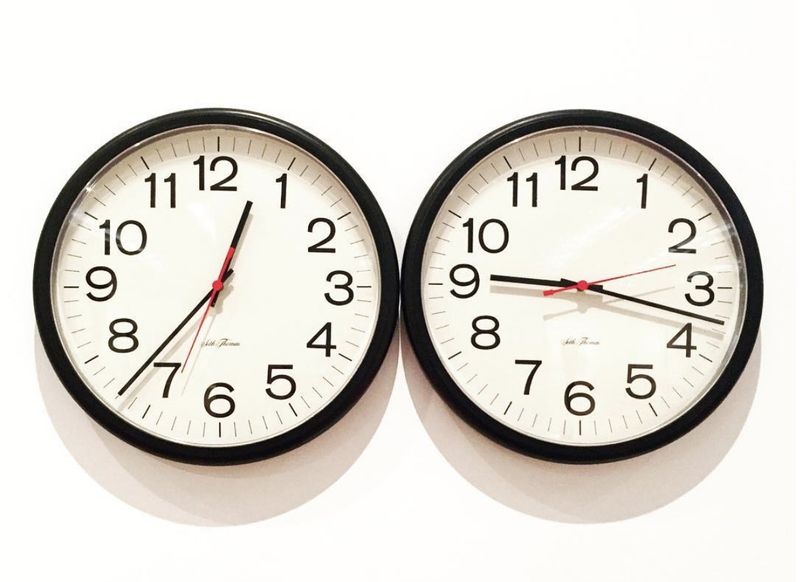
González-Torres’s response to discovering his partner had tested HIV positive in 1987 can be seen in Untitled (Perfect Lovers): two identical wall clocks, bought at any neighborhood store in Manhattan, synchronized at the moment of installation, under the same conditions and with the same batteries. Over time, the clocks fall out of sync—one runs ahead, the other stops.
“Time is something that scares me… or used to. This piece I made with the two clocks was the scariest thing I have ever done. I wanted to face it. I wanted those two clocks right in front of me, ticking.” (…) “Two clocks side by side are much more threatening to the powers that be than an image of two guys sucking each other’s dicks, because they cannot use me as a rallying point in their battle to erase meaning. It is going to be very difficult for members of Congress to tell their constituents that money is being expended for the promotion of homosexual art when all they have to show are two plugs side by side or two mirrors side by side.”[2]
During the Reagan presidency (1981–1989), the government’s response to the HIV/AIDS crisis was slow, belated, and widely criticized. The epidemic emerged in 1981, but the administration considered it a problem of minority “lifestyles,” stigmatizing gay men in particular as criminals and degenerates. Reagan did not mention the word “AIDS” until 1985, and only addressed the issue publicly in 1987. The so-called Helms Amendment prohibited the use of federal funds for AIDS education that “promoted” homosexuality, focusing solely on abstinence and morality; similarly, the National Endowment for the Arts censored artworks and exhibitions dealing with the crisis.
In this context, González-Torres understood that minimalist abstraction was a strategy for entering the heart of the system—to speak of grief, homosexuality, and AIDS-related death without giving censors anywhere to point their finger. “I love the idea of being an infiltrator. I always said that I wanted to be a spy. I want my artwork to look like something else, non-artistic yet beautifully simple[3],» he declared.
“Félix was a great romantic. Ross was Félix’s one great love… Félix struggled deeply until the day he died because he and Ross were robbed, murdered while young. They could have gone the distance. The anger we all felt is impossible to imagine. But you don’t see that in the work he created between 1991 and 1996. It is resolute, profound and elegant, as always”[4]
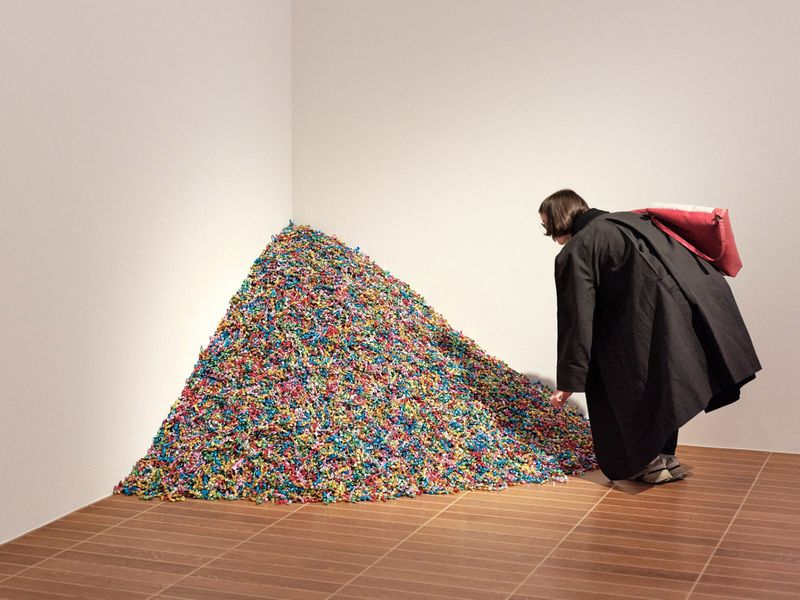
In 1991, the year Ross died after battling HIV/AIDS, González-Torres created Untitled (Portrait of Ross in L.A.), weighted to an ideal of seventy-nine kilograms—Ross’s healthy body weight when alive. He presented a pile of individually wrapped multicolored cellophane candies that visitors could take, functioning simultaneously as a testament to his partner’s life and to the illness that slowly consumed him. In this way, Félix González-Torres succeeded in placing the grief, love, and illness of a same-sex couple at the center of public discourse—without asking permission.
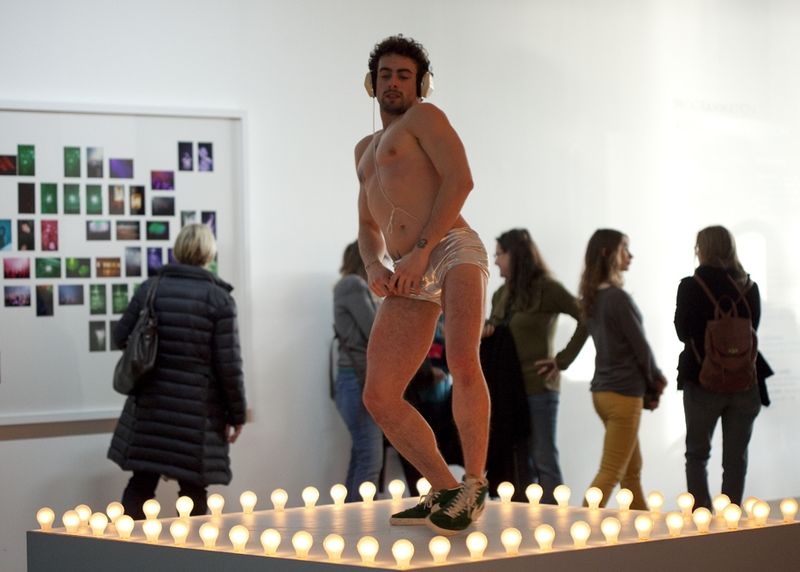
If the clocks and the candies represent the abstract image of a lover’s body in decline, Untitled (Go-Go Dancing Platform) is their reverse. It consists of a wooden platform painted light blue, just over half a meter high and nearly two meters on each side, rimmed by forty-eight always-lit light bulbs. Once a day, at an unannounced time, for five minutes, a dancer mounts the platform wearing nothing but silver briefs and sneakers, dancing to music audible only through his earphones.
A tension arises in this work when the performance occurs, but equally—or chiefly—when the platform stands empty, expectant. It is a platform with the lights on: something should happen. The absence of the body and of the action is equally profound, leading us to consider the performativity of life in both public and private spheres, the beauty of bodies, desire, and memory.
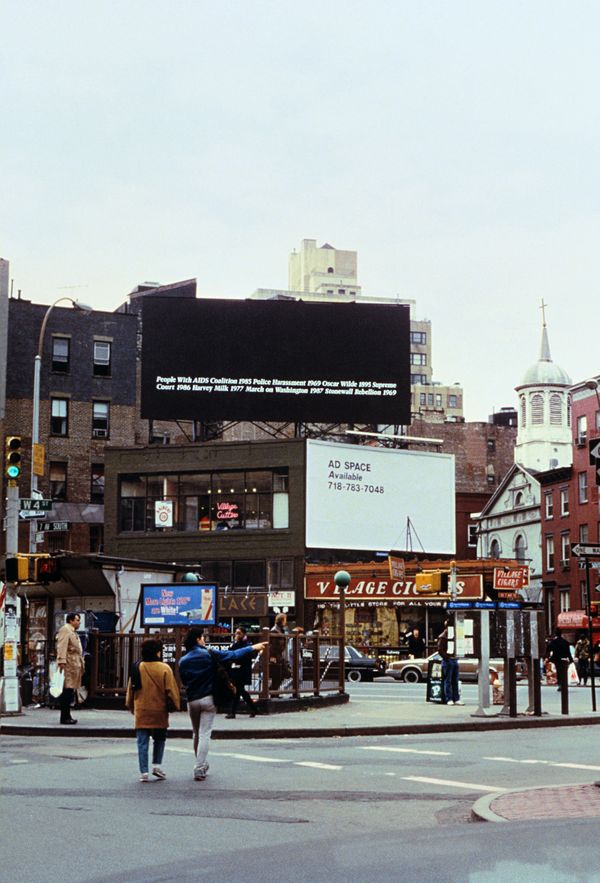
A few years earlier, Félix González-Torres had taken over public space with Untitled (1989), the billboard that the Public Art Fund installed at Sheridan Square, in front of the Stonewall Inn, for the twentieth anniversary of the uprising. Against a minimalist black background, a series of names and dates: “People With AIDS Coalition 1985 Police Harassment 1969 Oscar Wilde 1895 Supreme Court 1986 Harvey Milk 1977 (…)”
With this public work, González-Torres made visible the existence and struggles of an invisible community, opening the way for new generations. He died of AIDS-related complications five years after Ross.
Boris Torres: Between Pornography and the Domestic
Boris Torres was thirteen years old when González-Torres installed his billboard at Sheridan Square. He, together with his mother, had emigrated a few years earlier in search of a better future. He was born in 1976 in Piñas, Ecuador—a city that at the time had a population of barely eight thousand people, nestled within a cloud forest of remarkable biodiversity. Life unfolded between the countryside and the central plaza, dominated by the new Catholic church inaugurated in 1972.
“I was born in a small city in Ecuador and grew up working class, with little access to art or artistic role models. The few sensual paintings I encountered in church during mass became early portals of imagination and escape,”[5] says the artist in his official biography.
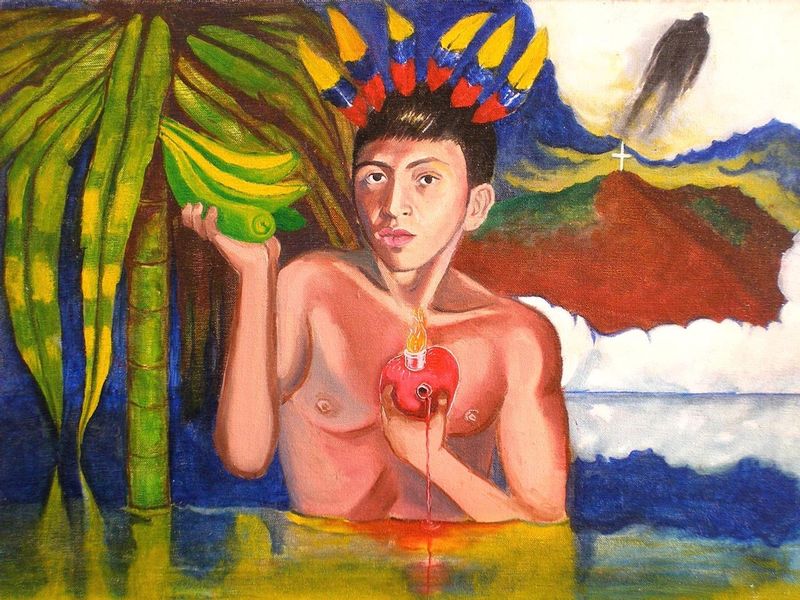
Boris Torres’s self-portrait does not limit itself to representing his physicality—it transports us to his hometown, a mountain crowned by Catholic morality, the richness of its vegetation, and the profound pain of the artist’s heart, echoing the widely recognized image of the Sacred Heart of Jesus in Ecuador, with the artist replacing the deity and crowning himself with a pre-Hispanic nationalist feather headdress. An uncircumcised penis appears in the form of a green plantain held by Boris, who turns his face toward it. In the background, like a ghost, an image that resonates with the sexual abuse he suffered as a child. All of this painted from Brooklyn, and now preserved in the Museo Nacional del Ecuador—through the initiative of the author of these lines and the generosity of the artist—creating a two-way bridge between origin and destination, in a gesture that illustrates the slow, almost always belated incorporation of such works into the cultural heritage of the countries these artists left behind.
Returning to his story: at the age of ten he emigrated with his mother to Brooklyn, where he had a complex childhood. He found his artistic path at an early age at LaGuardia High School of Music & Art and Performing Arts. He later continued at Parsons, City College, and Brooklyn College.
“In the early 1990s, as a gay immigrant creating queer images, I worked against the backdrop of widespread homophobia and the losses of the AIDS crisis. Yet beneath the surface of Manhattan, in the clubs, on the piers, and among other queer artists and immigrants, I found a community that mirrored my own experience. In those spaces, I was granted permission to make work that felt both forbidden and necessary, a tension that continues to drive my practice today.”[6]
And nothing confronts homophobia more directly than homosexual pornography.
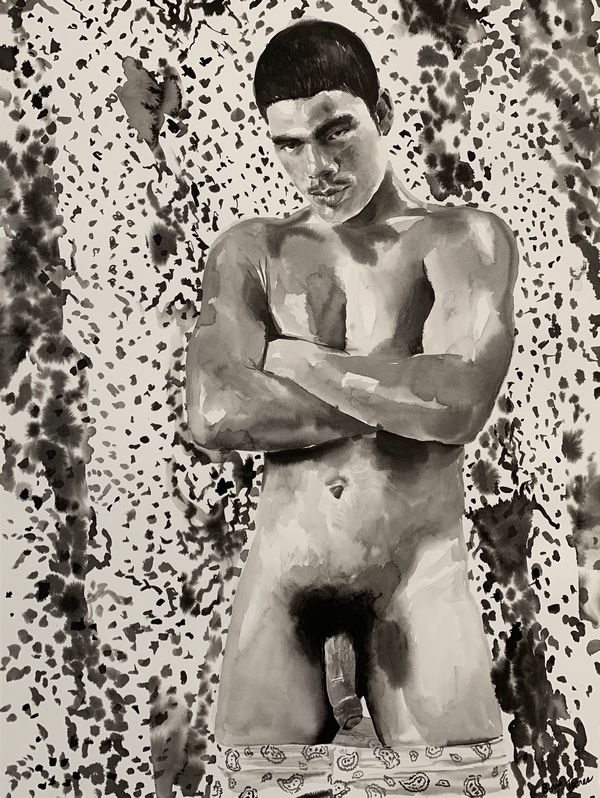
Boris Torres came of age in 1990s New York, a city that blazed at night under the chemical glow of crystal meth; poppers and ecstasy circulated like snacks at gay clubs, where sweating bodies pressed together until dawn to the rhythms of house and techno—nights that could last for days. These were the same bodies that on Thursday plastered ACT UP posters on Wall Street demanding visibility and rights, and on weekends dissolved on the dance floor, turning pleasure into the most radical political act of all.
A collective and almost ritualistic hedonism that included the flourishing of sex in bathrooms, in dark rooms, in Lower East Side after-hours clubs, where the intensity of pleasure was also a visceral and defiant response to a preceding decade that had tried to exterminate them with the complicity of the state.
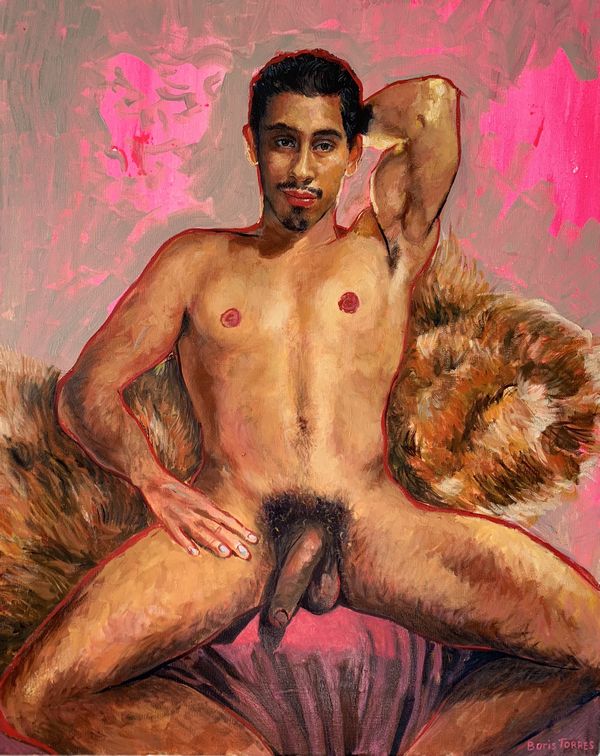
His paintings depart from images already fashioned by queer desire—from vintage bodybuilding magazines, from cinema, from pornography available on the internet. Boris observes them in silence, as he once observed saints’ images in church. He savors them and processes them in his paintings, drawings, and collages. Somehow his hands transform explicit sexuality into tender, intimate images. A more familiar desire.
Torres uses the sexualized body to process what neither Spanish nor English can contain: what it meant to grow up gay, working-class, and immigrant. To survive childhood sexual abuse. To be sexually very active toward the end of the AIDS crisis on the streets of New York.
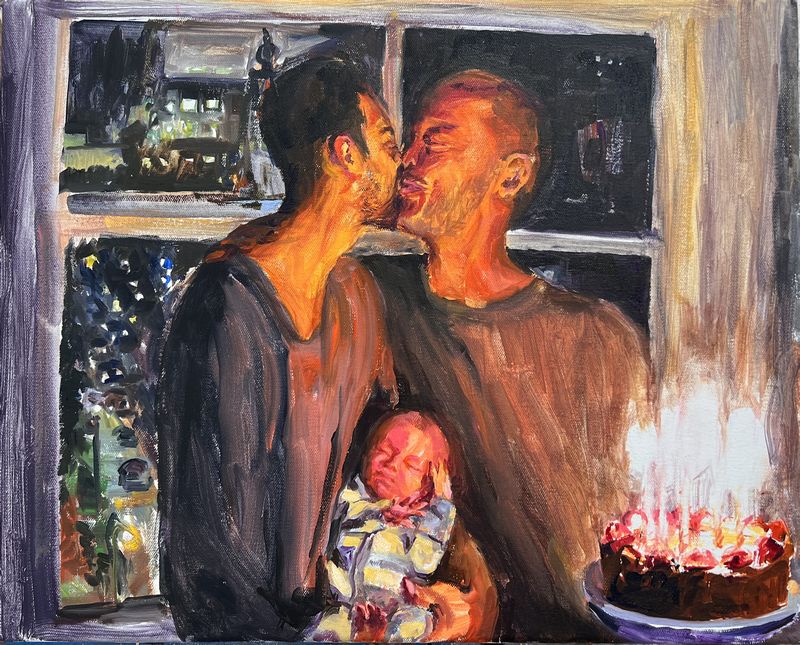
But Boris is a family man. Beginning in 2018, he started painting portraits of queer families, including his own—with his husband, filmmaker Ira Sachs, and their twin children. It is a response to the absence of representations of contemporary parenthood “because I had never seen queer families represented in contemporary painting,” he says.[7]
In being able to place above the fireplace a portrait of two fathers and their children, Torres makes visible another moment of queer life—a more peaceful and stable one. The life that has only become possible after the crisis. The domesticity of breakfast in the morning and preparing lunch for the weekend outing. In a context where homophobia remains structural—both in the United States and in Ecuador—representing the everyday life of a queer family is a radical gesture, and therefore a necessary one.
For Boris, New York is a place of inspiration and of life. Of hard drugs, anonymous sex, animal desires, and family growth. It is his home. A revolution from the domestic, from the familiar, because he knows it. From the hypersexualized body as an instrument of confrontation to the tenderness of queer parenthood—this is how Boris Torres traverses the complete arc of a queer life in his work.
Carlos Motta: The Body Inscribed by the Colonial Archive
Carlos Alejandro Motta “documents the social conditions and political struggles of gender, sexual, and racial minorities, challenging dominant and normative discourses through visibility and self-representation”[8]. He was born in Bogotá in 1978 and has lived and worked in New York since the late 1990s. His work functions as the production of a parallel historiography—through a queer analytical lens—in which the hidden is brought to light, deployed with force across video, installation, sculpture, performance, and digital archives.
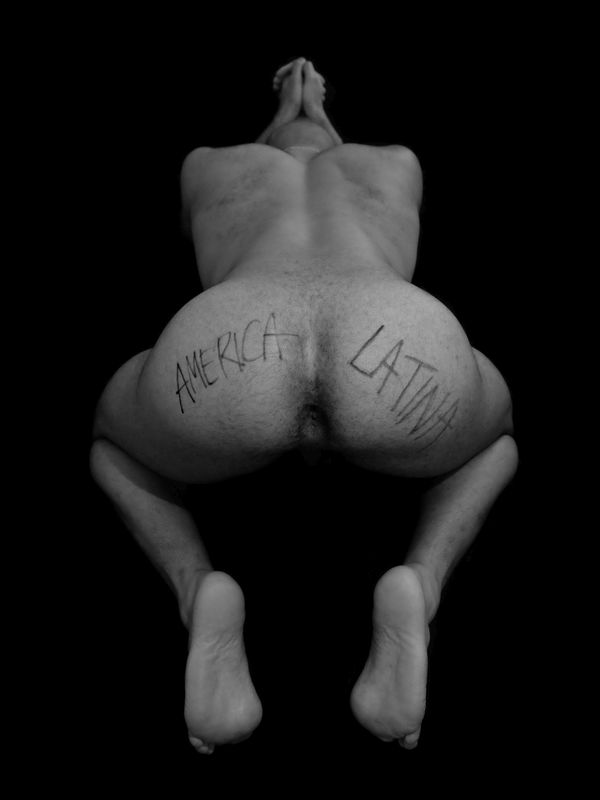
Untitled (América Latina) (2016) is a photograph by Motta more than a meter tall depicting a nude man kneeling, head bowed toward the ground, representing a continent in a position of supplication and submission. “A metaphor image of the continent’s body ready to be fucked.”[9] It is the power that inscribes itself upon bodies, the historical and geopolitical dynamics that configure individuals. This image—reviewing Motta’s work—simultaneously summons the violence of European conquest, neocolonial economic exploitation, and the stigmatization of the Latin American queer body, not as separate phenomena but as expressions inscribed within the same logic of power.
In Motta, the sexualized body is not inscribed solely within the field of desires; it functions as an archive, a surface, upon which the work reveals and makes explicit the historical dynamic that determines it. Imperialism, religion, medicine, the state, and the law do not appear as elements to be considered from outside. They cease to be concepts and become marks, inscriptions, and silences on bodies traversed by a history that began long before the contemporary subject.
The Latin American queer body is, therefore, also like the city itself: a field of historical confrontation.
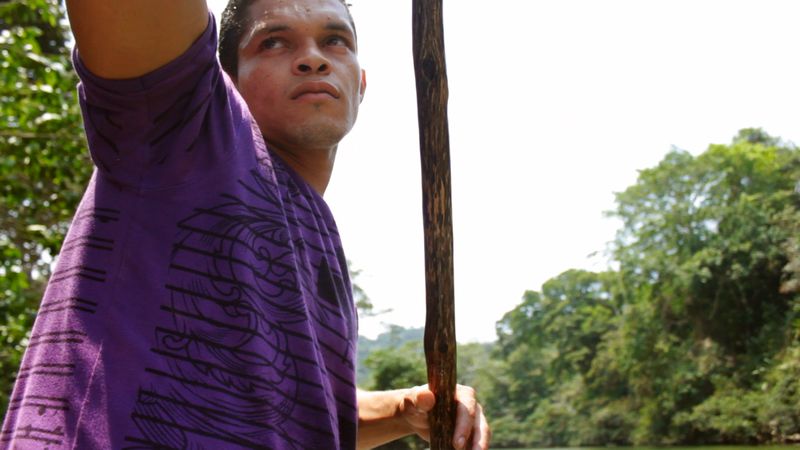
The Nefandus Trilogy (2013–2014), centered on three short films dealing with the concept of European morality in the sexual sphere through analysis of judicial proceedings against the pecado nefando (the abominable sin)—that is, sodomy—argues that the colonial process imported and imposed non-native categories onto local practices. It is a visual essay on the cultural construction of sexuality and the origins of its condemnation as unnatural and abominable, to the point of burning sodomites at the stake. The audio of the short films is delivered in indigenous languages; colonial chronicles and legal records are referenced; and ceremonial homoerotic practices are traced.
This work and those that follow address the natural and the unnatural, the human and the non-human, friends and enemies—in other words, exclusion in many of its forms. Motta’s works are academically grounded, yet they employ fiction and reinvention to structure their message.
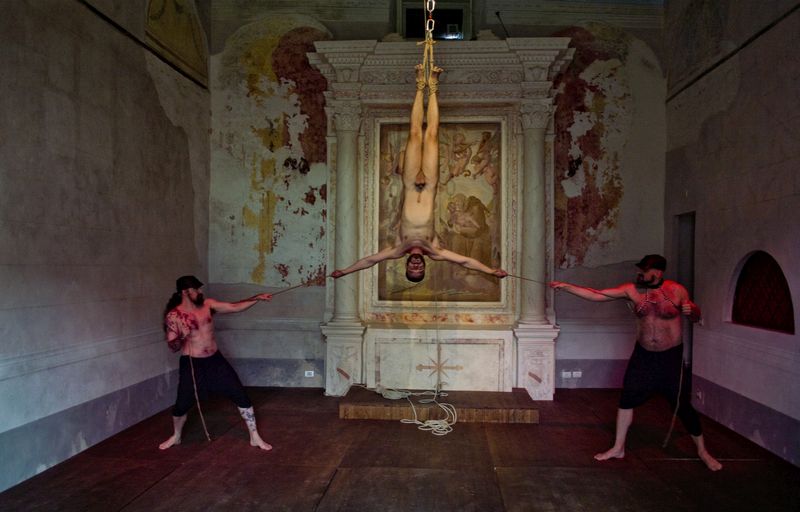
By situating the origin of sexual repression in 1492 rather than in the years prior to 1969, Motta complicates the heroic Western narrative and demonstrates that the Latin American queer body has been, since the conquest, a sexual battlefield. But he does so from his base in New York.
Motta carries the weight of modern history in his celebrated 2019 video Legacy, in which, wearing a dental mouth retractor that prevents him from closing his mouth, he recites a chronology of HIV/AIDS from 1908 to 2019 as narrated by American radio journalist Ari Shapiro, in English.
Years earlier, Motta presented at the New Museum the project We Who Feel Differently (2011–2012), a titanic documentary archive and exhibition that brought together more than fifty interviews with queer activists, scholars, and artists from Colombia, South Korea, Norway, and the United States.
This project was produced in challenge to the liberal presumption that marriage equality and gay-friendly constitute the maximum horizon of sexual liberation. It is a work that reviews more than four decades of LGBTIQ+ experiences and struggles, confronting the contemporary challenges of being different and free—beyond tolerance and assimilation. For the purposes of this essay, there is an irony in the fact that this cultural production of excavation and historical revision takes place precisely from New York City.
This city—which presents itself as the global capital of sexual liberation and the center of the world—becomes a privileged site from which to signal the paradox by which the very identity categories used today as tools of queer emancipation were, to a large degree, Western constructions that traveled toward Latin America through circuits similar to those that exported colonial violence and the censorship of desire.
The city becomes an observation platform.
Raúl de Nieves: Per aspera ad astra
The three artists discussed above were already producing their work when, at the age of nine, Raúl de Nieves arrived in the United States. He was born in 1983 in Morelia, the capital of the state of Michoacán, Mexico. His father died when he was two years old, and at nine he boarded a plane, with no luggage, bound for the United States. He was raised by his mother, Josefina, under difficult material circumstances. In 2006 he moved to New York, and today lives and works in Brooklyn.
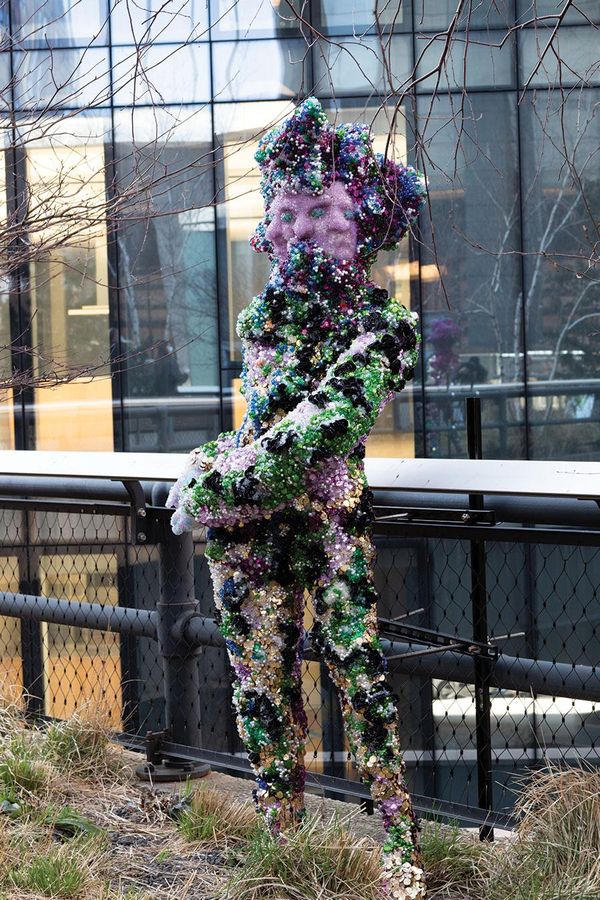
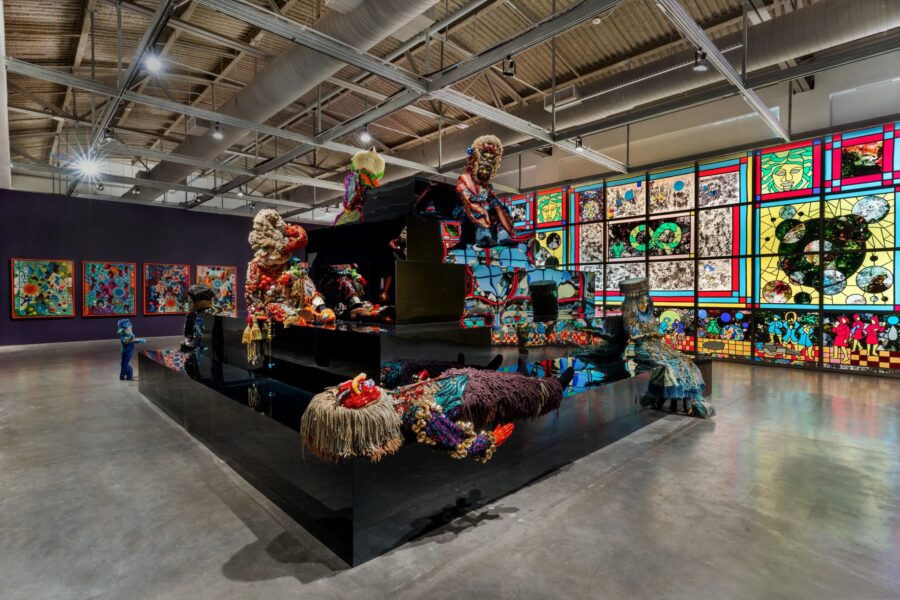
His work is a baroque explosion of beads, sequins, small bells, glue, colored cellophane, and other materials with which he constructs his pieces.
In Raúl De Nieves’s art, the tradition of embroidery, ceremonial vestments, and the craft of Latin American women coexists with drag experience and queer nightlife. Latin American folk craft—maximalist and so often reduced to the merely decorative—enters, through his queer hands, the museum through the front door. Everything in it is excess, brilliance, and spectacle.
Raúl speaks to us of the beauty and strength of diversity and migration.
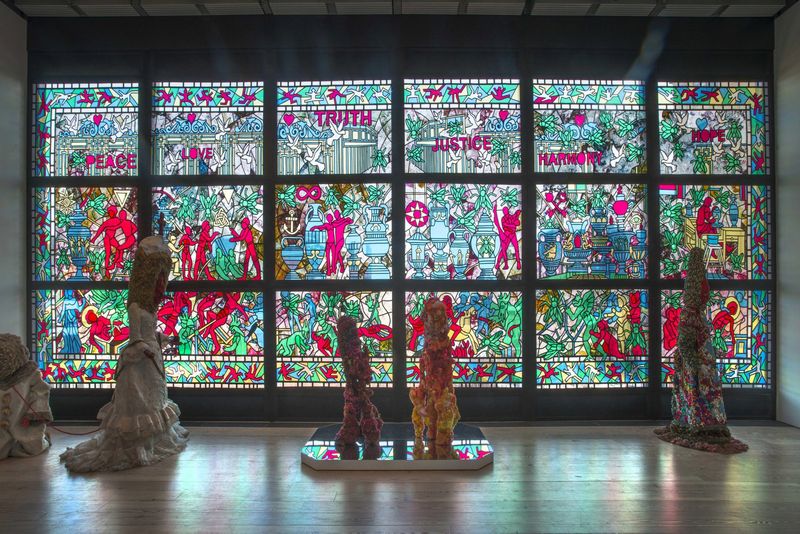
The piece that established him definitively on the international stage was his installation for the Whitney Biennial in 2017, created in his underground studio in Ridgewood. It is an enveloping mural that imitates the stained glass of a cathedral, in front of which he installed his dancing figures covered in beads, and in which the narrative—celebratory in spirit—recounts his experience of migration and the acceptance of his identity. Both are processes of uncertainty and pain, but where, in the end, everything turns out well, or at least better.
De Nieves exhibited this stained glass at the Whitney Museum of American Art precisely during the first months of the Trump administration and the promise of a border wall to stop migration.
His work, which fills spaces with joy, responds with a material affirmation that Latin American tradition is also American art—and it is, because it has been built upon the bodies of migrants and of those queer bodies that have enriched this country.
De Nieves’s tradition is not solely a visual tool; it is a reclamation of domestic experiences whose roots are older than the Latin American republics themselves. They remind us of the syncretism between the pre-Hispanic and the colonial, in the ornamentation of our folk dances, in age-old traditions that were never entirely supplanted and that now, in the artist’s hands, reach new discourses.
A kind of queer folklore.

Where González-Torres left the lights on of an empty platform—communicating desire in suspension, turning the museum into the stage for a waiting—Raúl de Nieves responds with the exact opposite: showing himself for all to see, dressed in saturation and excess. A presence, in the form of his work, that offers no apologies. If the former infiltrated the system with the prudence and poeticism of minimalism, the latter overflows it with the noise of the baroque and the popular festival. These are two strategies of occupying the same institutional territory, separated by three decades of queer history.
Evan Moffitt titled his profile of De Nieves for Frieze magazine “Raúl de Nieves’s Endless Party.” And the artist’s party is a political one. For decades, the Latino and queer dance venues of New York have been the spaces where pain is processed, where the loneliness of migration grows less rigid, where the ceremonies and traditions of the motherland acquire different flavors without losing their familiarity. De Nieves’s work is the materialization of that experience.[10]
Other Voices of the Same Genealogy
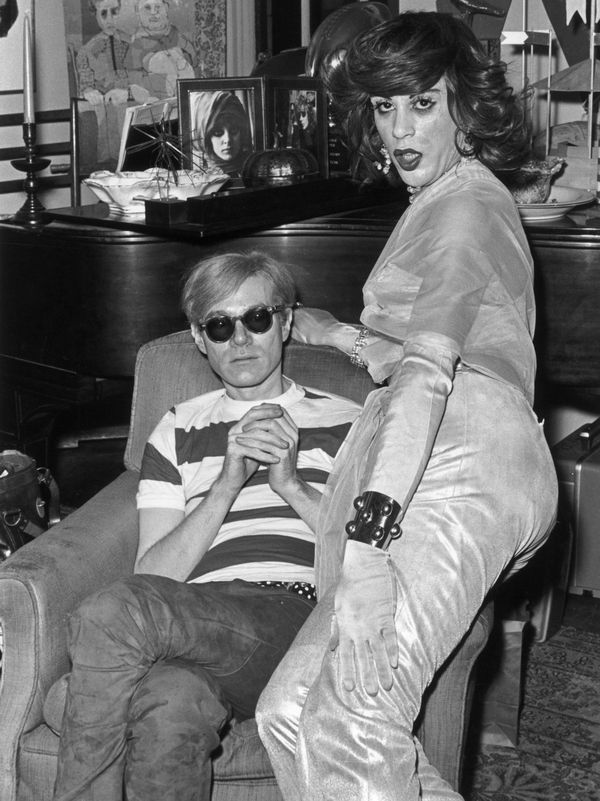
Before closing, it is worth recalling that the genealogy of queer Latino artists in New York neither begins nor ends with the four names in this essay. Before them came the Brazilian Hélio Oiticica, who turned his apartment Babylonests into a space where art, sex, and experimentation intermingled; and the Puerto Rican Mario Montez, born René Rivera—Andy Warhol’s first drag superstar and a central figure of the Theatre of the Ridiculous. Also belonging to this constellation are the Nuyorican Juan Sánchez, whose work addresses ethnicity and Puerto Rican identity from Brooklyn; the Colombian Camilo Godoy, focused on political memory and queer migration; and the Guayaquileño Stephano Espinoza Galarza, who, from the diaspora, asserts a coastal queer subjectivity that Ecuador still resists acknowledging—in his words: “two of the best Ecuadorian artists are queer men from Guayaquil: Sola Franco and George Febres-Cordero.”[11]
Outside the Script
It is curious that the Spanish-language version of Sex and the City is not Sexo y la ciudad but Sexo en la Ciudad (Sex in the City). In any case, the series premiered on HBO in 1998—two years after the death of González-Torres from AIDS-related complications.
Both the rosy narrative and superficiality of the city and the Latin American queer migrant reality coexist in the same moment in time. The difference is that one was sold as a global cultural product while the other has had to fight, exhibition by exhibition, archive by archive, canvas by canvas, article by article, for its right to exist.
The four trajectories presented here trace a map that bears little resemblance to Sarah Jessica Parker’s Manhattan. González-Torres places homosexual love and AIDS grief at the center of the conversation. Boris Torres conjugates both the pornographic lie and the truth of a portrait and the tenderness of family. Motta excavates colonial archives to remind us that the repression of queerness has always been inscribed on our bodies. De Nieves celebrates the difficulty of being different in this homogenizing world.
But what happens when the New York museum that González-Torres wanted to infiltrate as a political act begins to claim these same queer Latino artists as its own and turns them into part of its institutional symbolic capital?
Appropriation can itself be a form of colonization. And yet—could we have sustained these lives and these works from Latin America alone?
New York was the laboratory where these works were able to exist. What obligations does that city and its institutions have toward the generations of queer Latin Americans who today no longer want—or can no longer afford—to move to Brooklyn?
The uncomfortable answer to what this essay has raised is that the artists of this genealogy do need New York for their production: just as the city feeds on them, they feed on the city. González-Torres needed the Guggenheim in order to infiltrate it. Boris Torres needed the piers and clubs of the Lower East Side to survive and, later, to paint. Motta needed the New Museum to deploy his colonial archive. De Nieves needed the Whitney so that his migrant stained-glass work could become public. Recognizing this does not absolve New York of its contradictions. It means understanding that the most honest criticism is made from within.
Perhaps the next queer Latino genealogy will no longer be written in New York, but in some other place where it is possible to pay the rent.
And without these artists, and many other Latinos besides, one cannot talk about sex in the city.
[1] Félix González-Torres, interview with Ross Bleckner, BOMB Magazine, Spring 1995.
[2] Félix González-Torres, BOMB Magazine, Spring 1995, p. 46 y 47
[3]Félix González-Torres, interview with Tim Rollins, 1993. New York: Art Resources Transfer, Inc.
[4] Carl George, «Félix González-Torres and Ross Laycock,» Visual AIDS (blog)
[5] Boris Torres, Bio: https://www.boristorres.com/btcv
[6]Boris Torres, artist statement for Poems, Kates-Ferri Projects, New York, November–December 2025.
[7]Boris Torres, interview in Metal Magazine, February 2024.
[8] Artist biography at Mor Charpentier.
[9] Manuel Betancourt, «Carlos Motta on Excavating a Queer Historical Past and Imagining its Future,» Extra Extra Magazine, no. 12, April 22, 2020.
[10]Evan Moffitt, «Raúl de Nieves’s Endless Party», Frieze, no. 219.
[11] Romina Muñoz, “Profile: Stephano Espinoza Galarza,” Arts of the Working Class, April 21, 2021.

También te puede interesar
TRANSITAR LA FRACTURA DEL CARIBE
Con la más reciente exposición en el Museo MAPUKA - Museo Arqueológico de los pueblos Karib, de la Universidad del Norte en Barranquilla (Colombia), se conforma un espacio para pensar el arte contemporáneo desde...
Totoral Lab Gana Premio Pop_up Spaces de Ch.aco 2015
Totoral Lab, un espacio que funciona desde hace cinco años en medio de un bosque de la Quinta Región de Chile, ha sido el ganador de la tercera edición del Programa Pop_Up Spaces, una…

CARLOS ARIAS. BORDAR LA CHILENIDAD
Después de haber pasado cuatro años sin exponer en su tierra natal, y no haber quedado como finalista para representar al país en la Bienal de Venecia, Carlos Arias decidió concretar la exposición ante...