
PATRICIA DOMÍNGUEZ: THE WHITE HORSE, PREGNANT
What emerges when ancestral knowledge encounters the extractive logic of late capitalism? When ancient cosmologies intersect with corporate machinery, do we witness a mere collision, or does something altogether new gestate in the spaces between worlds? The pregnant pause, introduced by these questions, summons an interstitial, symbiogenic realm that refuses the neat categories of tradition and modernity, nature and technology, sacred and profane.
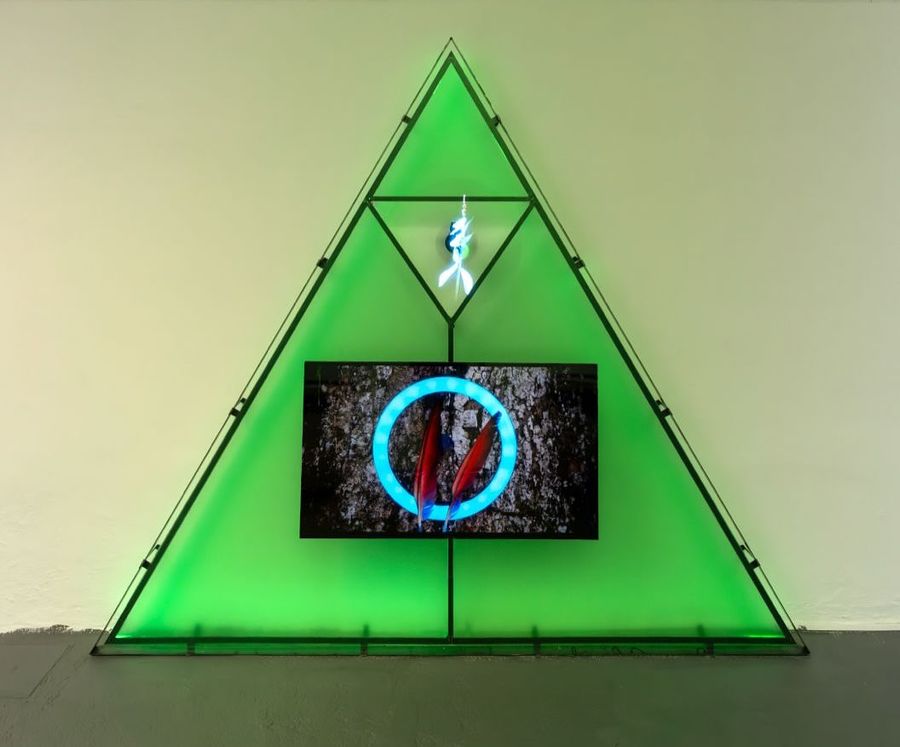
Patricia Domínguez’s cybernetic altars conjure an ecosystem where serpents commune with drones, where pre-Columbian artifacts cohabitate with corporate imagery in acts of unlikely, unholy kinship. These shrines to Water, Earth, Animals, Plants, and the Invisible do not merely offer an inventory of worlds but create conditions for their mutual transformation. Drawing on extensive ethnobotanical research, Domínguez activates what she describes as strategic withdrawal from digital entrapment in favor of interspecies alliance, in order to access planetary memory and its ancient, generative wisdom.
Consider the winding trajectory of symbols across Domínguez’s hallucinatory landscapes: in the colonial imaginary, roses introduced to South America by European settlers became symbols of divine truth and validation through the legend of Our Lady of Guadalupe’s apparition to Juan Diego, the first indigenous saint from the Americas. Here, these same roses are repurposed in healing rituals to absorb harmful electromagnetic radiation from Wi-Fi networks.
Toucans, left blind by ecological catastrophes, navigate realms where vegetal intelligence counters mechanical force and surveillance drones shed sorrowful tears. The artist turns to spiritual fiction and metamorphic montage, showing how resistance emerges not from purity but from the fertile contamination and conspiratorial enmeshment between worlds.
The figure of the horse, chemically salvaged from the cloister’s restored fresco, embodies this paradox of preservation and transformation. Once accidentally woven into Catherine of Alexandria’s martyrdom, this gleaming companion now carries the possibility of escape from prescribed narratives.
Domínguez traces this figure from its arrival on the South American continent with Spanish conquerors, who molded territories to match their imperial visions, to its contemporary manifestation in riding schools, where horses are forced to internalize elaborate choreographies foreign to their instincts.
Here, however, the horse rejects this imposed choreography, reaffirming its defiant drive through alternative unscripted links and entanglements, becoming a companion for futures not yet written. Like the frescoed horse itself — maintaining its radiance despite decay and ruin — it insists on its own transformative potential, refusing the protocols of domination and dressage.
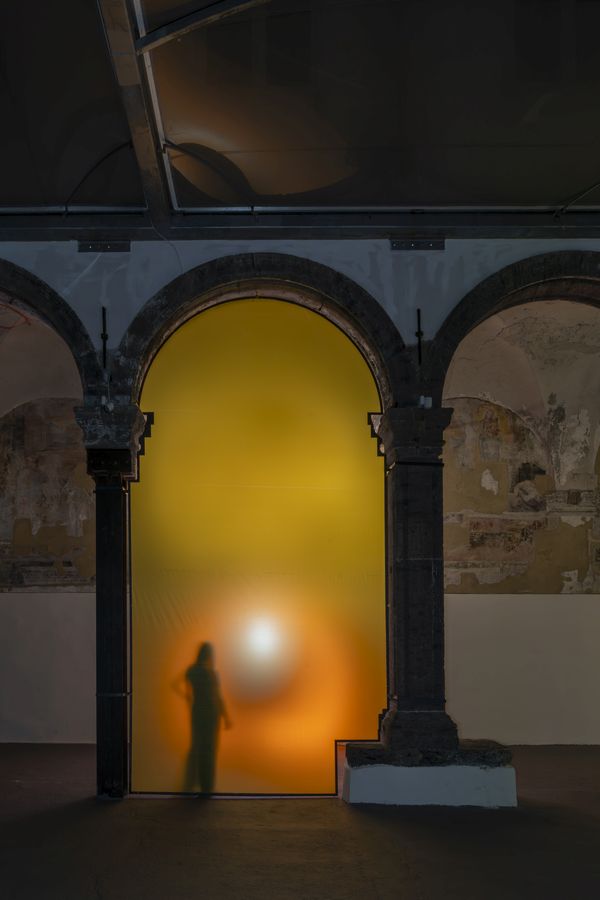
This is the first time that all these videos are shown in unison, forming a planetary braid, where each video is a knot — a dreamlike trance through the realities of South America, where spirituality, closeness to animals, drought due to privatization of water, and the digitization of life coexist in a ballad of ecological mourning, but also of hope and artistic ritual to activate emotional bonds with these earthly beings, re-educating us in the question: What are we connected to? Up until what point do “we” remain “our” selves?
If we contain particles that are quantum-entangled with others in the Andromeda, might our sense of self extend far beyond the limits of our bodies? Who are we and how can we enter into alliance with the Earth and the spirits of the elementals? And how can we activate the spiritual information of the Earth and the cosmos? An invitation to expand our cosmological sensor as we move from altar to altar, from mantra to mantra, from prayer to prayer, to emerge transformed.
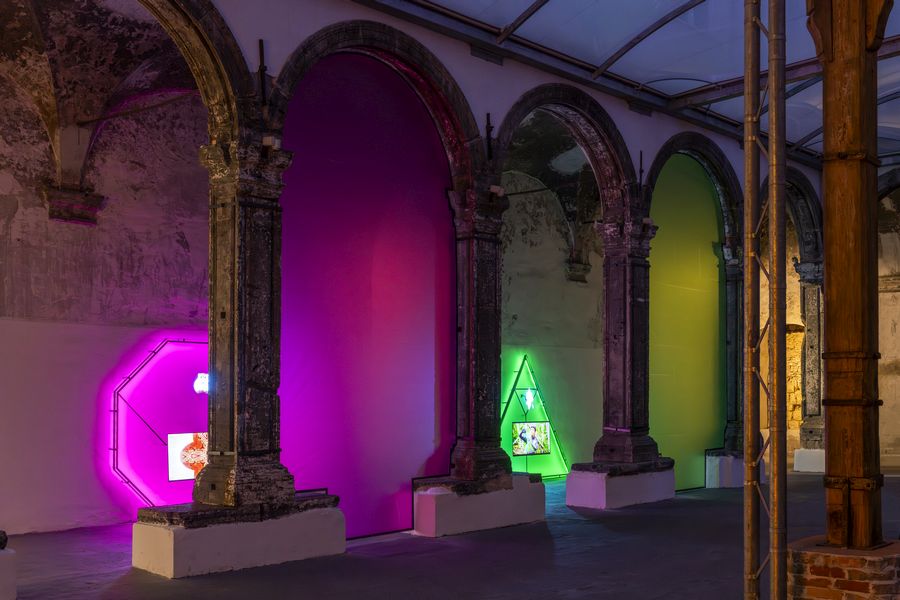
Altars and shrines represent, in this reality, a gateway to initiate communication with invisible dimensions. The altars presented here come from my artistic practice, which involves the creation of altars of light as portals for connection with the invisible. These works enter into dialogue with the incredible and vital tradition of urban altars in Naples — ever-changing emotional landmarks created to remember loved ones who have passed on. These pieces resonate materially, luminously and spiritually with this formalization to invoke, remember, and pray to invisible energies, appealing to invisible connections.
Patricia Domínguez
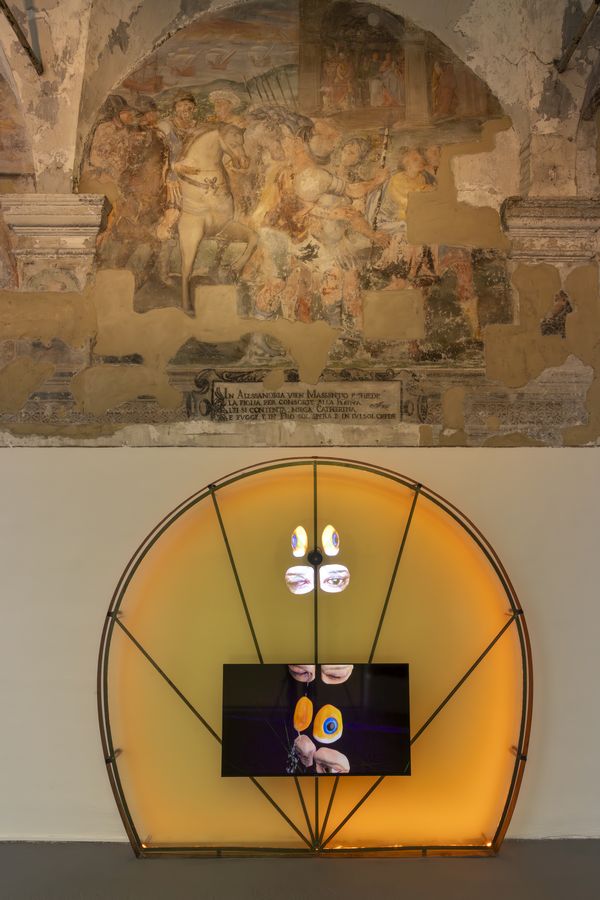
Animal Shrine. Gruta de la nación de los animales
The Animal shrine is both an altar and a manual for planetary praying.It is an altar inlaid with two video works: Madre Drone and The eyes will be the last to pixelate, the ex-voto with an effulgent sun-horse crownedwith a crescent moon, and a fragment of the wall fresco featuring the white animal. The transtemporal and translocal composition consists of the films created by Dominguez in Bolivia and Spain in recent years, the figurine crafted in Naples and the surviving 16th-century image — from the cloister of Santa Caterina a Formiello.
A voice accompanies slow and deliberate hand manipulations amid kitchen dishware. A woman is washing a white horse tail in a bowl of water in preparation either for a magic potion or a ritual. This tail belongs to the last white horse found in New York in an African video game store. Alongside the potion, the graphic symbol displayed on the screen serves to reduce “electrosmog” — the excess of electromagnetic waves affecting the viewers — and to protect the bodies of the horses as they undergo the process of being reduced to pixels.
This phantasmagorical narrative could be read as a surreal sci-fi tale, a slightly exaggerated conspiracy theory or a retro-futuristic fable about humans fighting pixels in the so-called Horse Era. Perhaps it is all of these at once. At the same time, it traces the figure of the Spanish conqueror and his horse back to their origins in Spain and Chile. Within this context, the slow, deliberate scanning of the horses’ bodies in the video becomes a meticulous act of recording —mapping the complex interplay between domination and liberation in these animals.
A similar cyber-burlesque unfolds in the other film: a snake-woman clad in electro-armor emerges from a hazy forest bathed in neon light, accompanied first by a blind toucan and later by a weeping drone. The scenes captivate through their sheer transmutational theatricality — until we come to understand that the toucan was blinded by the Amazon wildfires in Bolivia, and the tears belong to the protesters in Chile, where lasers are used to bring down the flying drones.
These creatures — the snake-woman, the toucan and the drone — search for new ways of seeing. This quest for alternate optics echoes a central concern of the artist herself: the pursuit of a planetary, shared vision system, one guided by the combined biological and technological intelligence of all living beings. Her work imagines a reversal of power structures, and a rethinking of what empowerment might mean — for everyone. Perhaps then, humans may finally see animals “as more than just images to remember”.
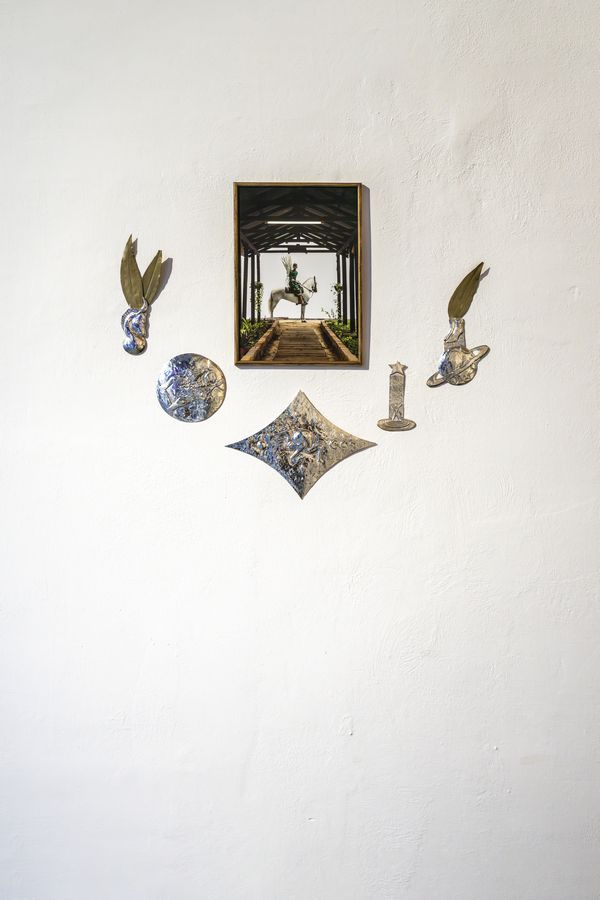
Earth Shrine. Nave terrestre flotante
Domínguez’s engagement with terrestrial forces goes beyond botanical study and extends to extractive environments where earth becomes commodity. The film Eyes of Plants serves as the focal point for the Earth Shrine and examines how sacred landscapes survive the industrialplunder. Shot across Chile’s Atacama Desert — where mining operations destabilize local ecosystems — the work documents a world in which mythological thinking clashes with global capital. The film follows the journey of a jarro pato, a pre-Columbian ceramic vessel from the artist’s grandfather’s artifact collection, whose weeping eyes witness the dramatic transformation of desert culture.
Through a playful juxtaposition incorporating family members as performers and handmade props, Domínguez creates what she calls a “contact zone” between spiritual healing and corporate wellness. Amid the numbing drone of a digital narrator, and as intermittent mobile phone vibrations punctuate the ambient soundtrack, jolting viewers between trance and alertness, the work reclaims different colonial symbols — roses introduced by European settlers, LED therapeutic masks manufactured in China, 3D scans of the artist’s green eyes as “genetic residue of colonization” —as unlikely allies in navigating the damages of both colonialism and neoliberalism.
The artist questions whether we can develop new forms of terrestrial empathy in an era of planetary extraction. As surveillance drones replace ancestral sight technologies and LED-lit shamanic shrines emerge within fluorescent healing economies, Eyes of Plants asks: how can we honor the Earth’s generative power in a world where capitalism has turned shamanic knowledge into a commodity and spiritual practices into products?
Plant Shrine. Templo vegetal
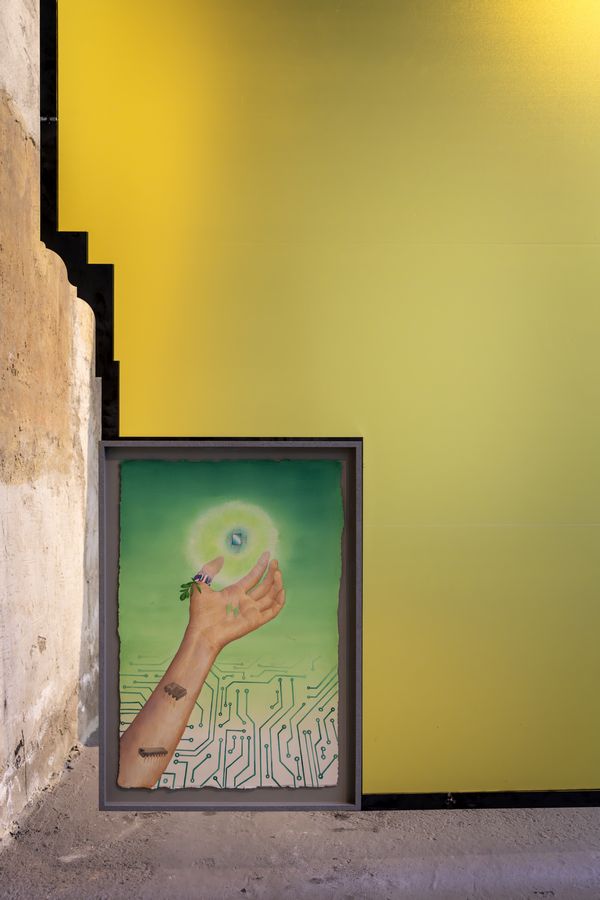
The artist’s relationship with the plant world reflects a long and evolving journey. Initially trained in botanical and natural science illustration in the United States, she soon shifted away from a strictly Western scientific perspective toward exploring the complex cultural relationships between humans and plants, both globally and within Latin American contexts.
Domínguez critically examines the historical appropriation of rural and indigenous plant knowledge following colonization. In 2014, she founded Studio Vegetalista, an independent botanical illustration school in Chile.More than a school, it became a vibrant community dedicated to learning about plants and advocating for the protection of land and climate against the impacts of extractive industries, large-scale mining and industrial agriculture.
In her personal artistic practice, Domínguez continues to deconstruct traditional notions of plant representation. She focuses particularly on healing, visionary and sacred plants, seeking new modes of visual and conceptual engagement. Alongside the Studio Vegetalista community, she initiated a series of experimental drawing sessions — first under the title Decolonial Botany and later Matrix Vegetal.
At the core of the Plant Shrine, the film Matrix Vegetal weaves together Domínguez’s long-standing research into reimagining our relationship with plants in the digital age — one shaped by the legacies of colonialism, extractivism and the commercialization of well-being. Matrix Vegetal also functions as a guide for learning how to “enter the vegetal dimension.” It invites us to ask: Can we perceive the world differently? Can we cultivate a new form of empathy, curiosity and care?
The silent hands of the Angel’s Trumpet flowers (Brugmansia), crafted in a tiny ex-voto for the Plant Shrine and echoed in the film, reach out for human hands from their pixelated present. What if, in a gesture of anti-capitalist resistance, we could truly “shift the discussion from the ‘invisible hand’ of the market to the ‘silent hand’ of plants so that we might take control of our own lives and connect with the planet”?

Water Shrine. La espíritu de las aguas
The Water Shrine forms a dreamlike altar, a hypnotic plea for waterjustice. As cultural theorist Astrida Neimanis aptly puts it: “We live in a watery commons, where the human infant drinks the mother, the mother ingests the reservoir, the reservoir is replenished by the storm, the storm absorbs the ocean, the ocean sustains the fish, the fish are consumed by the whale. The bequeathing of our water to another is necessary for the custodianship of these commons. But when and how does gift become theft, and sustainability usurpation?”
This is the issue raised by the artist in the accompanying video, which explores the privatization of water in her native Chile. The video focuses particularly on the drought caused by water-intensive avocado monoculture, and the subsequent aridity which leads to disruption in communities and ecosystems.
Domínguez employs a reinterpreted canto a lo divino, a musical tradition rooted in Jesuit teachings and folk communal practices. Here, the ballad functions as a prayer mourning the absence of essential elements. By incorporating this elegiac music into the current, profit-driven, planetary-wide crises, the artist proposes a path towards reconnection with the more-than-human dimension and a way to address our growing ecological disconnect. The ex-voto, depicting a star spreading its rays as if in an open embrace and generously spilling water, provides a hopeful counterpoint to the menacing avocados in the video.

The Invisible. Gruta de inter-reconexión de partículas entrelazadas
The film Three Moons Below, presented in the Invisible portion of the exhibition, occupies the center of the space — functioning perhaps as an antenna or portal of communication within this temporary cosmos shaped by the five elements and the Cloister. Produced during a dual residency between CERN (the European Organization for Nuclear Research), the ALMA Radiotelescope (Atacama Large Millimeter Array) as well as the La Silla Observatory, the video reflects more than just its scientific context.
At its core lies the artist’s spiritual journey — a search for new poetic ways to reconnect with celestial and terrestrial agents. The particles of this path are embedded in the film and are beautifully articulated in a text the artist describes as a “spiritual science fiction”.
This journey begins with a weekend trip to the Atacama coast, where the artist spent much of her childhood. There she unexpectedly discovers petroglyphs beneath the beach sand and attempts to decipher the choreography of the ancient footprints carved in fossilized sand. Along the way, she encounters a woman who speaks with birds — and learns her language to communicate with all creatures of the Earth, the heavens and even the lithium in the soil.
She ascends the arid heights of ALMA, following the antennas as they search for signals from the coldest clouds in interstellar space. In a conversation with her grandfather, she uncovers the dimension of “the three moons” within the Chilean cueca dance — whose melodies echo at the end of the film. Finally, her journey dives into the depths of the Great Particle Collider.
This longing for the Invisible is not a mere adventure for Domínguez — it is, she insists, an urgent necessity: “In times of profound crisis, when we are called to invent new paths, new tools, and to expand our possibilities, I feel a pressing need to bring the unseen and the unspoken aspects of our era into the foreground of our being, especially after the fall of the ‘high eye’ of modernity and science. In this state of exhaustion of the world and of our bodies, there is also a deep need for ritual, for ceremony, for healing, for inspirational images or objects; for the invisible technologies of the planet that preserve the balance of the more-than-human nations and that serve human needs.”
PATRICIA DOMÍNGUEZ: THE WHITE HORSE, PREGNANT
Made in Cloister Foundation, Piazza Enrico De Nicola, 48, Naples, Italy
From September 27 to December 20, 2025

También te puede interesar
BEAUTIFUL DISTRESS: ART AND MENTAL HEALTH. MARTÍN LA ROCHE IN CONVERSATION WITH CAROL STAKENAS
Carol Stakenas, curator at-large for the Social Practices Art Network (SPAN), talks to Chilean Amsterdam-based artist Martín La Roche (1988) about his three-month residency experience at Kings County Hospital in Brooklyn, New York, as...

JORGE TACLA: STAGINGS/ESCENARIOS
Prior to this body of work, Tacla largely excluded the human figure from his paintings, letting buildings and rubble suggest a human presence or intervention. His practice shifted after personally processing images of political...

SENSORIA: NATURALEZAS, FICCIONES Y OTROS SENTIDOS DE REALIDAD
"Sensoria", proyecto curado por los artistas multimedia Juan Covelli (Bogotá, 1985) y Juan Cortés (Bogotá, 1989), explora las naturalezas, ficciones y otros sentidos de realidad a través del videoarte y obras digitales. Participan más...