
THE EXERCISE OF RESISTANCE BEGINS WITHIN
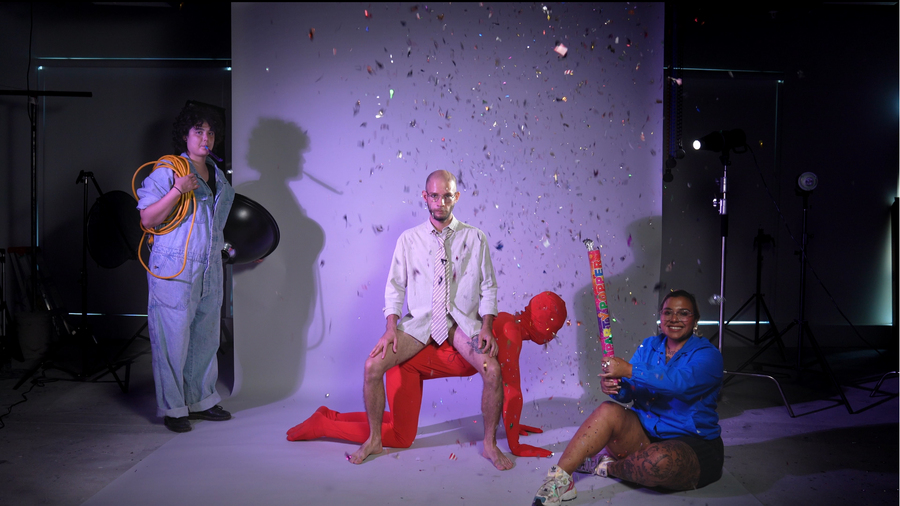
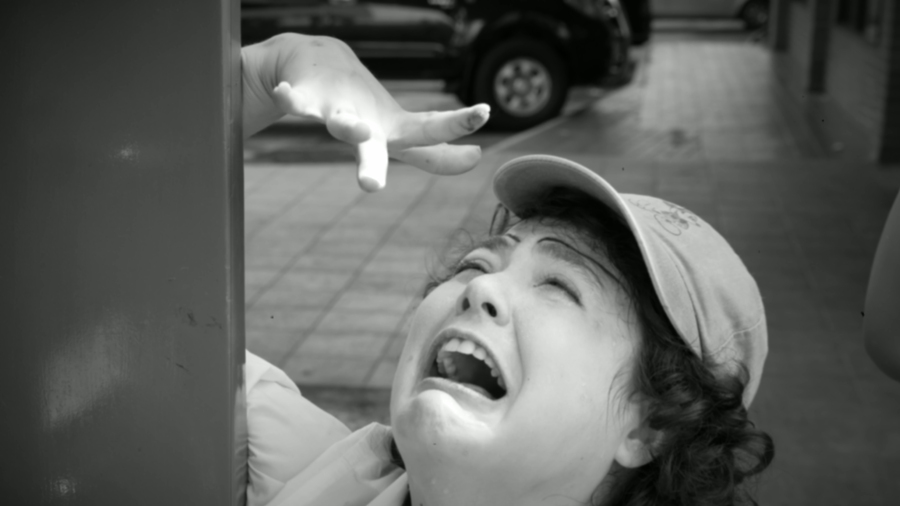
Milko Delgado, a transdisciplinary Panamanian artist, participates in El Rojo me Recuerda as part of Visual AIDS’ Day With(out) Art, showcasing their short film The AIDS Club. J Triangular (they/them), coordinator of DWA for Latin America, Asia, and Africa, invites us to an intimate and thought-provoking conversation with Milko. Drawing its title from a sensationalist episode of a telenovela, Delgado presents an innovative project that merges art, activism, and memory into a unique visual proposal.
This year, Day With(out) Art debuts in Cambodia and several African countries. In this interview, we delve into Milko’s creative process, influences, and how The AIDS Club serves as a critical reflection on the stigma and dominant narratives surrounding HIV/AIDS.
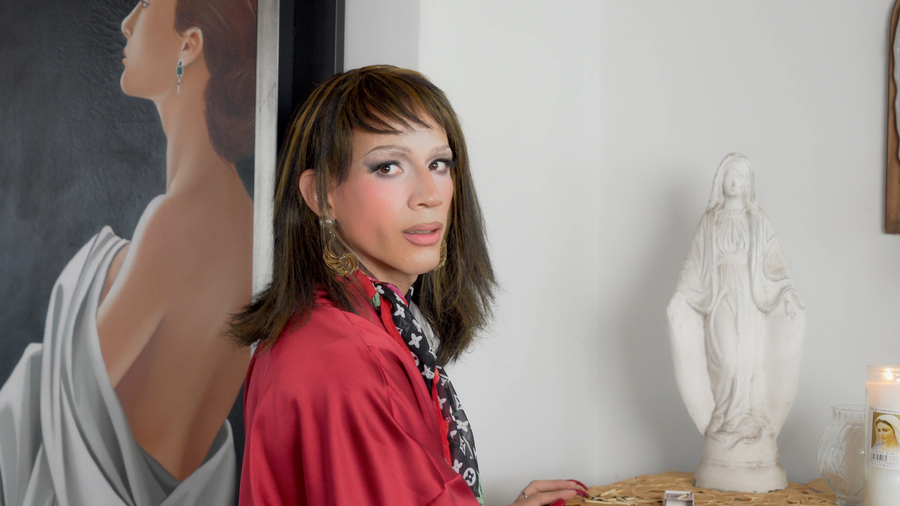
JT: Your short film begins with you speaking directly to the camera. Tell us about yourself—your position, your voice, your art, your life, and how the idea for El Club del Sida was born. How does your personal experience and artistic vision connect with the creation of this highly relevant project in such stigmatizing times?
MD: Overachieving queer in rehab, 29 years old, Leo, nonbinary, HIV-positive, Chiricana, Panamanian, Central American, Mestizx, Latinx. I am an artist and cultural activator particularly interested in the intersections between the body and nature, as well as the queer/dissident experience in Panamanian territory and beyond. I was born in Puerto Armuelles, a rural area on the western Pacific coast of the Chiriquí province in Panama but grew up moving between low-income or completely marginalized communities in the suburbs of the «Dubai of Central America»—Panama City.
I’ve been building a “formal” practice for four years, two of which have been fully dedicated to my creative work, resisting through art and storytelling. My practice is highly referential—perhaps autoethnographic. I’m drawn to performance, video, and visual arts, as well as cultural and community mediation/management as spaces for creating experiences, learning, cooperation, and collectivity.
When I initially applied to Visual AIDS’ open call, I had no clear images for the project. What I did know was that, like most of my works, this would be an act of honesty and transformation for me. I knew the creative process would be a space to confront, accept, and transmute my experience as a sidosa (slang for someone living with AIDS). It was also about understanding that I’m now in a different place—healthy, brave, full of life, love, and tenderness for myself and the world—and about building a better relationship with myself and the internal and external aspects of my universe.
I’ve done performances where I read texts written to speak to myself, listen to myself, and process wounds tied to illness, violence, colonialism, etc. These performances have been a mechanism to confront and honestly share myself. I approached this project as another such space, only this time on video. I started by writing a semi-monologue that became the foundation for intuitively finding images. These images emerged gradually—amid creative crises, conversations with friends, or moments of realization.
At first, I could only imagine cryptic or heavy narratives, and I got stuck in the process for months. Eventually, I saw the project for what it was: an exercise to reconfigure my narrative and begin to see myself differently. From that perspective, it became easier to make decisions and build the project with humor and lightness—to create an autobiographical fiction, laugh at the situation, and celebrate myself through satire. That’s how El Club del Sida and my drag alter ego, María Helena (better known as Tía Cuqui), were born.
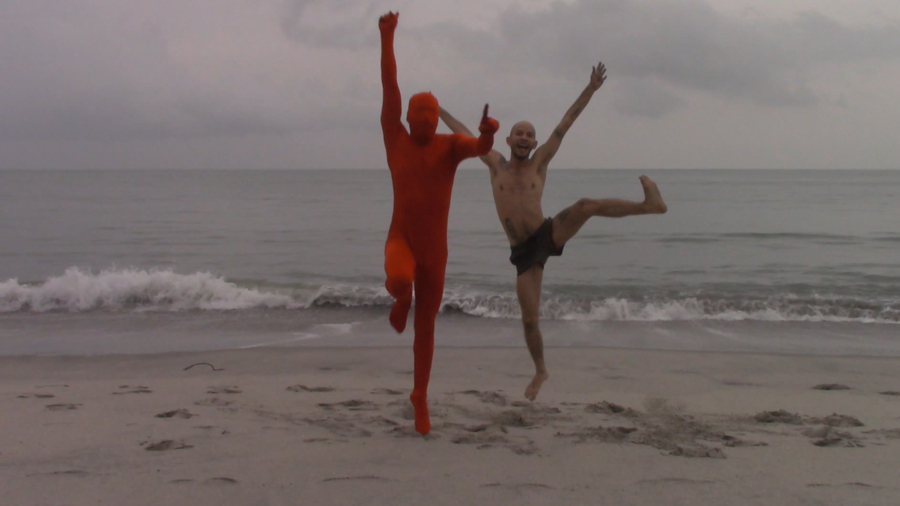
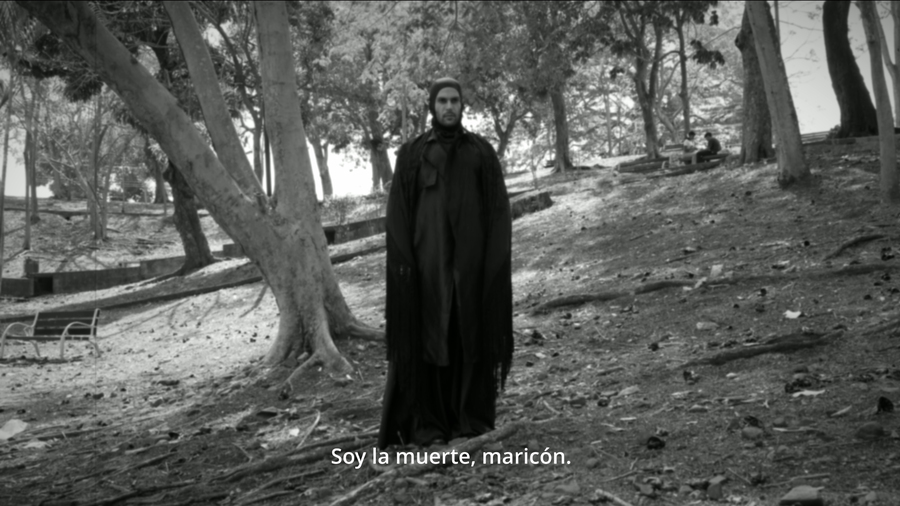
JT: In your project, you blend genres ranging from melodrama and camp to comedy, horror, and a playful intervention into Ingmar Bergman’s The Seventh Seal, featuring death and poppers. How did you decide to combine these genres? Do you think you’re creating and sharing a new aesthetic to address HIV/AIDS—one that transcends conventional and political boundaries?
MD: Mixing genres made sense to frame moments of my life in aesthetics that relate to me while making the ways I perceive the virus ironic—for instance, the fear of becoming a monster or the melodrama of soap operas. Using different genres and irony in the visuals was also a way to balance the “heavy” tone of the text I’d written for the voiceover. I enjoy the public honesty of art as a way to deconstruct and release what doesn’t belong to my essence.
Not having expectations beyond the process allowed me to see meaning in absurdity and laugh at it. It was beautiful to go out guerrilla-style to film on the streets with friends, with their creativity and bodies fully invested. It was liberating to create a space for play, performance, drag, clowning, and even cringe—an act that felt freeing in the face of my compulsion to present myself as perfect (a compensation for a lack of affirmation during my childhood).
Pushing the boundaries of the conventional and political sounds ambitious, but I hope that’s how some viewers interpret the video. I don’t think I’m creating anything new; I just tapped into the narrative capacity of someone who spent three years in film school (hence Bergman). What might feel novel is that someone from my context gets to narrate themselves and their relationship with HIV.
JT: What key references influenced your creative process? Are there historical moments or figures in art/activism that shaped how you approached this project?
MD: Making the body a channel for art has always been present in my practice, influenced by performance art within visual arts. Talking about the project with friends throughout the process helped immensely. I’d share my ideas and see what resonated with them, what made them laugh, and what conversations or symbols emerged. Most decisions for the video were intuitive, stemming from a process of listening to myself and putting my body on the line, as my friend L. A. Yero says.
JT: How can personal stories of artists living with HIV counter the stigmatizing images that abound today and contribute to the social programming you mention in El Club del Sida? Can art be a tool to decolonize the representation of the body and experiences related to HIV?
MD: Art has been my primary tool for self-exploration and untangling my life—not just through my practice but also through the perspectives and approaches of other artists. I’m fully convinced it can be a tool for many others as well.
JT: At the end of the short film, you compose a hopeful collage of images. How does your project serve as an act of resistance against the stigma and discrimination still present in narratives about HIV/AIDS?
MD: Even today, stigma and concealment around HIV persist in places where conversations about the virus are scarce. “Commitment to oneself and expression through self-recognition are great acts of courage—especially in spaces that seem inhospitable to diversity (as Panama seemed to me),” as a cultural worker commented on my work.
Resistance begins with ourselves. I was the first person moved by this project, and I feel the video carries that energy. That’s what makes the work resonate and connect with others.
JT: What does being part of DWA mean to you? How can contemporary art and visual activism collaborate to transform public perceptions of HIV/AIDS?
MD: Activism and art are driven by a shared spirit, each amplifying the other to create a network of experiences, emotions, and perspectives that help transform societal perceptions. Expanding the vocabulary of HIV/AIDS narratives means fostering dialogue in contexts where these experiences are least discussed.
In the Global South, we have nuances that may or may not align with the dominant narratives from the Global North. That’s why I like the term sidosa, a uniquely regional word that brings a distinct perspective to HIV/AIDS from Latin America. Visual AIDS, through DWA programming, provides a platform to include these narratives by calling on voices from all over the world.
JT: Finally, what message would you like viewers to take away from El Club del Sida?
MD: Art and its transcendence aren’t as important as the relationship we cultivate with our bodies. I hope El Club del Sida inspires viewers to take control of the narratives shaping their lives, to discern what doesn’t belong to them, and to find what aligns with the purpose and essence of their lives.

También te puede interesar

VIROSIS: ARTE Y VIH EN COLOMBIA (1981-2023)
“Virosis” es la primera exposición museística en Colombia en la cual se presentan obras de arte realizadas en respuesta a la epidemia de vih/sida en el país. La muestra reúne obras creadas por treinta...

PIES BAJO FUEGO: SOBRE EL DESPOJO
Pies bajo fuego: Sobre el despojo explora la noción multivalente de despojo y sus formas de representación a través de un conjunto de obras en video realizadas en la última década. El despojo es…

CONTRA LA ESTIGMATIZACIÓN DEL VIH/SIDA Y EL BIOPODER. ENTREVISTA A J. TRIANGULAR
J Triangular es artista, activista, curadora, poeta de neón y videasta. El artivismo nos unió a través de diferentes coyunturas. J me inspira a ser valiente y seguir buscando un mundo más justo a...