AFTER THE END. CARTOGRAPHIES FOR ANOTHER TIME
Bringing together the works of 40 international artists, the exhibition After the End. Cartographies for Another Time, curated by Manuel Borja-Villel and presented at the Centre Pompidou-Metz, questions the Western narrative rooted in a colonial system through stories that are at once new and ancestral, popular and modern. Highlighting the importance of community, the exhibition explores the diasporic condition and the limits of modernity’s intelligibility in order to imagine worlds beyond the end of time—and beyond our own time.
At the heart of this project lies a different conception of temporality. As Borja-Villel notes, Western time is usually understood as a linear sequence of events, “in which one supersedes the other.” By contrast, the artists in the exhibition work from a sense of spiral time, where past and future are interrelated and may erupt unexpectedly, creating ruptures in our perception of the world. This non-linear temporality is inseparable from a “borderland” condition, a place of constant crossing where identity is continually redefined.
The works in the exhibition reflect on a world system built on violence, a system that reduced entire communities to objects to be exchanged or disposed of at the will of power. “There is no way Europe can ever repay this debt,” Borja-Villel observes. What these artists propose instead are forms of mourning that are also forms of radical imagination: practices that create the conditions for conceiving new worlds beyond the epistemic closure that characterizes Western thought.
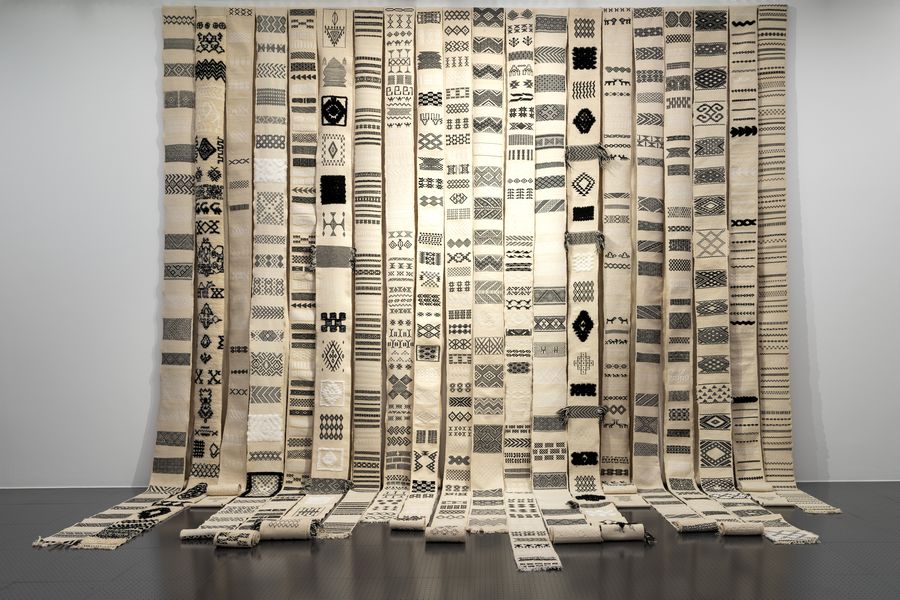
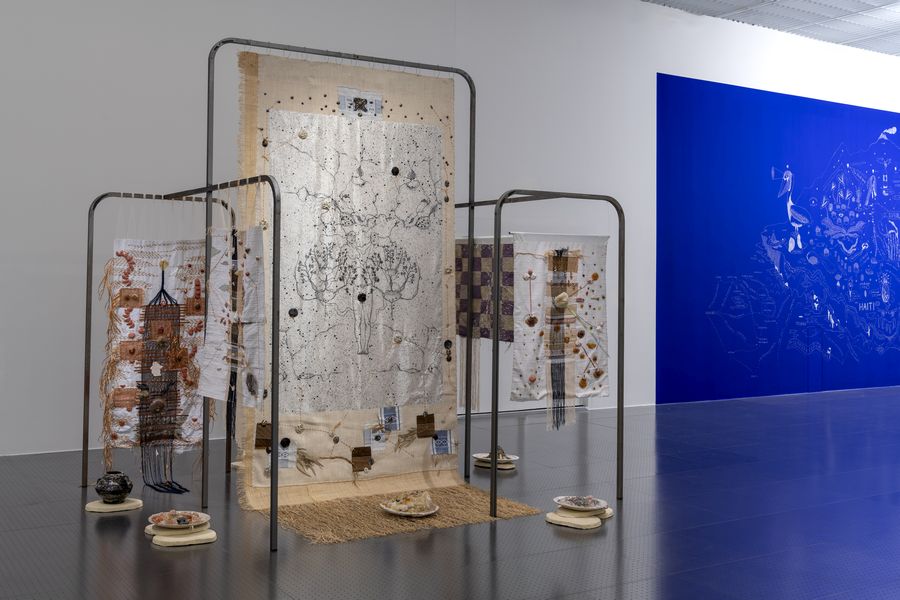
In After the End. Cartographies for Another Time, the Caribbean and North African diasporas—intertwined since the dawn of colonialism—intermingle. Spanning from the 17th century to the present, the exhibition explores the diasporic condition of these peoples and communities, this ‘borderland’ existence, this ‘belonging without belonging,’ to borrow the words of poet Gloria Anzaldúa. Instead of “geographies,” which, as the curator reminds us, still reflect the coloniality of power, the exhibition speaks of territories and epistemological spaces: the Caribbean and the Mediterranean, but also the ocean and the desert, water and land, entangled in multiple ways.
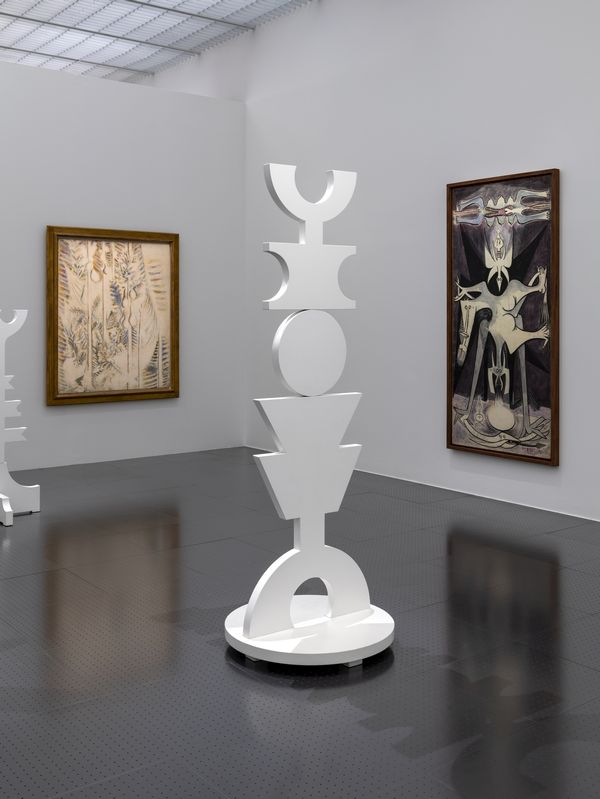
Artists move across multiple registers of meaning because they speak to and engage with diverse communities. This is evident in the works of Wifredo Lam, Rubem Valentim, Belkis Ayón, Frank Walter and Ahmed Cherkaoui. Their references to African-derived spiritualities and religions, as well as to vernacular traditions, are not forms of appropriation; rather, they combine with modernity while never fully merging with it. This borderland perspective—an invitation to decenter and to distance oneself from the world of modernity—is fundamental here.
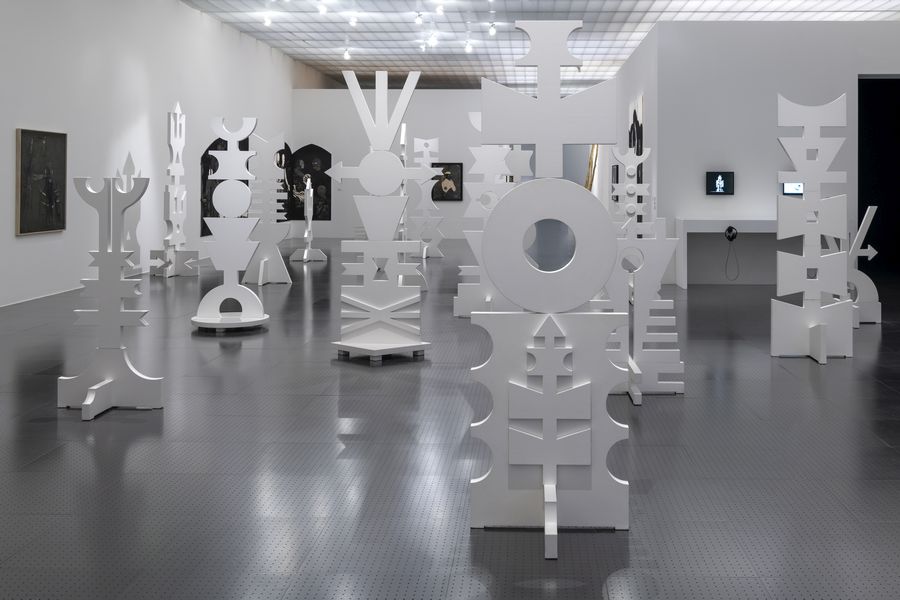
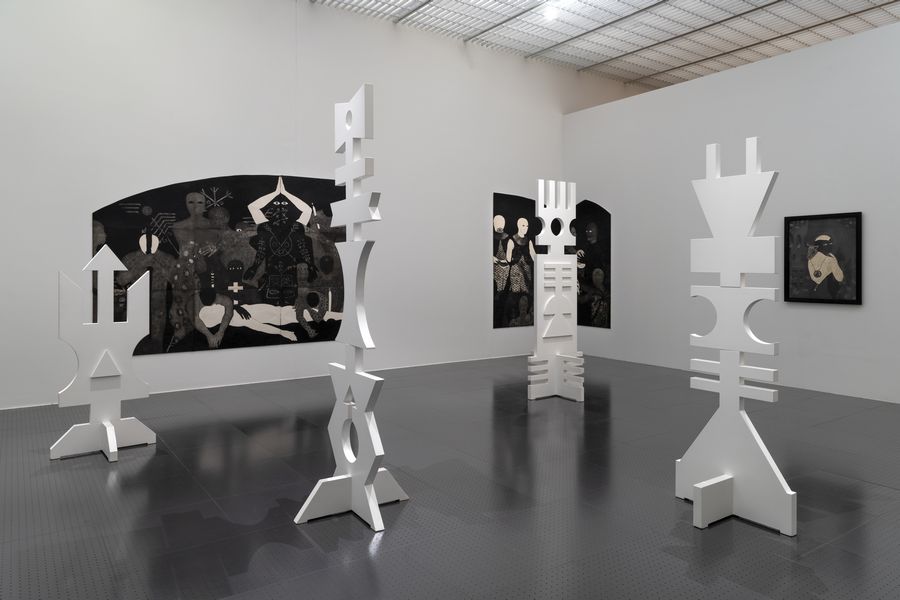
In his work, Rubem Valentim fuses the poetics of Concretism and geometric abstraction with gestures and motifs rooted in Afro-Brazilian culture and spirituality. Templo de Oxalá, comprising around twenty monochrome sculptures, was first presented at the 14th São Paulo Biennial in 1977. The arrangement of these forms evokes a pantheon of orishas saluting Oxalá—the divinity of creation, also known as Obàtálá, the “gentleman of the white cloth.”
The installation radiates both formal rigor and overflowing spiritual force, articulated through a distinctive visual language. This language draws on signs and references to ritual instruments, the spatial organization of terreiros, and the symbology and colors associated with Candomblé and Umbanda deities. Far from merely transposing the imagery of African-derived religions, Valentim—like Wifredo Lam and Belkis Ayón—engages these elements from a practice that stands “in opposition to systematic cultural colonialism,” grounded in a deep “awareness of the land and the people,” as he affirmed in his 1976 Manifesto ainda que tardio (Manifesto Although Late).
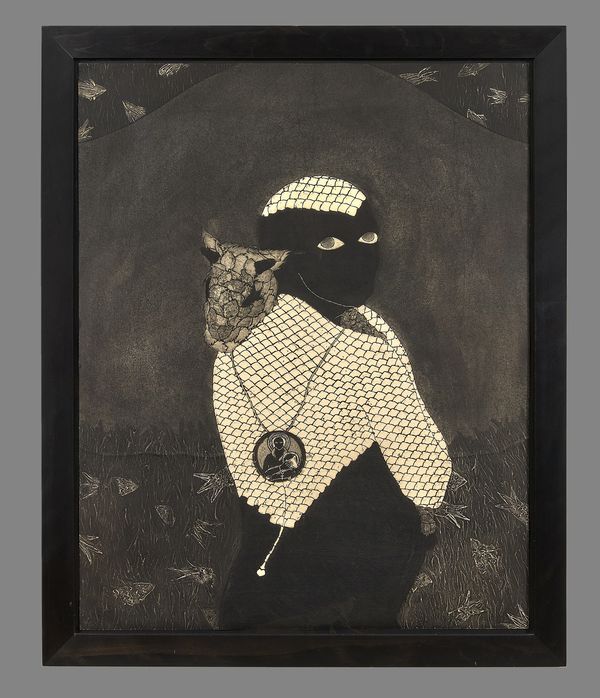
In 1985, Belkis Ayón encountered the Abakuá secret society through the writings of anthropologist Lydia Cabrera. This brotherhood, which originated in the Calabar region of Nigeria, was brought to the Caribbean by enslaved Africans and became established in Cuba in the early nineteenth century.
Ayón drew inspiration from Abakuá rituals to create works that transcend the traditional two-dimensionality of printmaking. Through imagery that evokes the heritage of Afro-diasporic religions while also incorporating elements of Christianity and popular Cuban culture, she explored social, cultural, and ideological questions. Although she identified with the mythic figure of the goddess Sikán, the artist never interpreted the myth literally or through a narrowly ethno-identitarian lens.
Her collographs, composed of infinite interwoven textures, develop a complex lexicon of symbols that merge traces of the colonial past with the matrix of a present in crisis: a post-Soviet Cuba in which questions of gender, race, and power come sharply into focus.
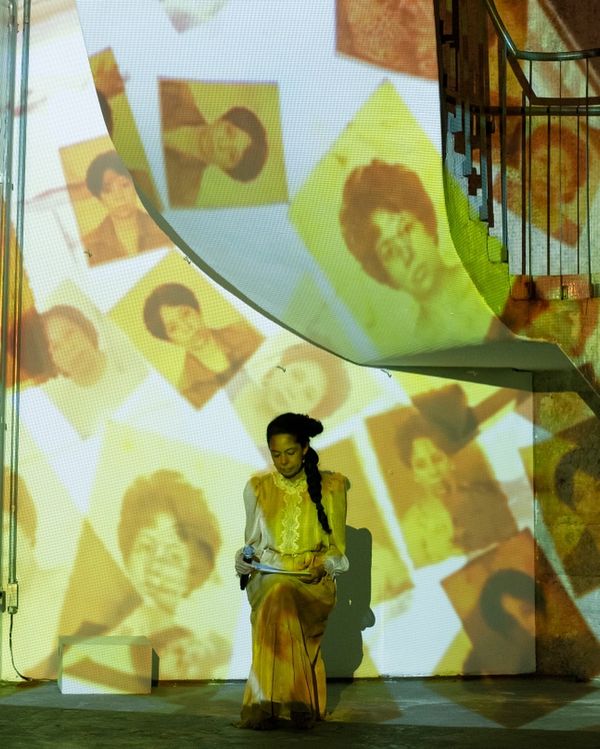
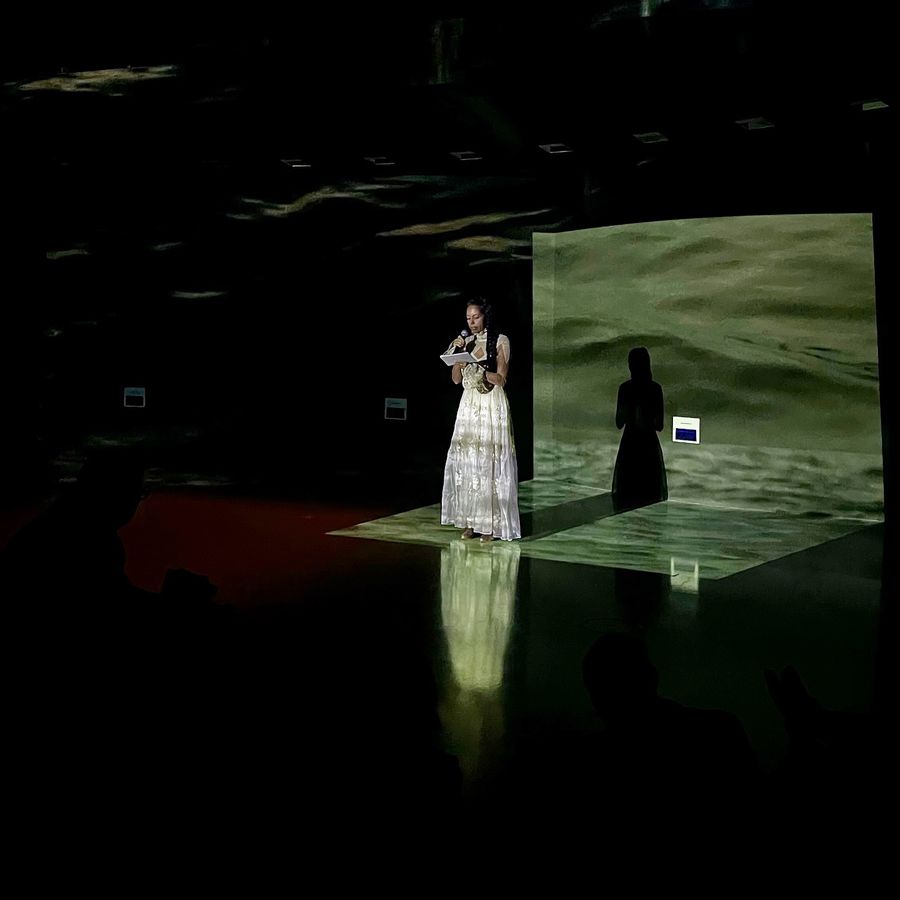
Aline Motta, Water is a Time Machine, 2025. Performance. Photo: Carine Wallauer / Exhibition After the end / 2025
The singular Western narrative has long occluded and erased the histories of subjugated and dispossessed peoples. Yet this erasure has not extinguished the living memories preserved in oral traditions, in bodies, in vernacular language, and even in the history of the earth itself. The works of M’Barek Bouhchichi, Bouchra Ouizguen, and Abdessamad El Montassir testify to this resilience. The sea and water, too, carry memories, as reflected in the works of Ellen Gallagher and Aline Motta. The thinking of Alejandra Riera also embodies this sensibility. In March 2022, when Sahara dust fell upon one of the gardens she was studying in Paris, she observed:
“Sometimes even imperceptible events permeate our environment and remind us that what we describe as local is only partially so, for that which exists and happens in a particular place is often the fruit of anonymous or little-known contributions from elsewhere…”
Many of the featured artists are from, or connected to, regions such as the Caribbean and the Mediterranean. Their works resonate with what the curator describes as “a sense of solidarity and caring,” as well as with the conviction that learning is always collective. Committed to questions of gender and belonging, these artists expand and enrich our understanding of the world. Their practices—whether spiritual, political, or communal—reconfigure our relationship to time and space. Several works have been conceived specifically for this exhibition and are presented here for the first time.
Water is a Time Machine, by Brazilian artist Aline Motta, is a multilayered project that traces the lives of her family members in Rio de Janeiro at the turn of the 20th century, a moment of political upheaval following the abolition of slavery. The work also incorporates intimate documents belonging to her mother—calendars and diaries from the 1970s—as well as a poignant account of her death in 2011, which becomes the emotional and structural core of the project.
Comprising a work of fiction, a video, and a performance, the piece unfolds at the intersection of literature and the visual arts. Navigating between word and image, archive and fabulation, Motta reconfigures memory through a non-linear perception of time.
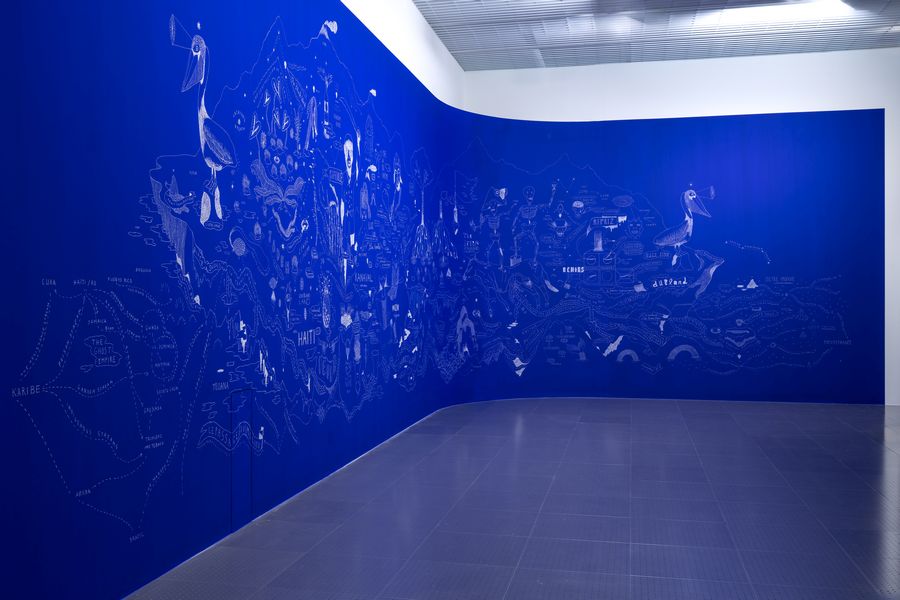
Before turning to the spirits of place and time that haunt Péyi en retour, the fresco created for After the End. Cartographies for Another Time, Olivier Marboeuf (Guadeloupe) offers a few preliminary reflections on the conditions of existence of such a work—on what it is and is not, what it cannot and will not represent, what overwhelms it, and towards what anger it gestures from its blue “overseas” screen.
The Blueprints series interlaces “major” events with “minor” ruptures. Here, the artist revisits his reading of Sylvia Wynter’s essay Novel and History, Plot and Plantation (1971), in which the Jamaican thinker identifies in episodes of refusal and acts of resistance—tiny revolts—the threads of a history of emancipation that is perpetually interrupted by the plantation’s narrative fabric and its infrastructures, which dictate the “big” story, even selecting the enemies deemed worthy of entering it.
The Blueprints are thus bound to this discontinuous tapestry, to moments lost in the past but also to the speculative future—to a “potential history,” whose very persistence becomes a form of repair without precedent or model.
Together, these works exemplify what After the End. Cartographies for Another Time proposes: an expansive and interconnected map of knowledge, memory, and imagination. They invite viewers to move beyond linear histories and dominant narratives, to inhabit borderlands where time spirals, identities shift, and new worlds can be envisioned. In this way, the exhibition itself becomes a living cartography for another time—a space where past, present, and future converge in constant dialogue.
After the End. Cartographies for Another Time is on view at the Centre Pompidou-Metz, France, from January 25 to September 1, 2025.
Artists
Juan y Miguel González, GIAP, Aline Motta, Olivier Marboeuf, Laeïla Adjovi, Marie-Claire Messouma Manlanbien, Ellen Gallagher, Kapwani Kiwanga, Myrlande Constant, Frank Walter, Donald Locke, Victor Anicet, Frantz Zéphirin, Georges Liautaud, Rosana Paulino, Belkis Ayón, Wifredo Lam, Rubem Valentim, Alejandra Riera, Maya Deren, Katherine Dunham, Sarah Maldoror, Philip Rizk, Abdessamad El Montassir, Tizintizwa (Nadir Bouhmouch and Soumeya Aït Ahmed), M’barek Bouhchichi, Amina Agueznay, Ahmed Cherkaoui, Bouchra Ouizguen, Baya, Mounira Al Solh, Basma al-Sharif, Ahlam Shibl, Ariella Aïsha Azoulay, Yto Barrada.

También te puede interesar
JUAN FRANCISCO ELSO: POR AMÉRICA
Mediante el uso de materiales mayoritariamente naturales y orgánicos -como barro, arcilla, paja, ramas, corteza y tierra-, la práctica escultórica de Elso explora las complejas configuraciones de la identidad contemporánea cubana, caribeña y latinoamericana,...
Visions of Brazil:reimagining Modernity From Tarsila to Sonia
"Visions of Brazil: Reimagining Modernity from Tarsila to Sonia" positions works by Brazilian Modernists (such as Tarsila do Amaral and Alfredo Volpi) alongside others made by artists working outside of Modernism's canonical time bracket...
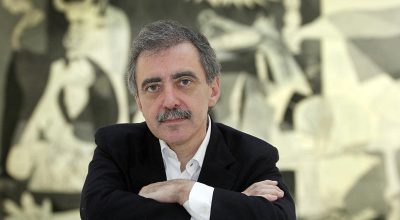
MANUEL BORJA-VILLEL DIRIGIRÁ EL MUSEO REINA SOFÍA POR CINCO AÑOS MÁS
El Museo Reina Sofía renovó el contrato de Manuel Borja-Villel (Burriana, Castellón, España, 1957) como su director por cinco años más, tras llegar a un acuerdo con el Ministerio de Educación, Cultura y Deporte...