
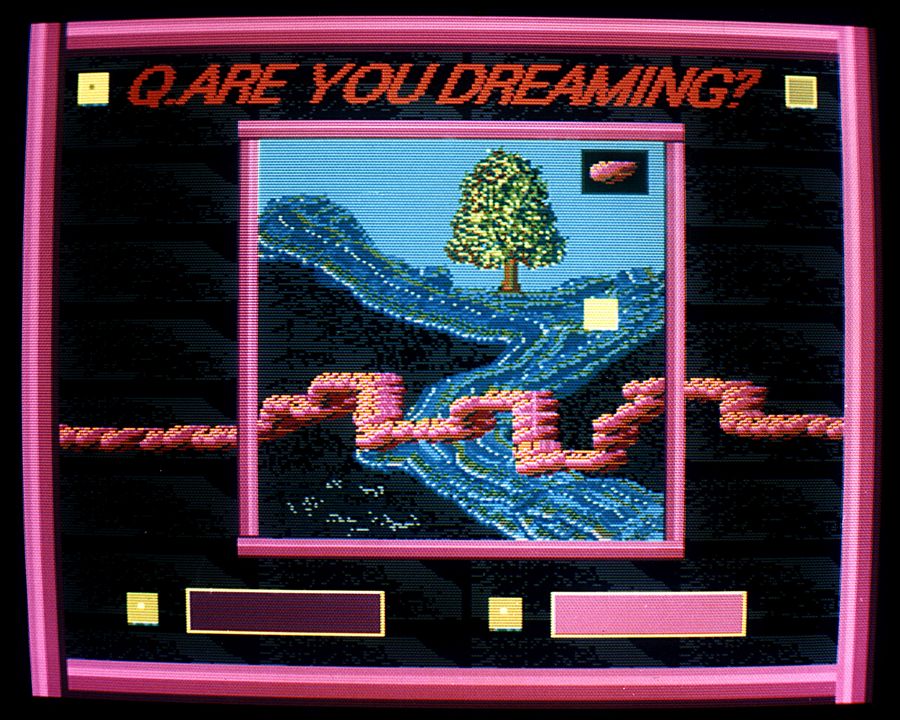
ELECTRIC DREAMS: ART AND TECHNOLOGY BEFORE THE INTERNET
From the emergence of Op Art to the dawn of the internet age, artists found new ways to engage the senses and challenge perception. Electric Dreams: Art and Technology before the Internet celebrates the pioneers of optical, kinetic, programmed, and digital art—visionaries who ushered in an era of immersive environments and algorithmically generated works.
This major exhibition at Tate Modern brings together groundbreaking pieces by a diverse network of international artists who explored the intersections of science, technology, and material innovation. Visitors are invited to step into psychedelic environments created in the 1950s and 60s using mathematical principles, motorized components, and emerging industrial processes. The exhibition also follows how radical artists embraced the rise of digital technologies in the 1970s and 80s, experimenting with machine-generated imagery and early personal computing systems.
Featuring over 150 works, many of which are shown in the UK for the first time, this ambitious exhibition offers a rare opportunity to experience incredible vintage tech art in action – from mesmerizing psychedelic installations to early experiments made with home computers and video synthesizers.
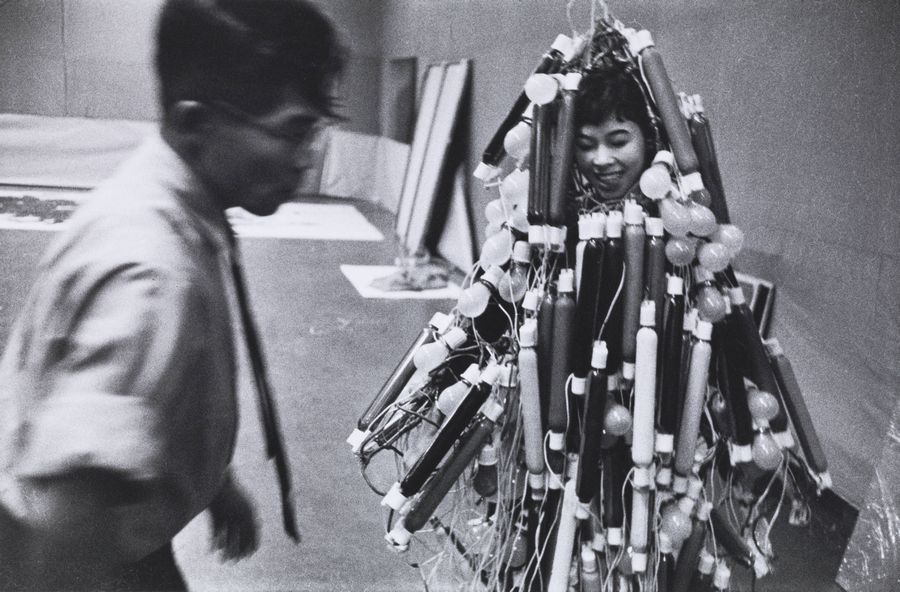
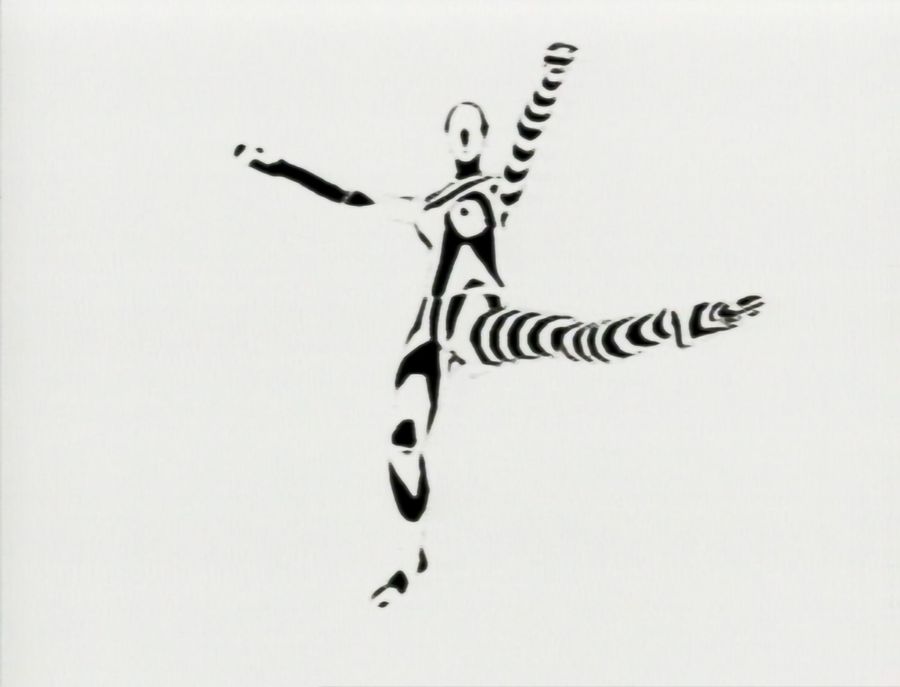
Electric Dress (1956) by Atsuko Tanaka is a sculpture, costume, and performative installation made of hand-painted lightbulbs and tubes. Inspired by Osaka’s neon signs, it embodies the electrified spirit of postwar Japan. As a member of the Gutai Art Association, Tanaka used technology to explore the body as circuitry. When activated, the dress blinked like fireworks—dazzling, dangerous, and radically ahead of its time.
Atsuko Tanaka, Electric Dress, 2nd Gutai Exhibition, 1956. Tate © Tetsuo Otsuji, Musashino Art University Museum & Library. Courtesy of Yokota Tokyo
Spanning from the 1950s to the widespread adoption of the internet in the early 1990s, the exhibition unfolds through a series of loosely connected narratives. It charts how artists across the globe—often working collaboratively—engaged with cutting-edge media and hybrid methods to expand the horizons of collective creativity. Many believed that technology should serve communal purposes, and worked together to steer its development toward experimental, aesthetic, and social uses.
Some artists harnessed electronics to sculpt light and sound; others introduced mathematical principles and algorithms as creative agents. New fields like cybernetics invited artists to conceive of the artwork as a ‘communication system,’ emphasizing interaction and audience participation. By applying emerging scientific concepts to art, they transformed the act of viewing into an immersive, participatory experience.
Breakthroughs in telecommunications enabled cross-border collaborations, leading to new artistic networks and communities. As computers evolved from room-sized machines to desktop devices, artists explored their potential to democratize production and reclaim technological tools from military or corporate domains. Many worked in high-tech labs or repurposed consumer electronics, often sharing access to expensive equipment with peers and local communities.
Organized roughly chronologically, Electric Dreams brings together large-scale immersive installations with thematic galleries devoted to shared interests and collaborative practices. From paintings inspired by mathematics and perceptual science to the earliest experiments with virtual reality, the exhibition presents a wide spectrum of ideas and technologies. At a time when digital technologies continue to reshape the world in unforeseeable ways, Electric Dreams offers a vital reminder of how past generations of artists merged scientific inquiry with human imagination.
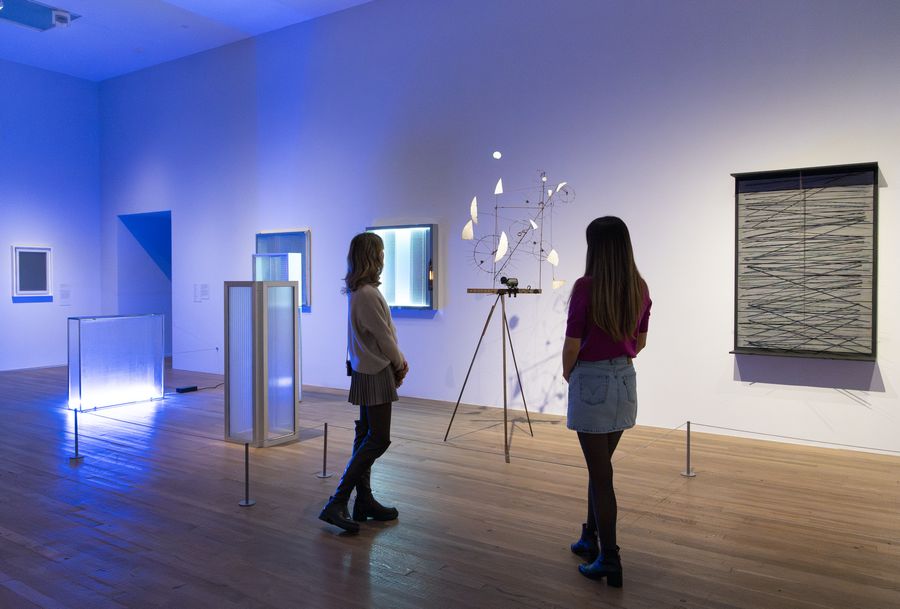
CYBERNETICS
Cybernetics—the science of systems—emerged during World War II, when mathematician Norbert Wiener developed a device to help improve the accuracy of anti-aircraft guns. From this origin in military technology, cybernetics quickly evolved into a field concerned with control, feedback, and communication between machines, humans, and their environments. By the 1960s, second-generation cyberneticists introduced more complex models of observation and interdependence, expanding the field into ecological, social, and even philosophical territory.
Among artists and countercultural thinkers of the time, cybernetics offered a compelling framework to make sense of an increasingly interconnected and technocratic world. Artists began to build works as open systems—self-regulating, interactive, and often minimally dependent on human intervention. These explorations of machine-human feedback loops reflected a desire not only to understand systems but to reimagine them. In this context, cybernetics became both a method and a metaphor: a way to rethink creative agency, collective intelligence, and the structures that govern our lives.
MATERIALISING THE INVISIBLE
The 1950s marked a new frontier in science and technology. With breakthroughs like the discovery of DNA, quantum fields, and microcircuitry, and the rapid spread of communication tools like the transistor radio and television, artists found themselves confronting realities previously unseeable and unimaginable. As the space race intensified, the possibility of leaving Earth stretched both scientific and artistic imaginations.
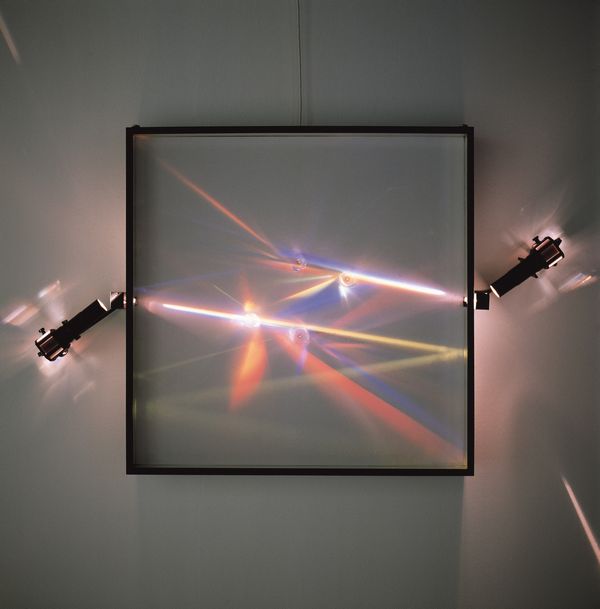
Faced with these shifting horizons, artists sought new forms to materialize the invisible. Electricity and analogue circuitry became media for poetic speculation; optical effects, cosmic imagery, and mathematical models were used to suggest worlds beyond immediate perception. Many of the works in this section are kinetic—powered by motors or light, these pieces move and change in real time, embodying processes of transformation and emergence. Far from illustrative, these artworks invited viewers to experience the tensions between the known and the unknown, the material and the immaterial.
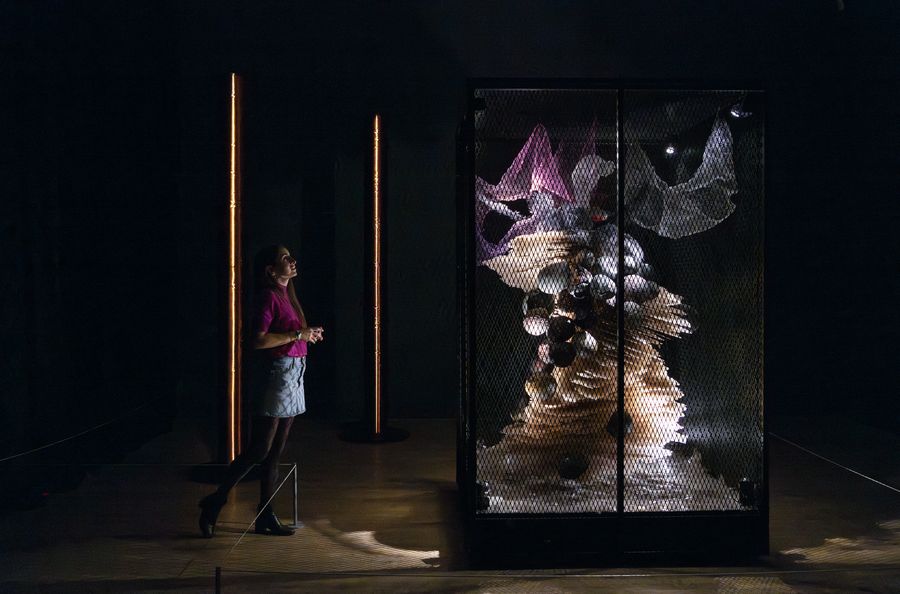
Lines of Power (1983) and The Bride (1980s) by Liliane Lijn merge industrial materials with light and motion to explore energy, mythology, and the feminine. In Lines of Power, rotating copper bands catch a beam of light, creating hypnotic patterns that evoke live currents. The Bride, encased in a protective mesh, pulses with symbolic elements—mica, feathers, egg forms—offering a spiritual and feminist interpretation of technology and matter.
Liliane Lijn, Lines of Power, 1983, and The Bride, 1988. Installation view in Electric Dreams, Tate Modern, 2024-2025. Photo © Lucy Green/Tate
LONDON: SIGNALS GALLERY AND BEYOND
In 1960s London, a network of artists began experimenting with technology, systems thinking, and mathematical principles. At the heart of this creative exchange was Signals, a radical independent gallery that became a hub for international collaboration and experimentation. Founded in 1964 by artists David Medalla, Gustav Metzger, and Marcello Salvadori—together with critic Guy Brett and curator Paul Keeler—the space was initially called the Centre for Advanced Creative Study. It was soon renamed Signals, after a series of sculptures by Greek kinetic artist Takis.
Over its brief but influential three-year run, Signals hosted groundbreaking exhibitions by artists from Latin America, Europe, and Asia—many of whom were showing in the UK for the first time. These included Jesús Rafael Soto, Liliane Lijn, and Takis himself. The works on view explored interactivity, participation, and generative processes using light, air, gravity, motion, and energy.
The gallery also published the Signals Newsbulletin, an experimental platform for discourse at the intersection of visual art, poetry, science, and technology. More than just a gallery, Signals became a transnational platform for rethinking the relationship between art and systems—an ethos that still resonates in contemporary practices today.
ZERO AND THE ZERO NETWORK
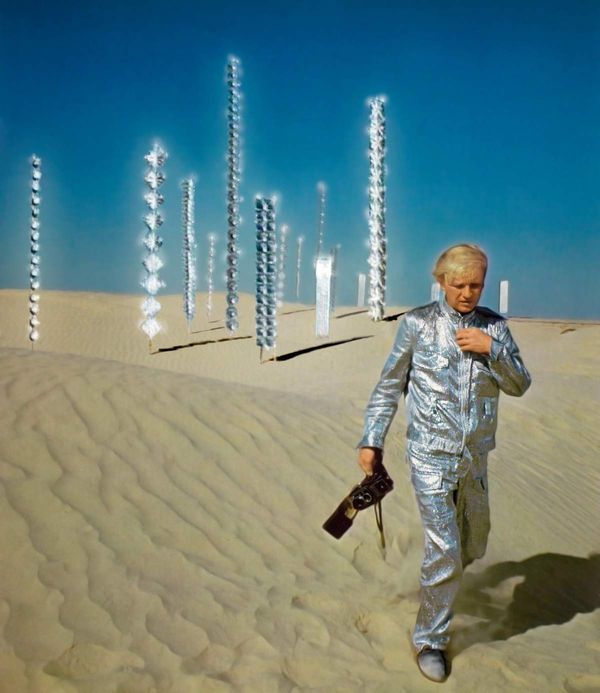
Founded in Düsseldorf in 1957 by artists Heinz Mack and Otto Piene—later joined by Günther Uecker—the Zero group emerged with a radical vision of art as a force for social and spiritual renewal. Drawing its name from the countdown to a rocket launch, Zero imagined itself as a clean slate: “a zone of silence and of pure possibilities for a new beginning.”
Rejecting the emotionalism and authorship of post-war painting, the group embraced collaboration, experimentation, and the sensory potential of light and movement. Their immersive Abendausstellungen (one-night exhibitions) began in shared studios and soon expanded into large-scale outdoor events. These gatherings gave rise to a broader, transnational network of artists from Europe, Japan, and the Americas—eventually known as ZERO in all caps, reflecting its growing ambition and reach.
OTTO PIENE
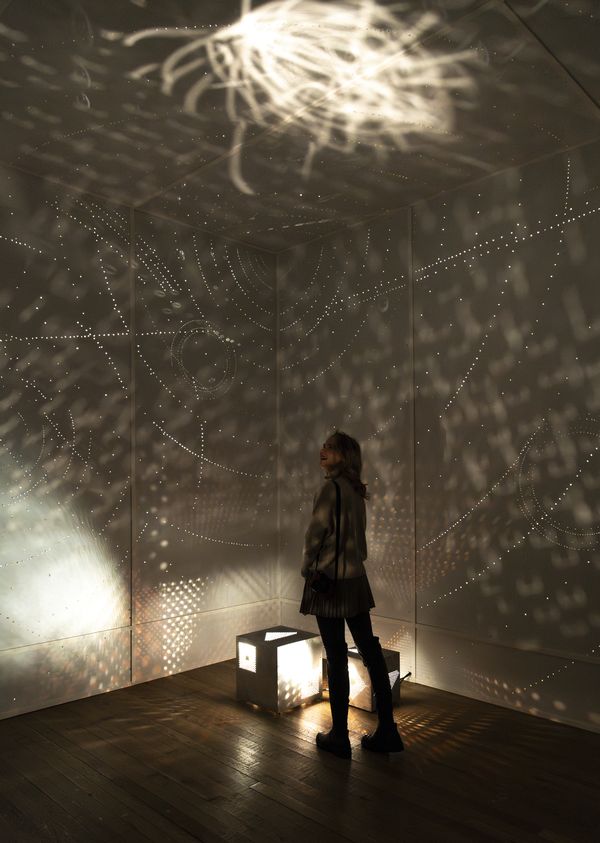
Otto Piene, a founding member of ZERO, was especially drawn to light as both material and metaphor. His installation Light Room (Jena) stages a luminous “ballet” of five synchronized light sculptures—rotating, flickering, and casting patterns in space. The work embodies Piene’s desire to create multisensory environments that transcend static form.
His first Light Ballet machines appeared in 1959, using stencils and candlelight to project shifting patterns. Over the 1960s, these kinetic devices became more elaborate: mechanized environments featuring motors, metal screens, and electric bulbs that dramatize the choreography of light. In 2007, Piene brought several of these machines together in a single installation.
Piene’s legacy extended beyond ZERO. In 1968, he joined the Center for Advanced Visual Studies (CAVS) at MIT as its first international fellow. Founded by György Kepes, CAVS became a key site for art-and-technology experiments. Piene helped shape it into a hub for global artistic collaboration at the intersection of science, light, and performance.

BRION GYSIN
Painter, poet, performer, and inventor, Brion Gysin was a catalytic figure of postwar avant-garde experimentation. In 1959, he created the Dreamachine—a hypnotic rotating light sculpture described as “the first art object to be seen with the eyes closed.” Developed in collaboration with the technologist Ian Sommerville and in ongoing dialogue with novelist William S. Burroughs, the Dreamachine was conceived as a device for inducing altered states of consciousness through flickering light patterns.
The idea was sparked by a revelation Gysin experienced while riding a bus through Marseille in 1958. As sunlight filtered through rows of trees, it produced pulsating patterns behind his closed eyes. This spontaneous vision inspired Gysin to build a machine that could simulate such phenomena, activating alpha brainwaves and generating vivid inner imagery. The Dreamachine invites viewers to engage it both with open and closed eyes, functioning as both artwork and psychotechnological experiment.
GRAV
We want to make audiences show an interest, shed their inhibitions, and relax.
We want them to take part.
We want to place them in situations they can trigger and transform.
We want them to be aware of their participation.
We want them to tend towards interaction with other audience members.
We want to help audiences develop their ability to perceive and act.
— GRAV, Enough with the Mystifications!, 1963
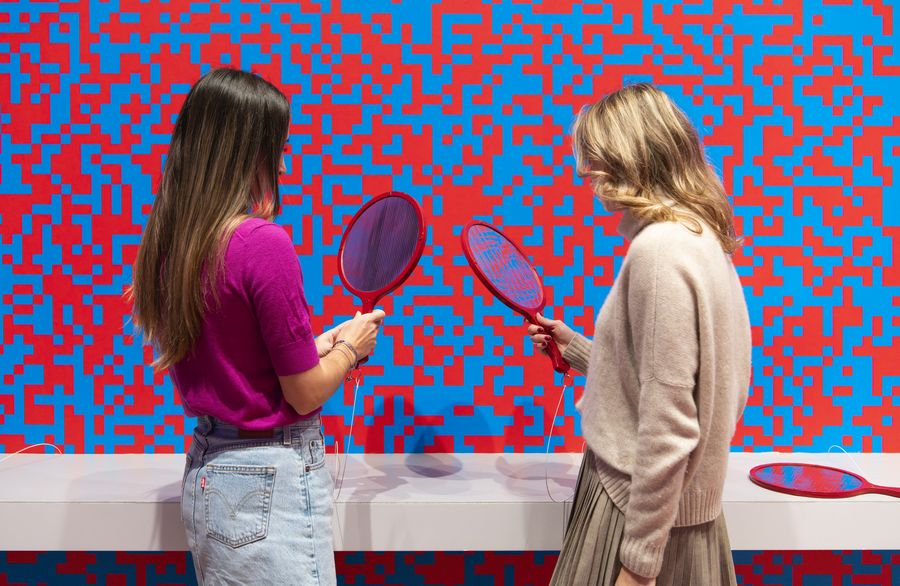
This manifesto, issued for the 1963 Paris Biennale, was a bold declaration by the Groupe de Recherche d’Art Visuel (GRAV): art should no longer be a passive, mystified object but a shared experience—collective, participatory, and open-ended. Rejecting the myth of the solitary genius, the group called for a new relationship between art and public life.
Founded in Paris in 1960 by an international collective of young artists, GRAV emerged as a key player in the postwar avant-garde. Among its leading figures were Jean-Pierre Yvaral and François Morellet from France, Francisco Sobrino from Spain, and Julio Le Parc from Argentina. Closely aligned with the New Tendencies movement, they drew on mathematical systems, optical effects and kinetic strategies to challenge visual perception and disrupt conventional forms of spectatorship.
From 1960 to 1968, GRAV organised a series of public experiments called Labyrinths—immersive environments composed of light installations, optical reliefs and moving components. Visitors navigated narrow, maze-like passages where artworks had to be physically activated, turning each experience into a unique collective event. These environments did not merely invite interaction—they demanded it, transforming viewers into co-creators.
A section of the exhibition includes works by GRAV members such as Le Parc and Morellet, including a wallpaper designed to disorient and animate the eye. Their legacy continues to inform contemporary practices that blur the line between observer and participant, system and play, art and life.
CARLOS CRUZ-DIEZ
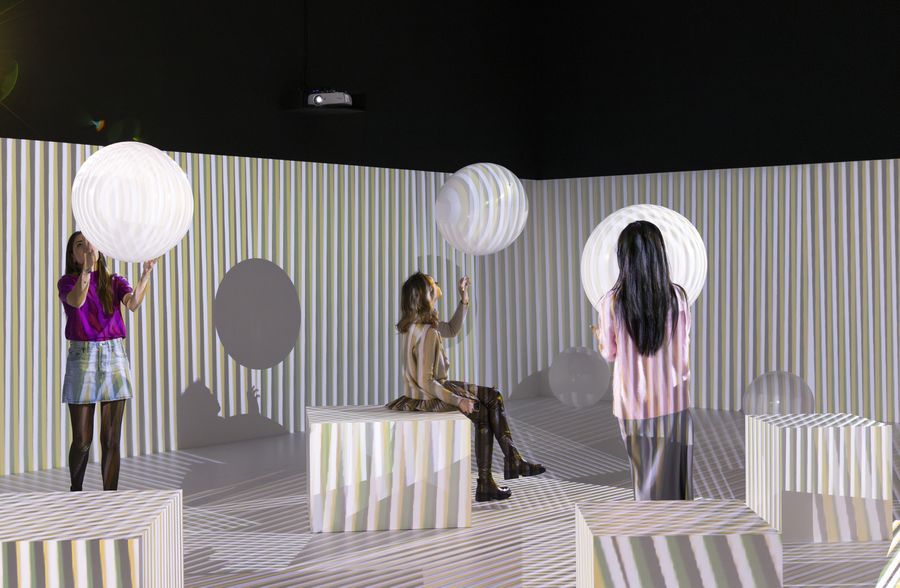
Carlos Cruz-Diez’s immersive installation Chromointerferent Environment fills the following room. A sequence of moving parallel lines colour the gallery floor and ceiling. The projection is constantly in motion, changing the appearance of the objects and people in the room. This creates a disorientating effect. Visitors are invited to interact with the cubes and balloons positioned around the room, engaging directly with the dizzying optical patterns.
Cruz-Diez experimented with different properties of color and light to generate visual illusions. This work is based on the effect generated by the movement of overlapping patterns. As a result, the human eye sees colors that are not in the source materials. Chromointerferent Environment was originally installed in 1974 using slide projectors with a 35mm frameless roll. A moving pattern of black lines was projected onto white panels painted with red, blue, and green lines. This chromatic interference was transferred onto the objects and people in the space.
The installation at Tate is a digital realization of the original work. This version uses high-definition video projection created with a computer graphics program developed by the artist with his son, Carlos Cruz Delgado. The lines and speed are more varied, which means the color combinations increase, and there are infinite possibilities for visual interference. Like GRAV’s Labyrinths, Chromointerferent Environment turns viewers into active participants, interrogating the relationship between artwork and audience through visual effects.
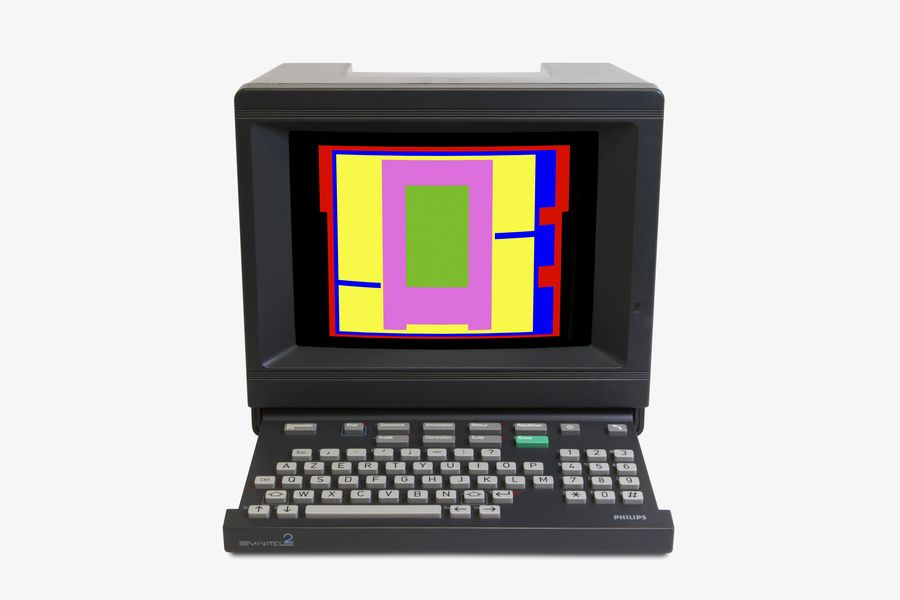
Eduardo Kac, Horny, 1985. Tate. Lent by the Tate Americas Foundation. Courtesy of the Latin American Acquisitions Committee, 2018 © Eduardo Kac
DIALOGUES WITH THE MACHINES
This room explores how artists began using computers and electronic technologies as creative tools from the 1960s onwards. The rapid development of computing during and after the Second World War—driven in part by military and aerospace research—ushered in a new era of image-making. Innovations like display screens enabled data to be visualised and manipulated in increasingly complex ways. But these machines, often the size of a room, were rarely accessible to the general public. Early computer-based artworks were typically created by engineers, scientists or artist-collaborators working in research labs with equipment such as the IBM 7094, also used by NASA for the Apollo space programme.
Programming languages like FORTRAN, developed for scientific and mathematical applications, offered artists new tools for expression. By learning to code, they could instruct machines to generate images—drawing lines, curves or complex patterns via plotters and cathode-ray screens. As electronic components became smaller and more affordable, artists also began experimenting with sensors that responded to movement, sound or touch, creating the foundation for interactive art.
The 1960s saw the emergence of the first exhibitions dedicated to this field. In the UK, Cybernetic Serendipity opened at the Institute of Contemporary Arts (ICA) in London in 1968. This groundbreaking show extended beyond visual art to include electronic music, poetry and dance, highlighting the broad creative possibilities of cybernetic systems. The following year, Arte y Cibernética—organized by the experimental workshop Centro de Arte y Comunicación (CAYC)—debuted at Galería Bonino in Buenos Aires, signalling Latin America’s early involvement in the dialogue between art and technology.
Meanwhile, in Zagreb, the New Tendencies movement helped forge an international network of artists working at the intersection of technology and aesthetics. The exhibitions Tendencies 4 (1968–69) and Tendencies 5 (1973) gathered early examples of computer-generated art from across four continents, setting the stage for the digital cultures to come.
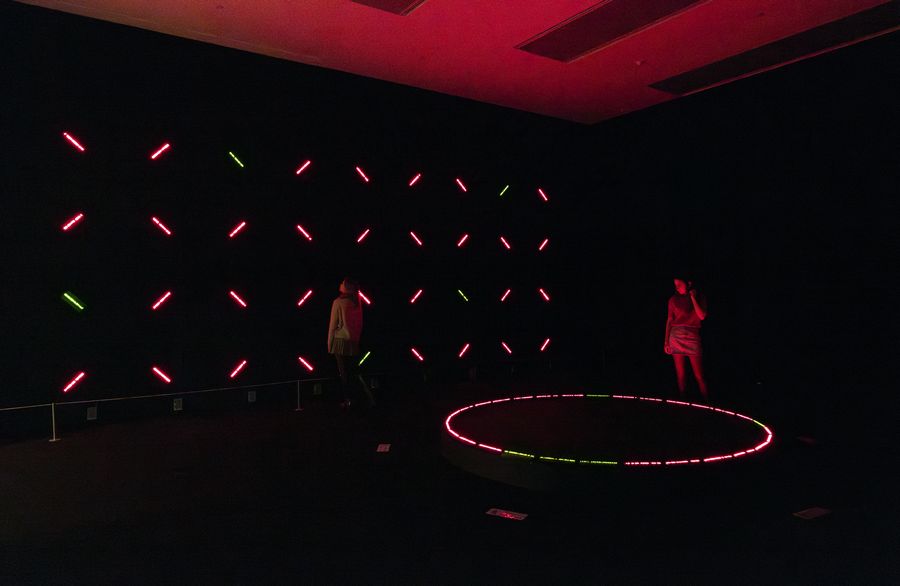
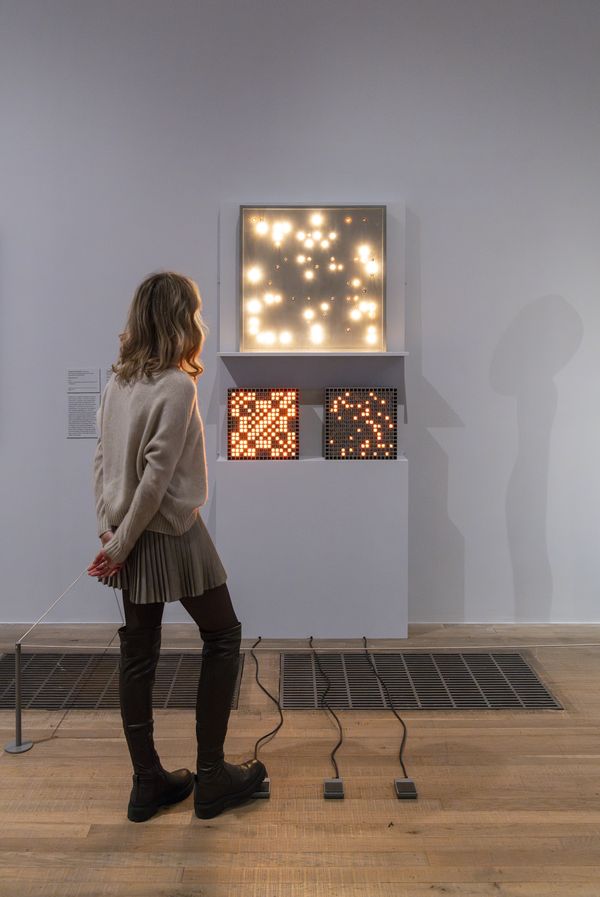
Lattice B and Opposite Circle (1990s) by Tatsuo Miyajima features two-digit LED counters arranged in geometric formations that count from 1 to 99 at varying speeds. The constantly shifting numbers evoke cycles of change and interconnectedness. Drawing from Buddhist philosophy, Miyajima uses technology as a means to explore impermanence, time, and life. His work is guided by three principles: keep changing, connect with everything, and continue forever.
Tatsuo Miyajima, Lattice B, 1990, and Opposite Circle, 1991. Installation view in Electric Dreams, Tate Modern, 2024-2025. Photo © Lucy Green/Tate
ELECTRONIC DIY
For many years, the only way artists and creative practitioners could access advanced technologies was by collaborating with the institutions and corporations that owned them. But by the late 1960s, the growing availability of consumer electronics allowed a new generation of artists to experiment with emerging tools on their own terms. This room explores how artists adopted a Do It Yourself (DIY) ethos—repurposing existing technologies, building new ones, and developing personal approaches to electronic media.
In the 1950s and 1960s, companies like Bell Labs and IBM hosted artist-in-residence programs that led to groundbreaking innovations. Rebecca Allen brought her artistic vision to software engineering, developing early motion capture and 3D modeling techniques. Nam June Paik, a pioneer of video art, collaborated on one of the first video synthesizers, expanding the creative potential of electronic image-making.
By the 1980s, the introduction of personal computers and commercial graphics software opened up new creative possibilities. Artists seized this moment of technological democratization to explore electronics outside institutional frameworks. Independent spaces like London’s New Arts Laboratory and Centro de Arte y Comunicación (CAYC) in Buenos Aires supported international collaboration and early experiments in video and “intermedia” work.
In Tokyo, the 1972 exhibition Video Communication: D.I.Y. Kit helped spark the formation of Video Hiroba, a collective that envisioned video technology as a shared, community-driven medium—an alternative to mass media. These efforts intersected with countercultural movements that rejected consumerism and corporate control over technological resources. Publications like Whole Earth Catalog and Radical Software encouraged people to develop technical skills and reclaim technology as a tool for creative and social empowerment.
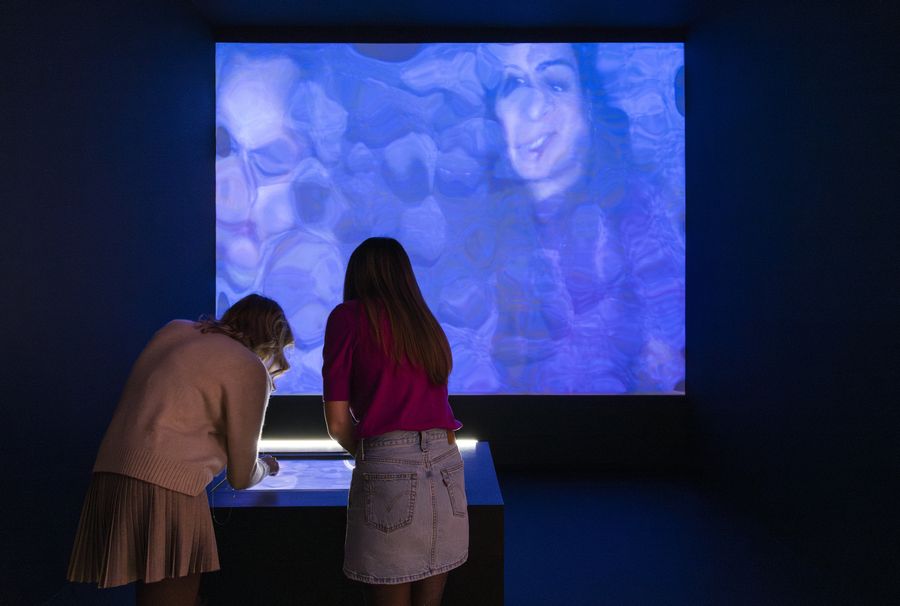
Liquid Views – Narcissus’ Digital Reflections (1992) by Monika Fleischmann and Wolfgang Strauss invites viewers to interact with their distorted digital reflection on a touchscreen simulating a pool of water. Using video texture mapping software, the work creates real-time visual effects, echoing the myth of Narcissus and exploring the relationship between personal perception and public visibility in the digital age.
Monika Fleischmann and Wolfgang Strauss, Liquid Views, 1992. Installation view in Electric Dreams, Tate Modern, 2024-2025. Photo © Lucy Green/Tate
SAMIA HALABY
Electric Dreams: Art and Technology Before the Internet also presents a collaboration between Tate Modern and Outernet London, featuring the renowned Palestinian-American artist Samia Halaby, bringing her vibrant digital works to the city. A pioneering figure in digital art since the 1980s, Halaby is known for her dynamic, geometric animations, originally created using early computer programming in the 1990s.
Two brand-new works by Halaby are presented for the first time, accompanied by the experimental and rhythmic sounds of celebrated electronic musician Four Tet. Halaby’s colorful kinetic works, which she calls «kinetic paintings,» are set to Four Tet’s layered, textured soundscapes, taking viewers on an immersive sensory journey.
The works are reimagined for the five 23,000 sq ft screens at Outernet, where they are presented using a computer program Halaby developed between 1990 and 1996. Halaby’s journey into creating kinetic works began when she taught herself to code on the Commodore Amiga 1000, one of the first widely available personal computers, released in 1985. For Halaby, these early technological developments open new possibilities, allowing her to push the boundaries of painting and explore new forms of visual language.

Works by
Rebecca Allen; Marina Apollonio; Manuel Barbadillo; Alberto Biasi; Vladimir Bonačić; Davide Boriani; Martha Boto; Pol Bury; Harold Cohen; Analívia Cordeiro; Waldemar Cordeiro; Carlos Cruz-Diez; Charles Csuri; Computer Technique Group; Dadamaino; Atul Desai; Lucia Di Luciano; Ivan Dryer and Elsa Garmire; E.A.T.; Monika Fleischmann and Wolfgang Strauss; Herbert W. Franke; Brion Gysin; Samia Halaby; Desmond Paul Henry; Hervé Huitric and Monique Nahas; Edward Ihnatowicz; Eduardo Kac; Hiroshi Kawano; Ben Laposky; Julio Le Parc; Ruth Leavitt; Liliane Lijn; Heinz Mack; Robert Mallary; Mary Martin; Almir Mavignier; Gustav Metzger; David Medalla; Tatsuo Miyajima; Manfred Mohr; Vera Molnar; François Morellet; Tomislav Mikulić, Fujiko Nakaya; Frieder Nake; Georg Nees; Akbar Padamsee; Nam June Paik and Jud Yalkut; Ivan Picelj; Otto Piene; Günther Uecker; Paolo Scheggi; Lillian F. Schwartz; Sonia Landy Sheridan; Aleksandar Srnec; Jesús Rafael Soto; Vera Spencer; Takis; Atsuko Tanaka; Jean Tinguely; Franciszka Themerson; Suzanne Treister; Wen-Ying Tsai; Grazia Varisco; Steina and Woody Vasulka; Mohsen Vaziri Moghaddam; Miguel Ángel Vidal; Nanda Vigo; Stephen Willats; Katsuhiro Yamaguchi; Lawrence Paul Yuxweluptun; Edward Zajec.
Curated by Val Ravaglia, Curator, International Art, and Odessa Warren, Assistant Curator, International Art (Hyundai Tate Research Centre: Transnational), Tate Modern, with Kira Wainstein, Research Assistant.

También te puede interesar
Apostando al Performance
RoseLee Goldberg ha sido sin duda una de las principales agentes del «renacimiento» y multiposicionamiento de la performance en los últimos años. Su investigación seminal Performance Art: From Futurism to the Present (publicada por primera vez en…
BRAIN FOREST QUIPU. CECILIA VICUÑA EN LA TATE MODERN
Dos grandes quipus tejidos que cuelgan a 27 metros de altura, audios con cantos tradicionales y músicas contemporáneas, videos protagonizados por comunidades indígenas y un ciclo de encuentros de activistas por el cambio climático,...
LA PERFORMATIVIDAD DE LA NATURALEZA. DE EDUARDO KAC AL BIOARTE EN ECUADOR
Alexandra Trujillo analiza de qué manera la obra pionera del artista transgénico Eduardo Kac ha influido en el surgimiento del bioarte en Ecuador, y cómo ha sido un gran referente para los artistas ecuatorianos...