

FROM THE FAVELA TO NOTTINGHAM: ALLAN WEBER’S ORDERS
With My Order, his first solo institutional exhibition outside Brazil, Allan Weber (Rio de Janeiro, 1992) steps firmly into the radar of the international contemporary art scene. Co-curated by Pablo León de la Barra, the exhibition at Nottingham Contemporary (UK) expands the power of his visual language into new geographies and cultural codes—without losing the intimate, communal and critical pulse that defines his practice.
Weber works from Cinco Bocas, a favela in Rio de Janeiro’s North Zone. His interest in art emerged through his encounters with pixação—a raw, charged form of urban lettering that asserts territory and belonging on the city’s walls—and with photography, which he discovered while skating. Since then, he has built a body of work grounded in the everyday life of the favela, driven by the desire to tell those stories from within, with honesty and closeness.
The exhibition is an immersion into the visible and invisible orders that shape daily life in Rio’s favelas and their transnational echoes, embodied in the figure of the food delivery worker turned cultural agent, urban chronicler and assembler of realities. Weber worked as a delivery rider during the pandemic, a survival job that sustained him while developing his artistic practice. Ideas of service, class, and labour thread through his recent works.
His practice—spanning installation, sculpture, photography, and deeply relational gestures—is rooted in the specific material culture of urban peripheries in Brazil. It draws on and reclaims materials and objects from those contexts: tents from baile funk parties, water tanks, insulated delivery backpacks, razor blades from popular barbershops. These elements acquire new meanings as Weber constructs a social and aesthetic cartography of identity and belonging.
The exhibition’s title, My Order, operates on multiple levels. It refers to the delivery orders Weber received when working as a food delivery rider. It also evokes the religious and doctrinal “order” that marked his upbringing in a Pentecostal Evangelical family. Finally, it signals a personal, self-determined order—one that fuses art and community as forms of resistance and survival in the favela. In this sense, the exhibition unfolds as both a political and a vital manifesto.
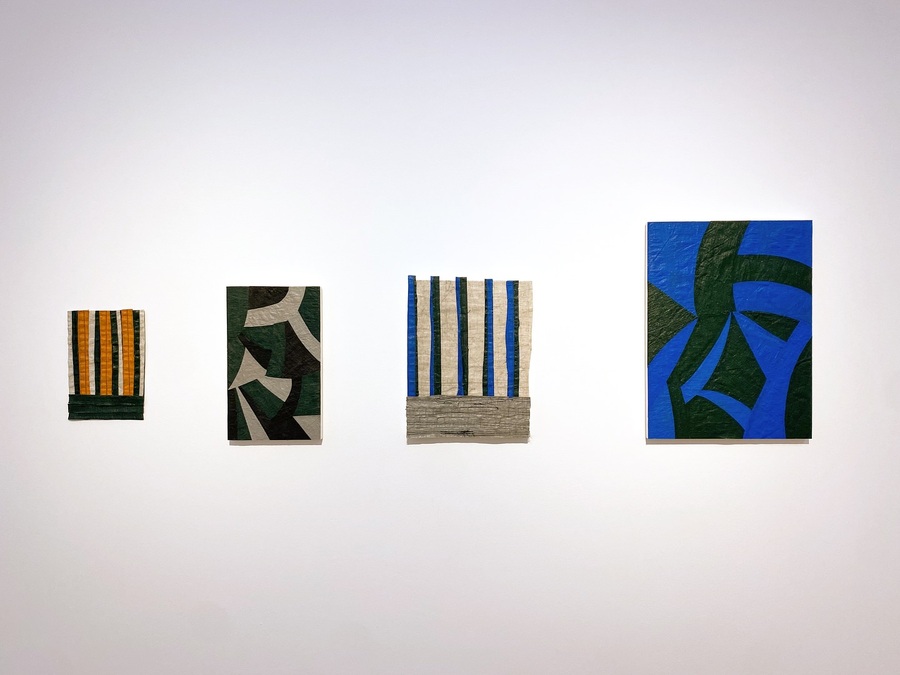
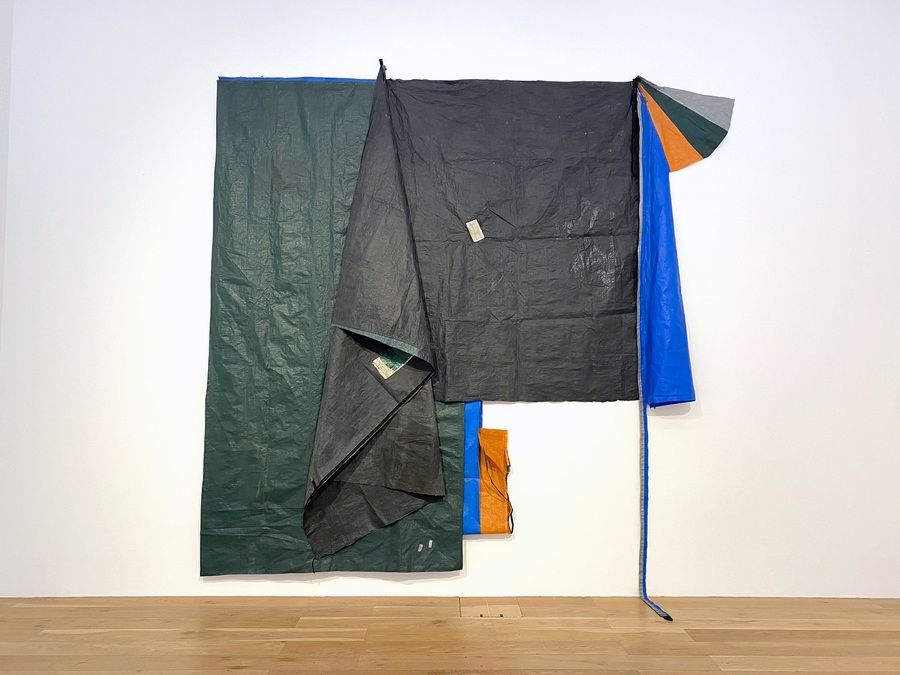
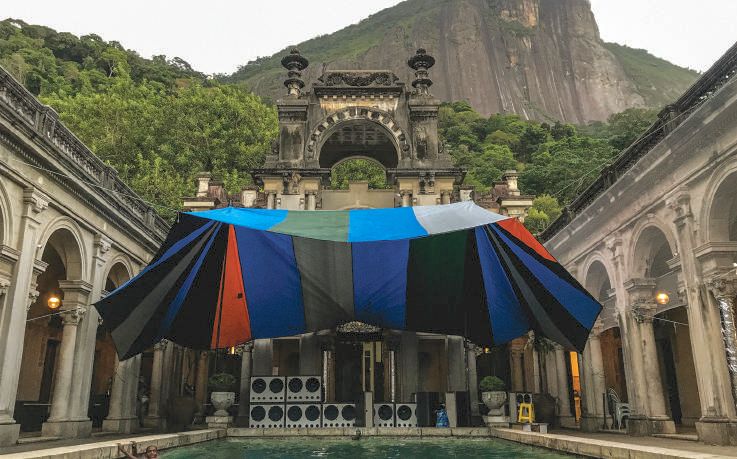
In the first gallery at Nottingham Contemporary, visitors encounter a selection of works made since 2020, many of which transform everyday objects to disrupt their function and symbolic charge. Among them is the series Día de Baile (2023), composed of colourful tarpaulins once used at baile funk parties—community celebrations often criminalised by the state.
These fabrics, cut, reassembled and framed, allude to both police violence and the aesthetic dimension of a musical culture that resists through dance and joy. Their colours and composition also recall the legacy of Brazilian Constructivism, which Weber subverts with irony—recasting its modernist association with progress, refinement and national identity through the lens of working-class celebration.
As the series has evolved, the festive tents have moved out of their frames and into the museum space, challenging its authority and injecting it with exuberance. In 2021, Weber installed a monumental 30 x 11 metre tarp over the central pool of Parque Lage—one of Rio’s main tourist attractions and home to a renowned art school.
The installation was part of a performative action: a real baile funk was staged, complete with sound, bodies, community and celebration. For the artist, the gesture inserted a historically marginalised event into a space “where poor people would only go to work, where children would never imagine diving into that pool.” The tarp—an object that usually announces an event: a party, a pagode, a birthday—here becomes a radical act of institutional reappropriation.
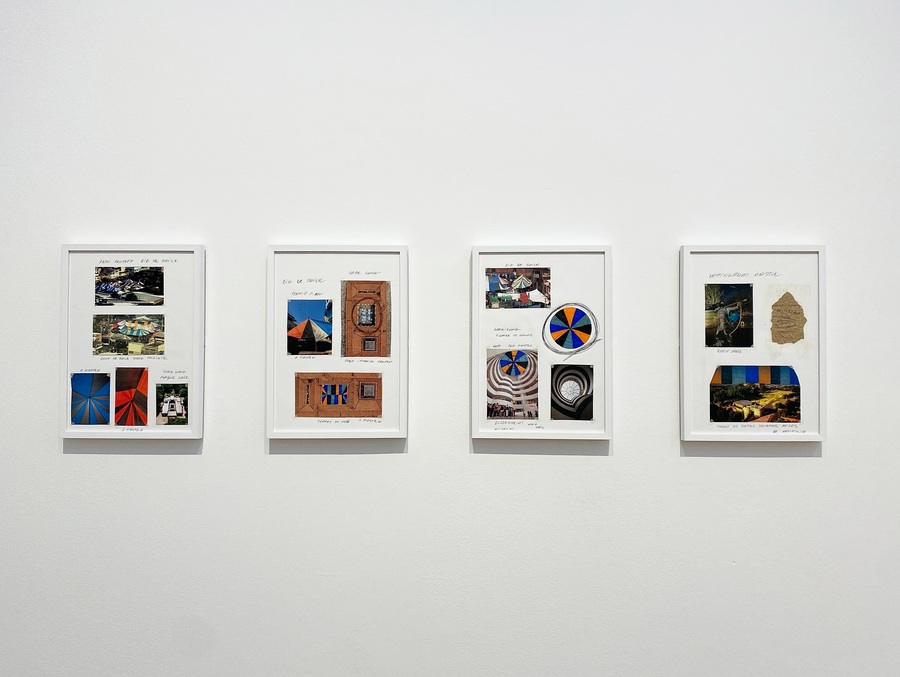
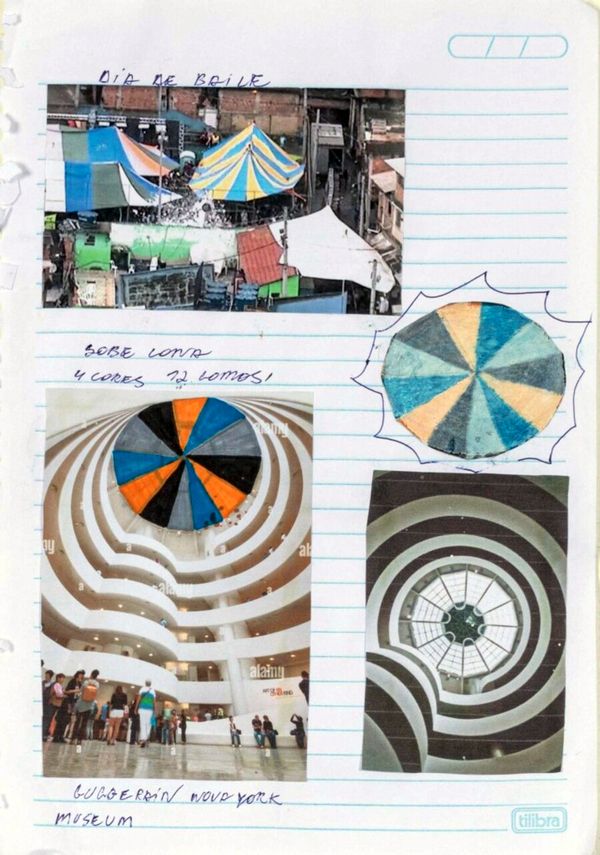
In a more speculative register, the Nottingham exhibition includes a series of collages where Weber imagines symbolic occupations of these party tents within art institutions like the Guggenheim Museum, where de la Barra works as curator.
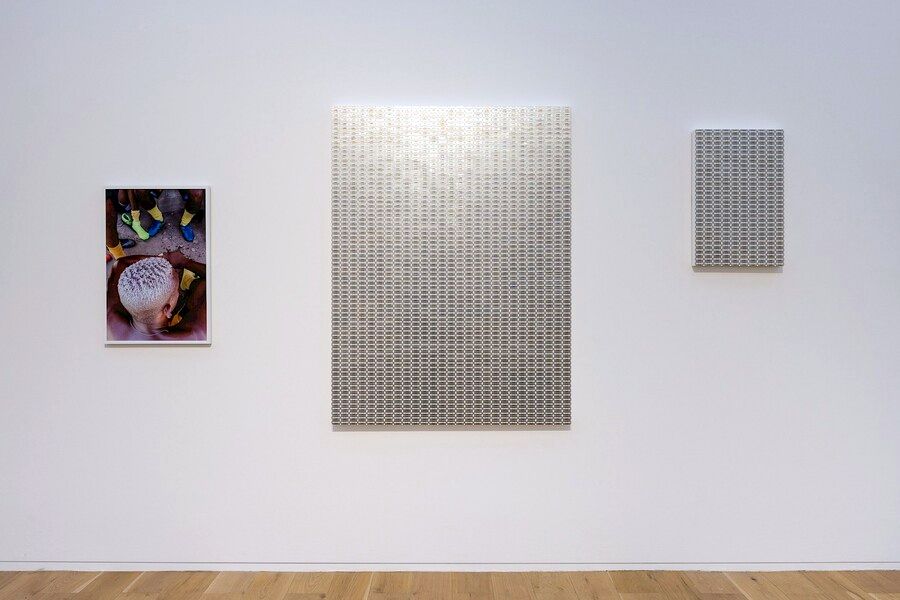
Another axis of the exhibition focuses on the figure of the barber and the aesthetics of razor haircuts—ubiquitous in working-class communities across Brazil and Latin America. These sharp hairstyles are a marker of style and pride, essential before going to funk parties. One wall display two minimalist, gleaming compositions made from razor blades, part of the ongoing series Traficando Arte (Trafficking Art).
This series draws parallels between drug trafficking and the art market, questioning notions of value—both monetary and symbolic—as well as systems of circulation and exchange. It also dialogues with Brazilian Neo-Concrete abstraction, but through a visceral materiality loaded with class and racial references.
On past occasions, Weber has priced these pieces by multiplying the number of blades by the cost of a haircut in his local barbershop, each blade standing in for a service. For the works created especially for this exhibition, he used Egyptian blades, inspired by the time he spent in Nottingham’s Arab barbershops. One of these pieces now hangs permanently in Arabian Barber, a local barbershop frequented by delivery riders, reinforcing the relational nature of Weber’s practice.
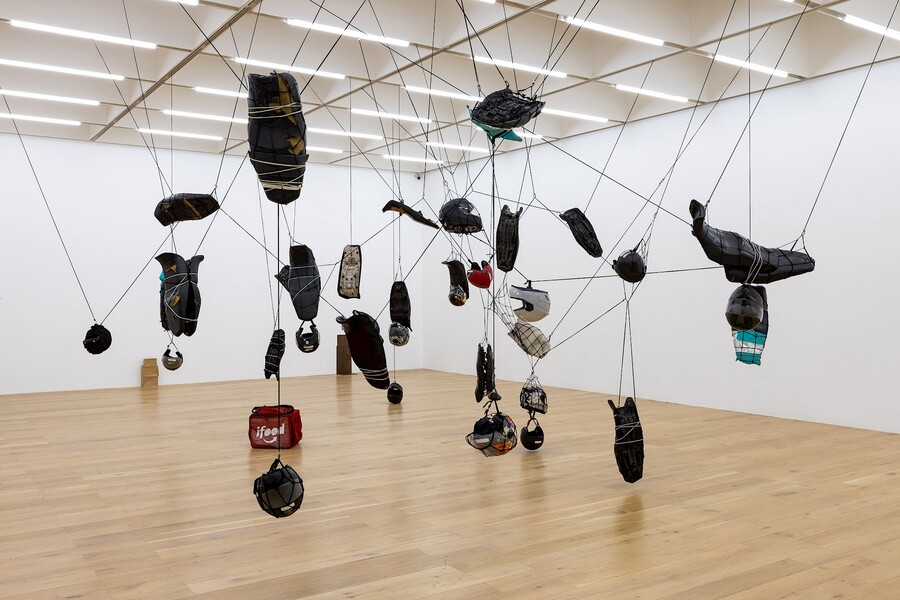


The second gallery brings together works produced during his one-month residency in Nottingham. Here, Weber shifts his focus to the UK’s network of deliverymen, embedding himself in the local scene and documenting their routes with second-hand cameras. In doing so, he broadens his investigation into app-mediated economies, foregrounding a contemporary mode of labour precarity. While not traditionally classified as informal, this work reproduces many of its logics: forced flexibility, relative autonomy, and deep dependency on technological platforms that mediate, regulate—and often exploit—the relationship between worker and client.
The centrepiece of this room is a suspended installation of helmets, backpacks, motorcycle seats and other delivery gear, all collected in Nottingham. Held together by elastic cords, these elements form an aerial sculpture that speaks to the precariousness of this job. Entangled in a symbolic network of labour and affect, the objects “elevate” the gig economy through a forceful visual metaphor. For Weber, immersing himself in the world of local riders is as much part of the artwork as the installation itself.
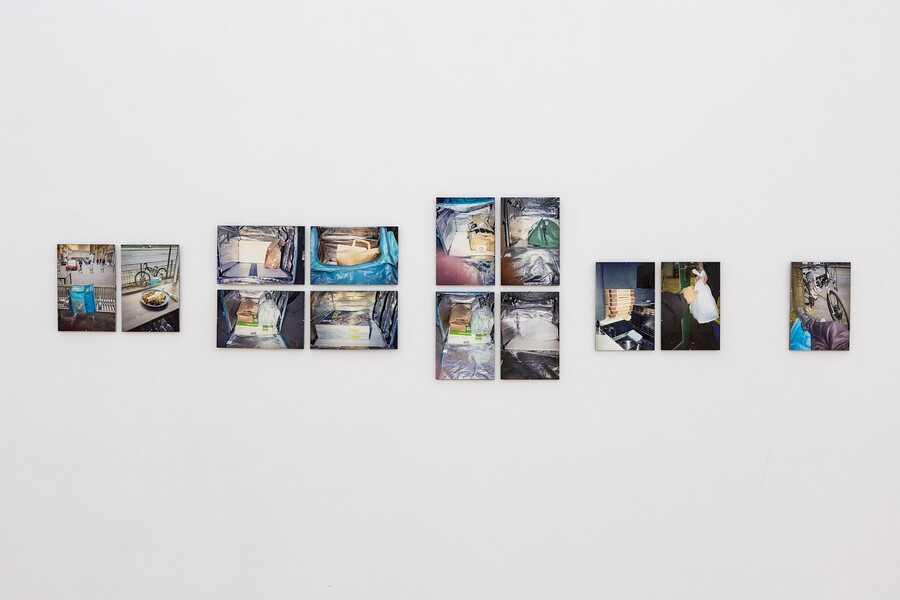
Hanging nearby are photographs from Weber’s own time as a delivery worker in Rio, when the aluminised interior of his thermal backpack served as a portable gallery. These images speak to other backpacks placed on the floor, one of which holds a lo-fi video showing children flying kites on a hot day. By storing these moving images inside the delivery bag, Weber reimagines it as a container of affection, leisure, and neighbourhood resistance. The delivery’s journey becomes a bridge between Rio and Nottingham—a traffic of images and lived realities.
Nearby sculptures—stacked seats, repurposed paper bags—blur the line between the utilitarian and the conceptual, gesturing towards the circulation of goods, the anonymity of invisible labour, and the fragility of the bodies that uphold these systems. There is something deeply ethical in the way Weber inserts himself into foreign contexts—not by exoticising or superficially aestheticising them, but by cultivating affective bonds and symbolic cohabitation.
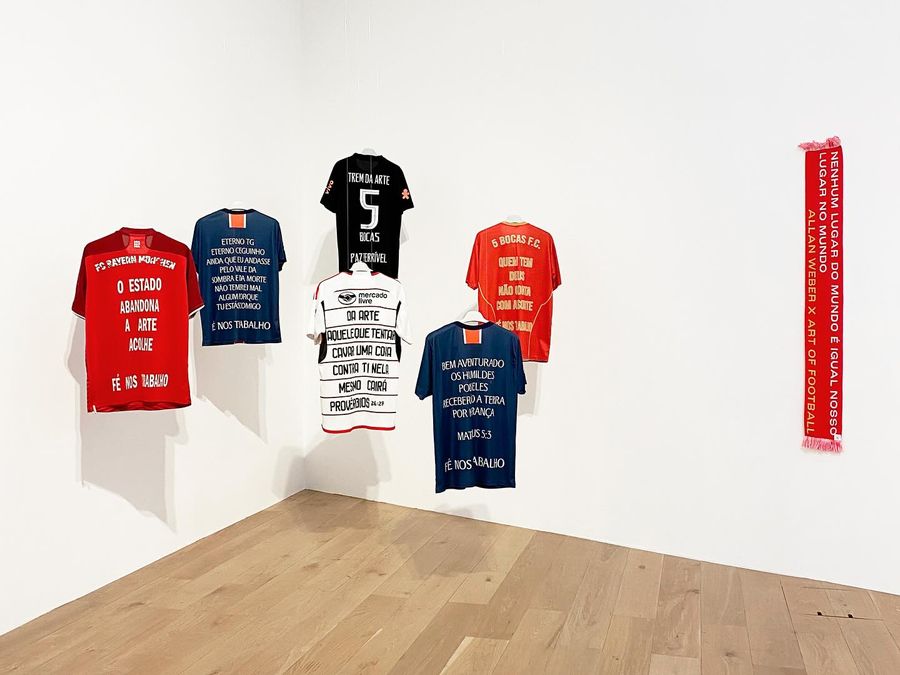
In 2020, during the pandemic, Weber founded an art gallery in his own neighbourhood, 5 Bocas, to bring art closer to the community as an alternative mode of subsistence. As part of this initiative, he created Cinco Bocas FC, a youth football team that gathers at the gallery before and after matches. The project merges art and sport as strategies to forge affective ties, a sense of belonging, and pathways beyond circuits of exclusion.
Emerging from this synthesis of art and football—and from his childhood fascination with football paraphernalia—Weber designs customised t-shirts for the team, each bearing its own vocabulary: biblical verses, popular proverbs, poetic phrases, and personal maxims that honour friends and family.
Each shirt functions as a portable manifesto—much like the delivery backpacks—where Evangelical spirituality meets the visual codes of sport and the gig economy. These garments not only dress bodies but also carry narratives: of the neighbourhood, of faith, of play as redemption. They circulate meanings in contexts where the written word holds both moral and emotional weight.
This series expands through a collaboration with Nottingham-based streetwear label Art of Football (AOF). In dialogue with the AOF team, Weber co-designed a football scarf now available at the Nottingham Contemporary shop. A quintessential object of football passion—and also a commodity—the scarf here becomes a critical emblem: an art object that weaves together memory, belonging, and resistance to the structural violences shaping life across both the Global North and South. The phrase emblazoned on it, “nenhum lugar do mundo é igual nosso lugar no mundo” [“nowhere in the world is like our place in the world”], crystallises this politics of rootedness, affirming the ties between territory, identity, and community.
Allan Weber brings the reality and imagery of the favela into the global contemporary art circuit—My Order will next travel to the De La Warr Pavilion in East Sussex—without diluting or translating its codes, and without softening their impact. From street visualities to the ephemeral architectures of baile funk, and through objects that engage critically with the legacy of Brazilian Concretism from a position of precarity and survival, his work dismantles the hegemonic languages of art and makes them speak in a different register—one that emerges from the South, from the margins, from the collective body.
At a time when discourses around socially engaged art risk becoming formulaic or slogan-driven, Allan’s work feels urgent, sincere and complex. It does not aestheticize poverty, nor does it romanticize the “margins”; neither does it fall into pamphleteering critique. What it offers is a radically situated body of work—one that, from the specificity of its territory, speaks powerfully to global tensions between labour, art, and life in common.

También te puede interesar
Midnight Moment:a Logo For America, de Nuevo en Times Square
A las 10:30 de la noche del pasado jueves 18 de agosto, un grupo de personas nos reunimos en el Lambs Club de la calle 44, el emblemático edificio diseñado por Stanford White que…
ZAHY TENTEHAR. MÁQUINA ANCESTRAL: UREIPY
Throughout her video practice, Tentehar has spoken about the Guajajara social movement known as the Guardians of the Forest, a group that inhabits and protects Arariboia Indigenous Land located in the north-eastern edge of...
ABUBUYÁ
Abubuyá, libro editado por el curador chileno Rodolfo Andaur, entrega diversas reflexiones sobre lo ocurrido en el Workshop Internacional de Artistas Km 0, organizado por Kiosko Galería (Santa Cruz de la Sierra, Bolivia).