
Mariana Castillo Deball:finding Oneself Outside
Working in sculpture, printmaking, photography, and installation, Mariana Castillo Deball (b. 1975, Mexico City, Mexico) examines how knowledge and cultural heritage are produced, organized, measured, and authenticated. Her works often take inspiration from Mesoamerican iconography and narratives, considering their early-colonial transformations and their presence in Central America today.
Exploring her philosophical interest in time and space as well as cosmology and depictions of natural order, Castillo Deball has engaged a diverse range of scholars in her research. Her works and installations often reflect Surrealist writer Roger Caillois’s notion of “diagonal sciences”—unusual cross-sections of the world that reveal what he called “neglected correlations,” and “tissues of thought.”
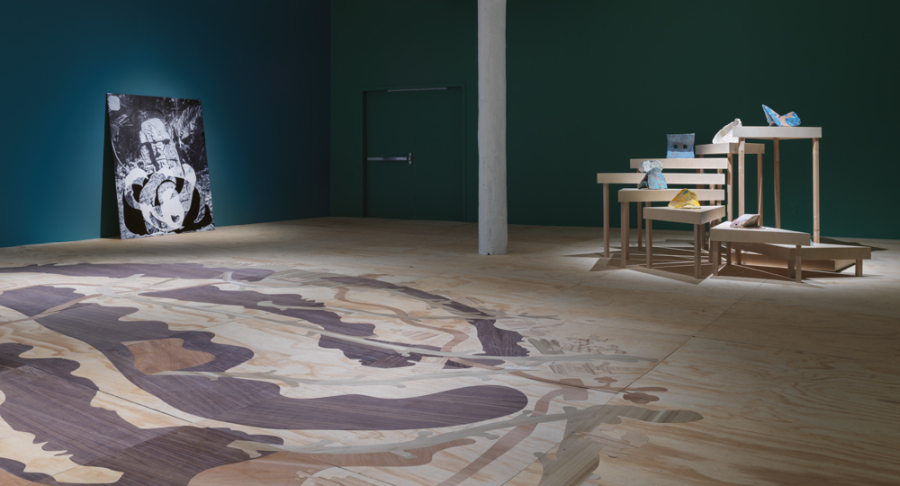
The title of Castillo Deball’s New Museum exhibition, Finding Oneself Outside, offers a possible description of a sensation that is central to both the study of history and the experience of encountering an unfamiliar culture. The exhibition’s centerpiece, a specially commissioned inlaid wood floor installation, draws from an early colonial map of San Pedro Teozacoalco, Mexico, which bears a unique stylistic blend of European maps and Mixtec codices of the sixteenth century.
The Map of Teozacoalco is fascinating in part because it represents not only a spatial domain but a temporal one as well, depicting the historical and mythical journeys of the people within it. While the author of the original map is unknown, some anthropologists have speculated that it was likely the product of collaboration between a Mixtec cartographer, or tlacuilo, and a colonial administrator, as the map bears a unique stylistic blend of European maps and Mixtec codices of the sixteenth century. The Map of Teozacoalco is also striking because it unveils a misunderstanding in what was actually being depicted of this place in New Spain: While the cartographer of the Spanish Crown had hoped for detailed records and maps made with astronomical references, what this map in fact offers is more a portrait of a community—a people and a past—than a simple survey of land.
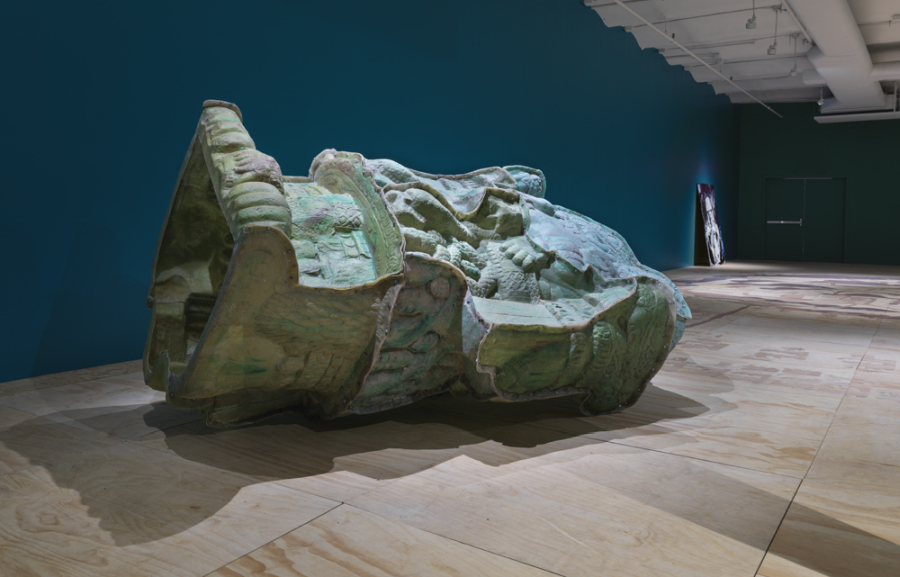
Uncomfortably positioned between a cast and a mold, Castillo Deball’s large-scale fiberglass sculpture, No solid form can contain you (2010), alludes to questions of authenticity, reproduction, and how knowledge of certain cultural artifacts is acquired through the circulation of models and copies. This work also offers a peculiar visualization of space as a would-be mold turned inside out— panels cast from a statue of Coatlicue [koh-at-lee-kway], the Mexica, or Aztec, mother goddess of earth and death, are inverted to reveal their concave sides and reassembled to create a hollow figure.
The sculpture’s form and process of production invokes the technique of paper molding, a method of documentation developed in the 1860s to capture the facades of archaeological monuments in lightweight and portable forms that could later be used to cast a positive. In many instances, these molds and replicas are the only remaining record of monuments that have since been destroyed. Castillo Deball’s work was similarly made in collaboration with a Mexican family that has, for three generations, produced reproductions of archaeological objects.
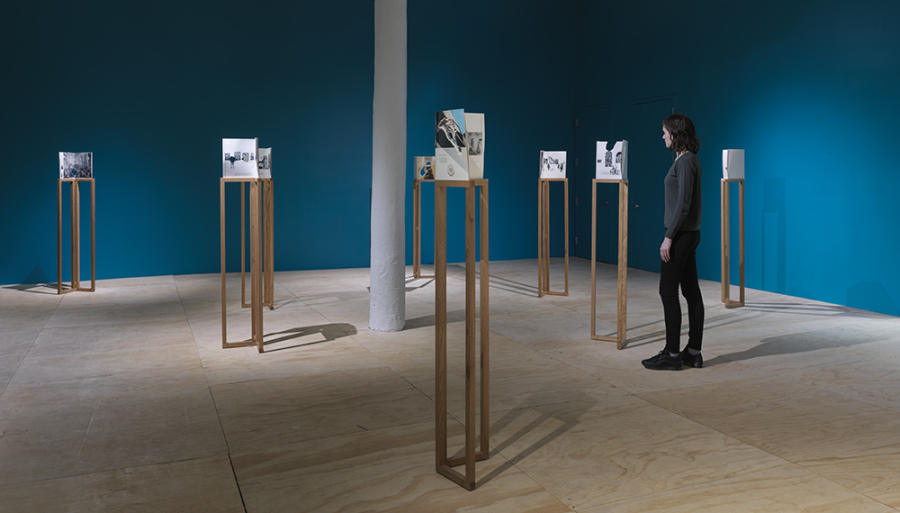
With Do ut des (2014–19), Castillo Deball alludes to the creative potential of estrangement and the interdependence of art and its viewers, as evoked by the title borrowed from a Latin phrase meaning, “I give so that you will give.” In this ongoing body of work, Castillo Deball bores holes and cavities in a series of books from the late 1960s called El Mundo de Los Museos (The world of museums) conceived by Brazilian designer Eugênio Hirsch. Each book features works from a particular institution’s collection, shown in relation to a human figure, revealing to the reader the perspective and scale on which a hypothetical viewer would encounter these works in a museum.
Castillo Deball’s excavations into these books double as Rorschach-like cross sections, which contrast the works visible on the books’ pages. Unlike the works housed in these museums’ collections, which demand a certain art historical knowledge on the part of the viewer, there is little prerequisite knowledge of cultural codes or symbols required for the interpretation of these ambiguous shapes. As the artist views it, these forms appeal instead to the imaginative process that is at the root of creative interpretation. As she sees it, a similar oscillation between knowing and not knowing generates a sense of estrangement that is essential to the creative process, both for artists and for viewers, because it allows for the possibility of new interpretations and correspondences between works and ideas.

Made using scagliola, a marble imitation technique that involves a special composite of plaster, rabbit glue, and natural pigments, the forms of Castillo Deball’s Mathematical Distortions, like those of mathematician Felix Klein’s models, reflect the limitations of matter by representing surfaces that do not exist—and in some cases, shapes that, like the Klein bottle, have no outside or inside. In the context of Castillo Deball’s exhibition, these objects speak to the potential of thinking across disciplines—and across dimensions of space—to reexamine notions of orientation and boundaries and how their theoretical absence could altogether undermine the validity and scope of our knowledge.
MARIANA CASTILLO DEBALL: FINDING ONESELF OUTSIDE
This exhibition is curated by Natalie Bell, Associate Curator.
New Museum, 235 Bowery, New York, NY
January 22–April 14, 2019
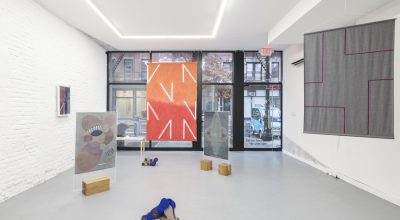
Featured image: Mariana Castillo Deball, Finding Oneself Outside. Exhibition view: New Museum, New York, 2019. Photo: Maris Hutchinson / EPW Studio

También te puede interesar

LOIE HOLLOWELL: GOING SOFT
Loie Hollowell’s pastel drawings for "Going Soft" explore the physical and psychological experiences of pregnancy, birth, and postpartum. Serving as abstracted self-portraits, each drawing reveals the artist's interior psyche at the time of the...
HASTA QUE LOS CANTOS BROTEN. MÉXICO EN LA BIENAL DE VENECIA
"Hasta que los cantos broten" no es una hipótesis ni una manifestación de alineación política, sino un esfuerzo de apertura a favor de lo que surge en el ‘ser con’, en lugar de simplemente...
Johanna Unzueta & Felipe Mujica:where Land And Sea Melt Into Sky
New York-based gallery Proxyco presents "Where Land and Sea Melt into Sky", an exhibition of works by artists Johanna Unzueta (Chile, 1974) and Felipe Mujica (Chile, 1974). The exhibition foregrounds the notion of the...