
MARIO GARCÍA TORRES: A HISTORY OF INFLUENCE
Much of Mario García Torres’s art takes as its starting point the works and cultural expressions of the recent past, particularly those associated with Conceptual Art, Arte Povera, and institutional critique. Working across various media—such as film, slide projections, photography, sound, text, sculpture, and painting—he analyzes artistic material (including works, documents, positions, strategies, and myths) to imagine new (hi)stories. In doing so, García Torres (b. 1975, Mexico) offers unconventional perspectives on the past and challenges supposedly universal truths. His works are often infused with a subtle, sharp-witted sense of humor.
With A History of Influence, the Fridericianum presents García Torres’s first institutional solo exhibition in Germany.
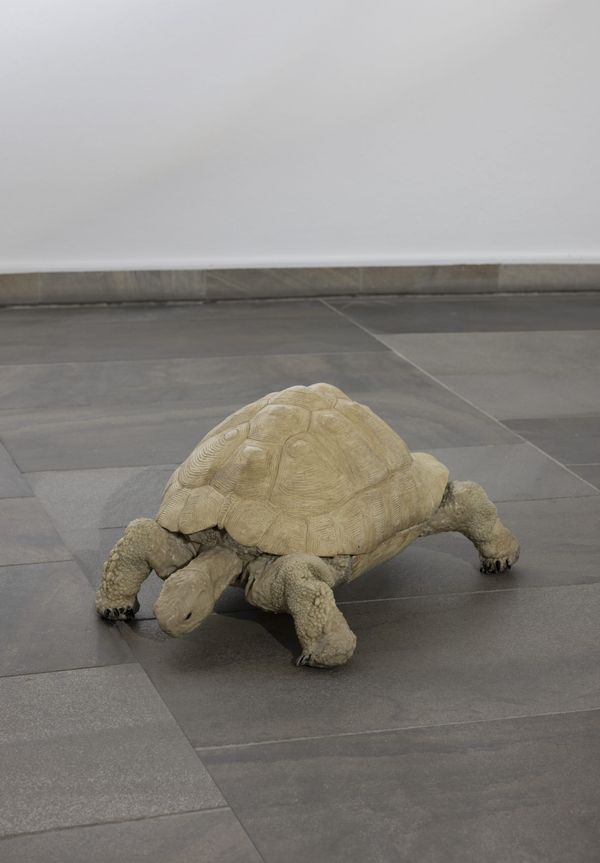
The García Torres show starts with various pieces displayed in the Rotunda that are part of the undated group of works entitled The Cordiality Paradox. These revolve around insoluble contradictions, that is, paradoxes, forging a bridge to positions in 1960s art, such as that of Italian artist Michelangelo Pistoletto (b.1933) and his piece Metrocubo d’infinito (1966) [A cubic meter of infinity]. García Torres’s work group includes sculptures made of glass and metal, a mobile robot tortoise, a light ballet, and a literary piece that is presented in the Fridericianum in the form of a manuscript.
The latter forms the launchpad for the group of works and was produced in collaboration with the comedian and director Eduardo Donjuan (b.1978). It tells the story of a math professor who, by chance, makes the acquaintance of an artist and then repeatedly encounters people from the creative world. For example, during his university teaching he is asked to teach math to art students. In this context, he tasks one of the class participants, an up-and-coming poet, to draw an infinite line.
On the lecture-hall blackboard, the student then makes three attempts, whereby her failure is documented in the brass work entitled Three Attempts at Drawing an Infinite Straight Line. She then tries again and draws a line acrossthe board, the wall, and out of the hall until she disappears. Months later she returns, still holding the writing utensil in her hand, and thus suggests she has solved the task, even if the solution is not tangible.
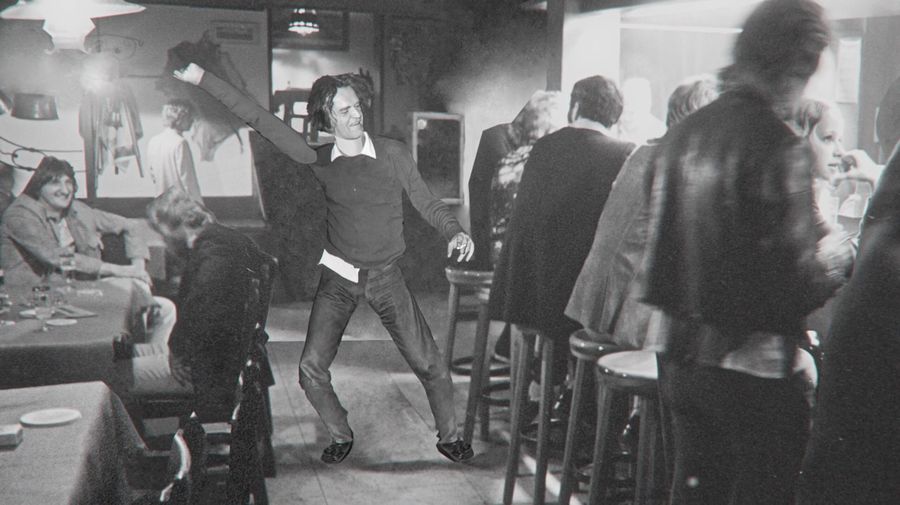
The Cordiality Paradox is followed in the central gallery hall by Merz, Rzemmmm, Zeeeeerm, Emrzzzzzz (At Fibonacci Pace). The title is reminiscent of a Dadaist sound poem, and the workpays homage to Italian artist Mario Merz (1925–2003). It is based on an image by Swiss photographer Balthasar Burkhard, showing Merz in the Standuhr bar that once existed on Kassel’s Fünffensterstrasse and which the Italian frequented during the installation work for documenta 5 (1972).
García Torres used the historical photo, which he found during research in the Harald Szeemann Archive at the Getty Research Institute in Los Angeles, to make a film: he animated the scenery so that in the course of the sequence Merz engages in an ever more frenzied dance. The moving images are accompanied by electronic sounds composed by Mexican musician Sol Oosel (b.1977) that likewise pick up their pace.
Taken together, with their steady increase in pace, the two interpret the infinite sequence number proposed by mathematician Leonardo Fibonacci (c. 1170–c. 1240), which Merz frequently cited in his works in order to outline the principle of progression. With his work, García Torres transforms the static momentum of photography into a dynamic narrative that metaphorically alludes to the essence of the artistic person.
Viewers in the central gallery only participate passively in Mario Merz’s dance, but in the next hall they are given an opportunity to play an active part and themselves perform rhythmic movements. There, a somehow nostalgic motto made up of countless lightbulbs encourages effusive physical movements without there being any musical sounds audible.

García Torres made this light sculpture in 2006: it displays the word “Moonwalk” and flickers and blinks to the silent rhythm of the song El Músico Chiflado by Mexican musician Rigo Tovar (1946–2005). He was one of several people who made the “Moonwalk” popular before Michael Jackson (1958–2009), who is now indelibly associated with the special dance move and made it world famous. The word formed by the lamp bulbs is not only related to Tovar’s “Moonwalk,” it likewise refers to the Mexican musician’s opulent stage sets, in which his name often formed the background, composed of illuminated letters.
García Torres’s light sculpture and the photographic instructions made in 2006, presented in a niche in the wall and entitled Moonwalk Lessons (Rigo Style), provide food for reflective thought on canons, developments, influences, appropriations, mutual relationships, and learning from one another.
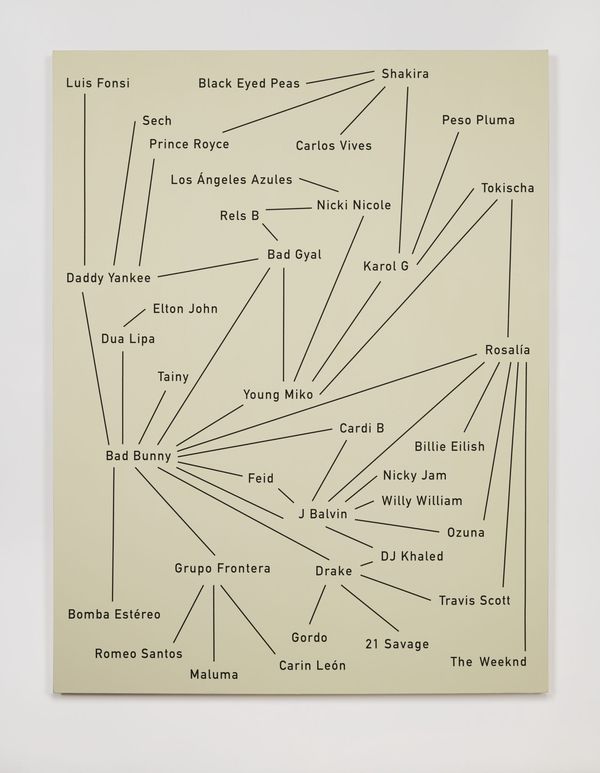
n.d. Acrylic, silkscreen and wax on canvas, 170 x 131 cm. Photo: Omar Bocanegra, Mexico City © Mario García Torres. Courtesy the artist; neugerriemschneider, Berlin
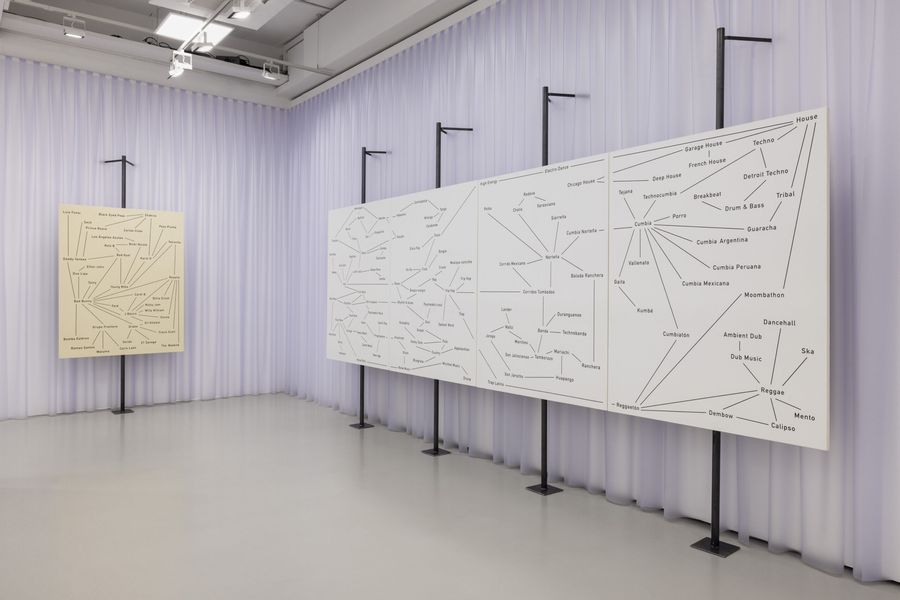
These themes also inform García Torres’s most recent works on canvas, made in 2024 and 2025, which are displayed in the next section of the exhibition. They consist of polyptychs, works made up of several panels that he has produced using silkscreen printing. They record countless names of musicians, dances, and musical genres, which are linked by lines to highlight dependencies, interdependencies, and changes. For example, they forge interlinkages between Michael Jackson, Quincy Jones (1933–2004), Donna Summer (1948–2012), and Beyoncé (b.1981), or between Hard Rock, Punk, Dance Punk, New Wave, and Synth Pop.
In terms of their specific thrust and design, García Torres’s images bring to mind display boards used in school or university classes and thus reference social conventions, education, training, and the genesis and transfer of knowledge. The lists by no means follow some conventional set of rules. Rather, they reflect García Torres’s personal perspective and to this extent comprise the attempt to declare the validity of new, alternative structures and agreements. The works are embedded in an installation-like layout that resembles a history lesson. García Torres has, for example, created a scenic setting in which to display his paintings with translucent curtains and sculptural mounts that point directly to the first documenta in 1955, which was explicitly intended to visualize (lost) historical processes.
The undated filmic piece Falling Together in Time, which follows on from the time travel back into the 20th century, takes a completely different point of departure. The piece runs to about 15 minutes in length and is presented on two large LED screens like those used for stage concerts. It amounts to a video essay that addresses issues of synchronicity, coincidence, and the subjective perception of time. It takes as its starting point Jump, the 1980s hit single by US hard rock band Van Halen that has long since become part of the collective music memory.
García Torres is less interested in the song itself and more in the unexpected linkages and coincidences that have arisen around it. He identifies a series of astonishing links between Van Halen and otherwise independent figures and events. For example, he discerns references to Muhammad Ali (1942– 2016), one of history’s greatest boxing legends, and to a trucker from Manchester.

Such links may seem arbitrary at first sight, but in García Torres’s essay they gain significance from their parallel temporal and thematic overlaps. The filmic piece combines elements of philosophy, Pop culture, and historiography in order to weave a complex narrative about the simultaneous existence of events that possibly have no direct causal relationship to one another but nevertheless and surprisingly resonate with one another.
By rendering these chance parallels visible, García Torres challenges us viewers to reconsider our own perception of time and history. Falling Together in Time can be read as a response to the way meanings shift when they are placed in anew context. The work shows how our perception is influenced by reality, what connections we make between individual moments, and that precisely these seemingly chance overlaps may function as the gateway to a deeper understanding of the world.
The absorbing, immersive effect of Falling Together in Time, which forms the endpoint in the northwest wing of the Fridericianum, contrasts with the essentially silent, empathetic formulations presented in the southeast section. These works all center on the character of Xoco, which can be experienced in two separate spaces directly next to the central gallery hall. They arose against the backdrop of García Torres’s participation in documenta 13 (2012), when he was on a sabbatical year to recharge the creative energy he needed for his artistic practice. The works therefore relate to the question of what impact a major exhibition that takes place every five years can have on an individual.
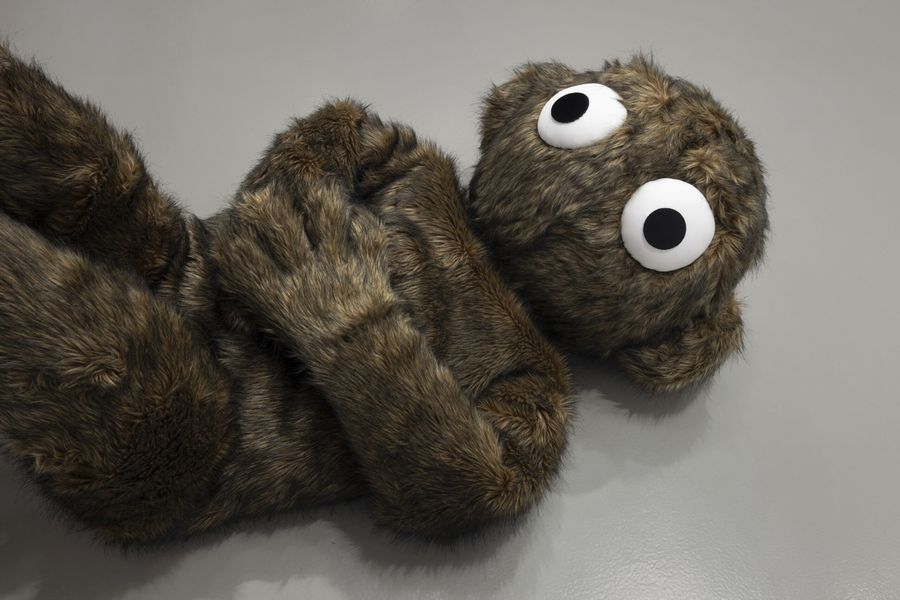
Xoco, the protagonist of both pieces, is a fluffy creature with outsized eyes who could have popped out of a children’s TV series. He crops up twice in the exhibitions: first, he is the central character in the 2012 cartoon film Xoco, The Kid Who Loved Being Bored, whose images were designed by Tomoko Hirasawa (b.1982), with Sol Ooselcontributing the accompanying music. The film, which will be screened within the exhibition in a room built to conform to children’s scale, narrates Xoco’s emotional world and describes the beauty and use of boredom, which can give rise to creative potential.
A similar narrative forms the basis for the performance he devised in 2021 and entitled Xoco está aburrido [Xoco is bored], which marks the creature’s second appearance here. In that framework,we watch the shaggy, larger-than-life Xoco listlessly trotting round the rooms, sluggishly leaning against walls, or lying lethargically on the floor—stimuli for introspection intended to inspire.
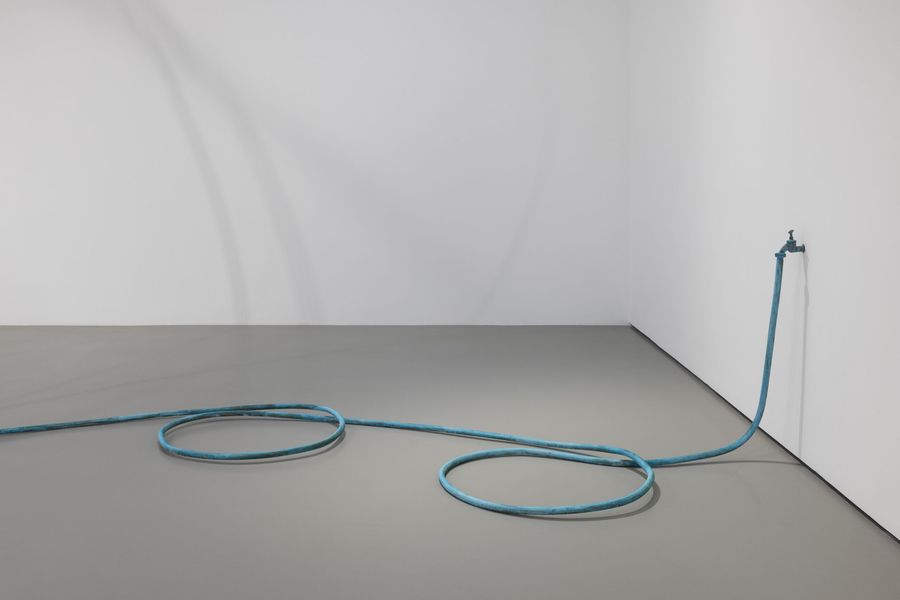
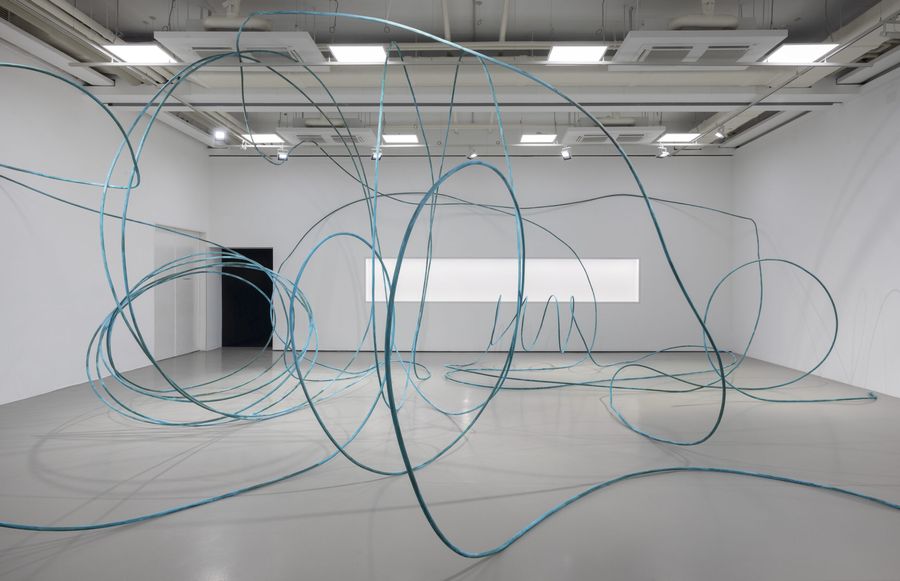
The expansive undated sculpture Manifestazione tangibile di una fantasia mentale [Tangible manifestation of a mental fantasy] directs our attention away from Xoco to the next suite of rooms and offers a perspective on another central field of García Torres’s work. Thus, the piece made of patinated copper that takes the shape of an infinitely long, tangled garden hose, functions as an homage to Italian artist Alighiero Boetti (1940–1994), to whom García Torres dedicated a whole series of works.
His sculpture immediately brings to mind Boetti’s piece Autoritratto (Mi Fuma Il Cervello) [Self-Portrait (My Brain’s Smoking)] made in 1993–94. As the title intimates, the pieceis a self-portrait of Boetti. In the form of a bronze statue, it presents the Italian artist standing in a slight contraposto stance. Clad in a loose suit, he holds a garden hose in his right hand and is squirting an arc of water over his head. There, heating elements embedded in his head transform most of the water into steam that is borne away by the air currents, while the remaining water drips down him in liquid form.
With this unusual but very striking image, Boetti alludes to the theme of innovative creation, the search for new thoughts that is so decisive for all creative minds. With manifest irony, García Torres takes up the theme in his own piece. And in the process, he exaggerates it in a way that might give one the impression that the garden hose has acquired a life of its own—has emancipated itself—and, in search of inspiration, is all wildly tangled up, and has gone mad.
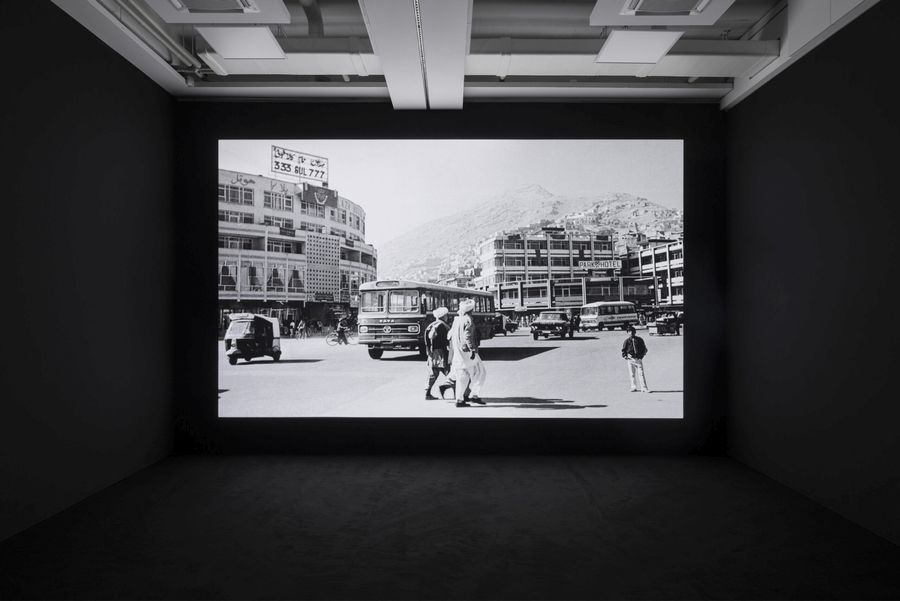
Made in 2010, the piece entitled ¿Alguna vez has visto la nieve caer? [Have you ever seen the snow?] also references Boetti. It was one of the main elements in García Torres’s presentation at documenta 13, and for the Mexican artist’s solo exhibition at Fridericianum it has been arranged with the same original spatial configuration that it had in the context of the large exhibition in Kassel.
¿Alguna vez has visto la nieve caer? is the outcome of García Torres’s many years spent searching for a mysterious place in Kabul, Afghanistan—namely the One Hotel. It was Boetti who ran the hotel there from about 1972 until 1979, shortly before the Soviet invasion of the country. For many years, the hotel was thought to have been destroyed, its exact address had not been documented, and only a few photographs and reports by Boetti’s companions attested to its existence.
The work García Torres created consists of a slide show in which he combines documentation and fiction. Using photographs by third parties, among other things, the Mexican artist set out to locate the One Hotel—a project that proved remarkably difficult, as Kabul’s urban fabric had changed drastically owing to the decades of war.
Personal exploration and comparisons with surviving photographs enabled him eventually to collect visual evidence for the existence of the hotel, even if he himself never reached it. In the narrative of images, to which he contributes the off-screen voice of the storyteller, García Torres thus reflects not only on Boetti’s legendary project, but also on the process of searching and seeing, and on photography as a medium.
In this way, Alguna vez has visto la nieve caer? becomes a meditation on memory, time, and the way we use images to construct, interpret, and feel history. This can be considered not least one of the overarching themes of the García Torres exhibition in Fridericianum, which constitutes not only a long, meandering walk through his oeuvre, but also, given the many references to art history and Kassel, through the seven decades of the documenta’s history.
With A History of Influence, the exhibition sets the tone for Documenta’s 70th anniversary celebrations — and the Mexican artist knows the terrain well. Back in 2012, García Torres took part in Documenta 13 in Kassel, curated by Carolyn Christov-Bakargiev.
García Torres’s institutional debut in Germany builds on a series of solo museum exhibitions held around the world in recognition of his artistic oeuvre. These include Stedelijk Museum Amsterdam (2007); Kunsthalle Zürich (2008); CCA Wattis Institute for Contemporary Arts in San Francisco (2009); BAMPFA—Berkeley Art Museum and Pacific Film Archive (2009); Galerie Nationale de Jeu de Paume in Paris (2009); Museo Nacional Centro de Arte Reina Sofía in Madrid (2010); Madre— Museo d’Arte Contemporanea Donna Regina in Naples (2013); Hammer Museum in Los Angeles (2014); Pérez Art Museum in Miami (2014); Modern Art Museum of Fort Worth (2015); Museo Tamayo in Mexico City (2016); TBA21 Thyssen-Bornemisza Art Contemporary in Vienna (2016); Walker Art Center in Minneapolis (2018); WIELS—Centre for Contemporary Art in Brussels (2019); Museo Jumex in Mexico City (2020); MARCO—Museo de Arte Contemporáneo de Monterrey (2021); and Arte Abierto in Mexico City (2024).
MARIO GARCÍA TORRES: A HISTORY OF INFLUENCE
March 15 – July 27, 2025
Entrevista a Mario García Torres por Carolina Castro Jorquera (2014, español)

También te puede interesar

ISA CARRILLO, CIRCE IRASEMA, LUCÍA VIDALES: TERRA PRETA
"Terra Preta" presents the work of three Mexican artists to consider the sacredness of fertile soil and the relevance of ancient wisdom. Through depictions of Mesoamerican mythology and deity representation, the examination of the...
HECTOR DIONICIO MENDOZA: BUSCANDO FUTURO
As an artist, curator, and educator based in the agricultural community of the Salinas Valley in California, Dionicio Mendoza (b.1969, Uruapan, Michoacan, MX) embraces Latinx/e futurism while exploring themes of migration and the environment,...

Almost Solid Light:new Work From Mexico
Paul Kasmin Gallery (New York) presents "Almost Solid Light", an exhibition of contemporary Mexican artists, celebrating the long history of cultural cross-pollination between neighboring nations. The exhibition brings together artists practicing in diverse media...