

LUCY + JORGE ORTA: FROM ROOT TO RAIN
The exhibition From Root to Rain marks the third solo show by the duo Lucy Orta and Jorge Orta at the Jane Lombard Gallery, offering a journey that connects territories as diverse and distant as the Amazon rainforest and the Saudi Arabian desert. Through painting, embroidery, tapestries, and film, the exhibition explores landscapes shaped by ecological instability, translating scientific data and research processes into poetic visual forms.
This approach is grounded in more than three decades of collaborative practice, during which Lucy + Jorge Orta have developed a sustained investigation into the relationships between ecology, community, and survival. Their work positions art as both a witness to and an active agent in planetary change, revealing—across multiple mediums—the deep interconnectedness of ecosystems and their vital role in sustaining life, particularly in the context of climate change and its impact on migration.
The field research and scientific methodologies that underpin the practice of Lucy + Jorge Orta form the foundation of the series presented in this exhibition. Their work draws on direct observation of territories in transition and close study of their ecosystems, translating data, documentation, and lived experience into visual compositions that balance rigor with sensitivity. These works move beyond representation, and not only depict landscapes but also condense complex processes linked to environmental degradation, adaptation, and survival.
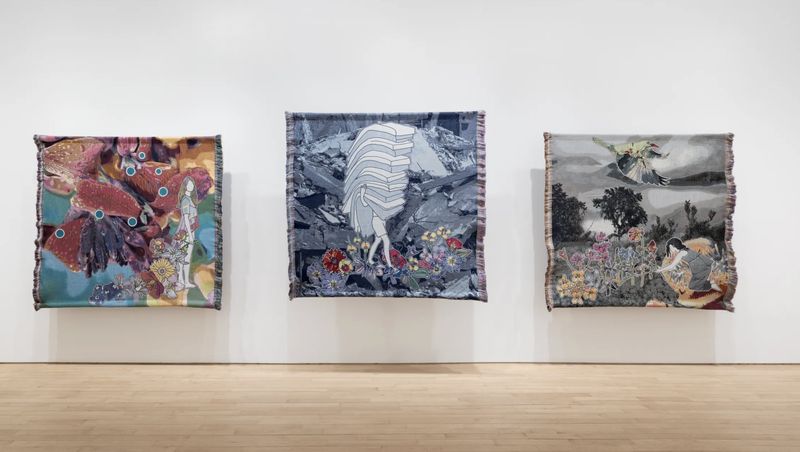
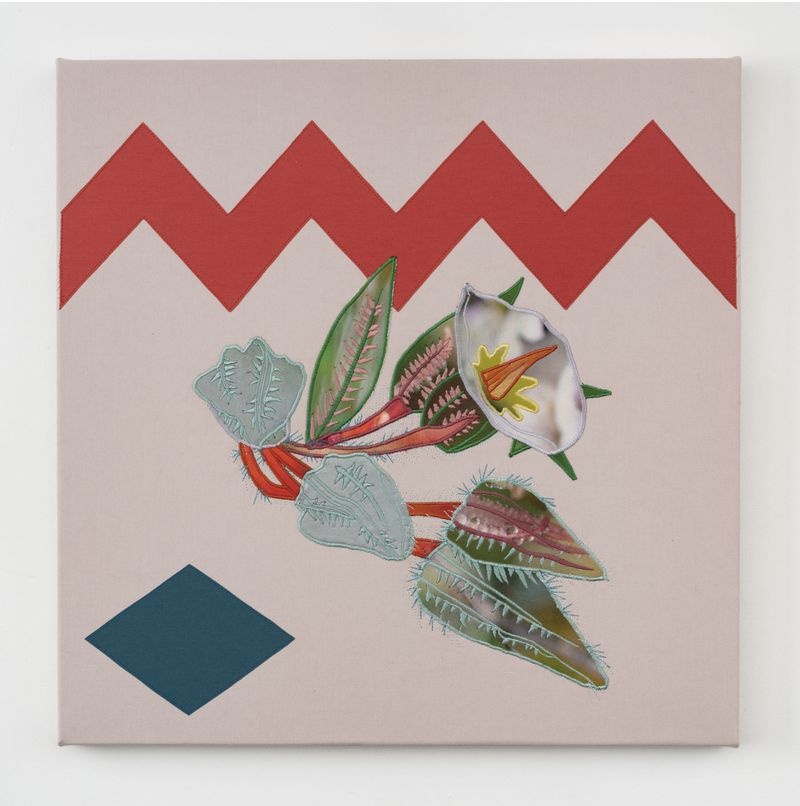
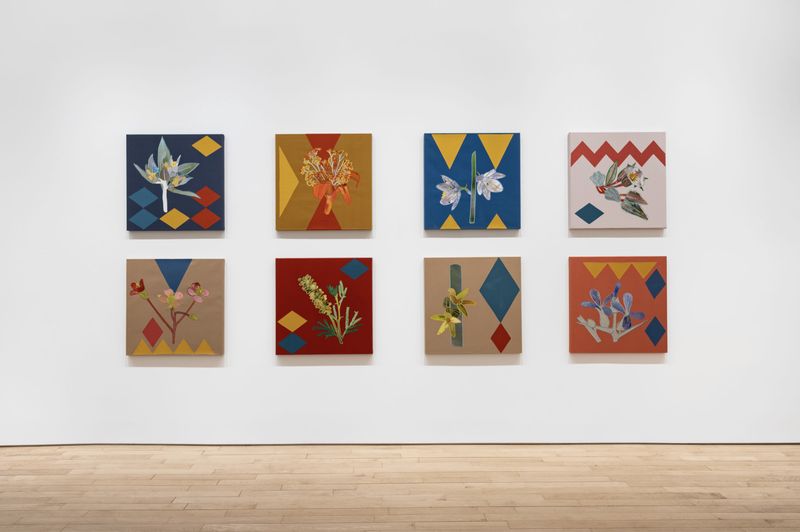
One example is the series Wadi Hanifah Embroidery Landscape, which develops a visual narrative around life in the desert. Through silk appliqués on colored canvases, the artists depict plant species native to Wadi Hanifah, whose resilient forms suggest strategies for adapting to extreme conditions.
These organic elements are interwoven with geometric patterns inspired by Al Sadu, a textile tradition practiced by Bedouin women that encodes essential astronomical and environmental knowledge for nomadic life. Triangles and rhombuses—referencing both constellations and local flora—come together to form a visual language that speaks to the ecosystem’s resilience amid the pressures of rapid urbanization and climate change.

Across the Atlantic, since their first expedition to the Amazon rainforest in 2009, the observation of floral species has become a sustained source of research and inspiration for the artists. The Fabulae Naturae series grows out of this evolving visual archive, presenting paintings that magnify and bring into sharp focus the intricate details of diverse botanical forms.
Each work is accompanied by a Certificate of Stewardship linked to a specific one-square-meter plot of rainforest, underscoring the project’s ecological commitment. In these pieces, floral forms expand toward abstraction: petals and botanical structures dissolve into layered fields of saturated pigment, oscillating between the recognizable and the imagined. Beyond their aesthetic dimension, these flowers carry multiple meanings—medicinal, cultural, and symbolic—serving above all as vehicles for a poetics that rethinks the relationship between nature and representation.
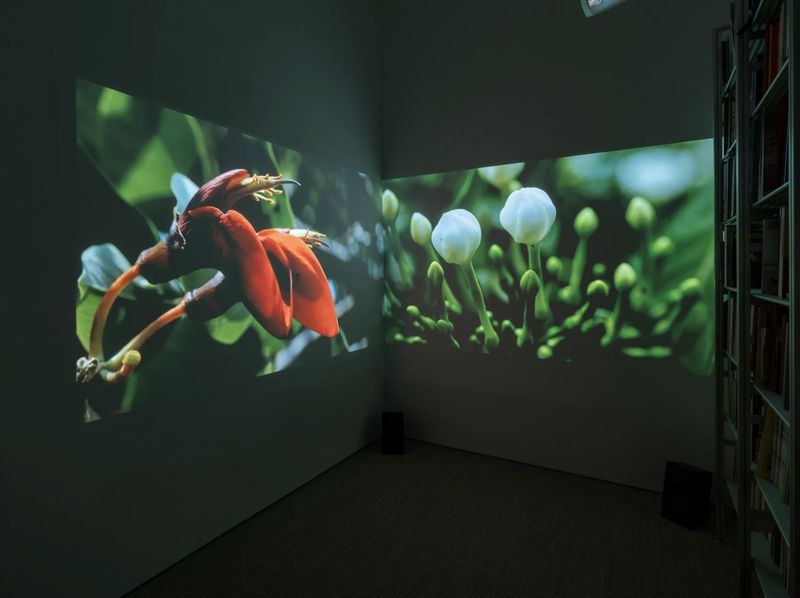
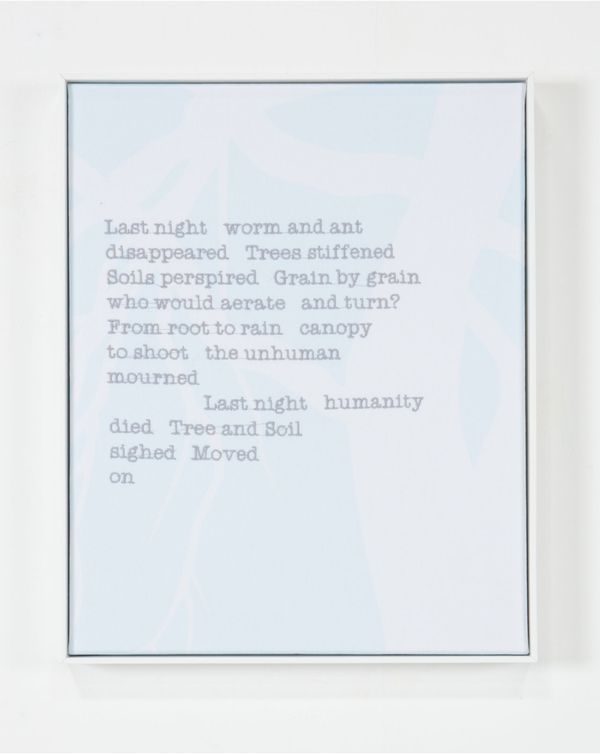
As part of the Amazonia series, an audiovisual work accompanied by three textile panels embroidered with poetic fragments broadens the exhibition’s scope, bringing into focus the sustained research that Lucy Orta and Jorge Orta have carried out on the interdependence of ecosystems. For this project, they collaborated with eco-poet Mario Petrucci, who developed the sound poem Amazonia using footage captured during their expeditions in the Amazon rainforest. The resulting work unfolds as an immersive narrative that interlaces voices, landscapes, and sonic textures, evoking the complex web that binds all species while underscoring the losses wrought by extractivist practices.
The film unfolds as an immersive experience in which the jungle emerges as a living organism: the echoes of howler monkeys, the hum of insects, birdsong, and the steady flow of rivers combine to create a sensory atmosphere that moves beyond representation. In dialogue with the floral paintings and tapestries, this audiovisual work anchors the exhibition in a direct encounter with natural systems, reminding us that what is at stake is not simply a landscape, but the fragile balance of the networks that sustain life.
One of the ideas that resonates with Lucy + Jorge Orta’s practice is Joseph Beuys’s notion of “social sculpture,” which frames art as a catalyst for societal change. Over more than two decades of collaboration, they have engaged with urgent crises affecting both social structures and the ecosystems that sustain them, positioning their work at the intersection of the aesthetic, the ethical, and the political. Rather than simply representing contemporary crises, their practice aims to generate awareness and to explore new ways of relating—between individuals, communities, and the environment.
Lucy Orta’s trajectory is key to understanding this approach. Trained in fashion in Paris, she soon moved away from conventional circuits to engage directly with urban realities. It was in this context that emblematic projects such as Refuge Wear emerged, in which garments become forms of shelter—portable structures that can transform into protection, housing, or basic refuge. Developed in dialogue with vulnerable communities, these works encapsulate a central idea in her practice: the body and clothing as a minimal architecture of survival, where design and necessity converge in a deeply political gesture.
For his part, Jorge Orta’s career has been shaped by his education in Argentina and France, as well as by an early interest in art as a vehicle for social awareness. His experience in Argentina during the dictatorship and his subsequent relocation to Europe after receiving a scholarship informed a perspective marked by themes of displacement, borders, and community. In the European context, his practice expanded to address global issues such as the environmental crisis, migration, and resource management, adopting a research-based approach that involves collaboration with scientists, the use of real data, and engagement with organizations and communities.
The encounter between Lucy Orta and Jorge Orta in 1991 gave rise to a long-term collaboration that later took shape as Studio Orta, an interdisciplinary space of production where sculpture, architecture, design, and participatory art converge. Within this framework, they have developed projects addressing issues such as climate change, water scarcity, and migration, approaching art as a field capable of engaging with and influencing reality.
However, his practice also includes a critical reflection on its own limitations, particularly when it comes to assessing the impact of art on society. In the words of Jorge Orta, “art, despite its scientific processes, can transform society, but mechanisms to verify that impact have yet to be developed.” This tension between transformative potential and the difficulty of measurement places his work in a field that remains fertile ground for exploration and experimentation.
In this context, many of his works emphasize a fundamental idea: no one exists in complete isolation. At times quite literally, devices that physically connect bodies make the social realm visible as a network of interdependencies.
This notion also extends to the territories they explore. When asked about the relationship between the Amazon and the Bedouin world in this exhibition, the artists point to a clear affinity between the two contexts: both the jungle and the desert are fragile ecosystems, shaped by extreme conditions and made even more vulnerable by global forces that threaten their survival. In this way, their work draws connections not only between people, but also between distant geographies, as if stitching together a shared terrain of fragility. It suggests that contemporary crises are never isolated, and that their response cannot be either: ultimately, what sustains these environments and communities is a continuous practice of collective care.
The exhibition is on view at the Jane Lombard Gallery in New York through April 25, 2026.

También te puede interesar

LUCY + JORGE ORTA: FROM ROOT TO RAIN
La tercera muestra individual del dúo Lucy Orta (Reino Unido, 1966) y Jorge Orta (Argentina, 1953) en la Jane Lombard Gallery (Nueva York), propone un recorrido que conecta territorios tan diversos y distantes como...