

BAGGAGE/LUGGAGE. MATERIAL AND SYMBOLIC MEANINGS IN DISPLACEMENT EXPERIENCES
In 1989, political scientists Aristide R. Zolberg, Astri Suhrke, and Sergio Aguayo published the seminal work on refugee studies Escape from Violence: Conflict and the Refugee Crisis in the Developing World. Early in it, they raised the philosophical concern of defining the term “refugee,” emphasizing that this is not a mere academic debate but a pressing issue with life-and-death consequences.
That same year, Venezuela experienced a violent popular revolt known as the «Caracazo» or «Sacudón,» triggered by severe macroeconomic measures that betrayed the principles of the moral economy. This episode resulted in hundreds of deaths and became a pivotal moment in the nation’s history, laying the groundwork for Hugo Chávez’s Bolivarian Revolution.
Thirty-some years later, nearly eight million Venezuelans –me included– have been forced to leave their home country, pushed by the far-reaching consequences of the Bolivarian Revolution. What began as a promise of social reform has been overshadowed by pervasive corruption, authoritarianism, the loss of basic freedoms, and an unprecedented humanitarian crisis.
It’s worth noting the use of the term “refugee” according to the insightful distinction made by philosopher Castor Bartolomé Ruiz: The term “refugee” is connected to that of refuge but also to the verb “to fugue, to escape” (from the Latin fugam). A refugee is the one who’s compelled to flee and escape. (personal translation from Los refugiados, umbral ético de un nuevo derecho y una nueva política, 2014).
And while the realities of refugees and exiles can be examined from multiple angles –sociological, legal, political…– each offering valuable and complementary insights, this research approaches the topic through the epistemological lens of art.
Venezuela’s mass displacement represents over a quarter of its population to date, amounting to the largest recorded refugee crisis in modern history, surpassing displacement numbers of Syria and Ukraine. It has reshaped not only Venezuela’s demographics, but that of countries across the world, mainly Latin America, North America, and Europe. The newly formed Venezuelan diaspora –termed «Venespora» by artistic scholar Waleska Solórzano– has become a defining feature of the nation’s contemporary narrative.
Families have been torn apart, communities scattered across continents, and generations forced to rebuild their lives in unfamiliar territories. As we navigate the complexities of life in exile, we face the emotional and physical challenges of separation from loved ones, possessions, and the land we once called home.
This has left a profound mark on the Venespora, molding new and shared identities as we carry the weight of displacement, and the weight of our memories. The trauma of leaving everything behind lingers, while the struggle to find stability in foreign lands continues.
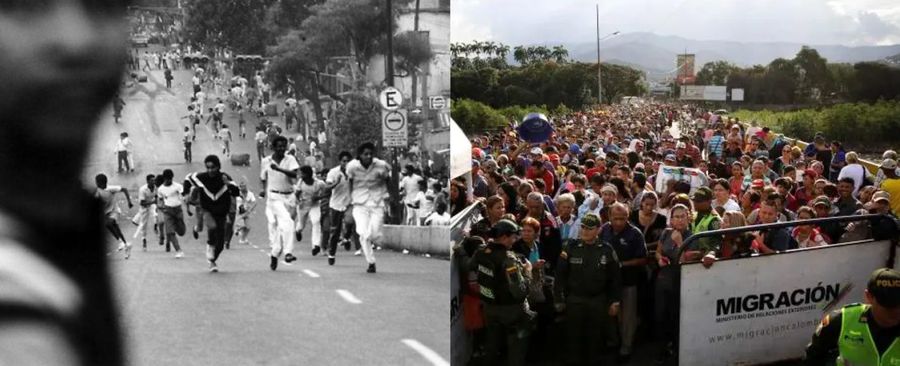
Key phases of Venezuela’s “Bolivarian Emigration”
Early 2000s: First Wave
The first notable emigration wave began shortly after Chávez’s rise to power, comprising primarily upper- and middle-class professionals and entrepreneurs. Many of these individuals opposed Chávez’s agenda, which included the nationalization of private businesses and land redistribution programs. The 2002 coup attempt and the political unrest that followed further accelerated this trend, as state-sponsored repression targeted opposition figures, labor leaders, and media outlets.
Mid-2000s: Erosion of Democratic Freedoms
As the decade progressed, worsening economic conditions, political prisoners and the silencing of dissent had become defining features of the Chávez administration. Currency controls, expropriation of private property, and mounting corruption eroded trust in the government. The 2004 recall referendum, while unsuccessful in ousting Chávez, exacerbated polarization, as electoral irregularities and state violence became more evident. These conditions prompted many to leave, seeking safety and a viable future abroad.
Late 2000s: Consolidation of Power
Emigration reached new heights after the 2007 constitutional referendum, which sought to extend presidential term limits. Although defeated, Chávez responded by intensifying his efforts to consolidate power. This period was marked by democratic backsliding, with increased political persecution and dissent brutally suppressed. A new surge of violence targeted students, who had become some of the most vocal opponents of Chávez’s authoritarianism. Young activists were detained, tortured, or killed during demonstrations, taking a grim turning point.
Post-2013: The Maduro Era and Mass Exodus
While emigration under Chávez set the stage for the Venezuelan diaspora, things escalated dramatically under his successor, Nicolás Maduro. Beginning in 2013, hyperinflation, nation-wide shortages of electricity, food and medicine, and intensified political repression created unlivable conditions. The 2014 student protests led to a brutal state response, with dozens of students killed and hundreds detained, while political prisoners are subjected to inhumane conditions.
The 2017 anti-regime protests, driven by demands for free elections and basic rights, resulted in over 100 deaths at the hands of security forces and pro-government militias (colectivos). These intersecting crises triggered a mass exodus, with Venezuelans fleeing to neighboring countries and beyond in search of refuge, increasingly by foot.
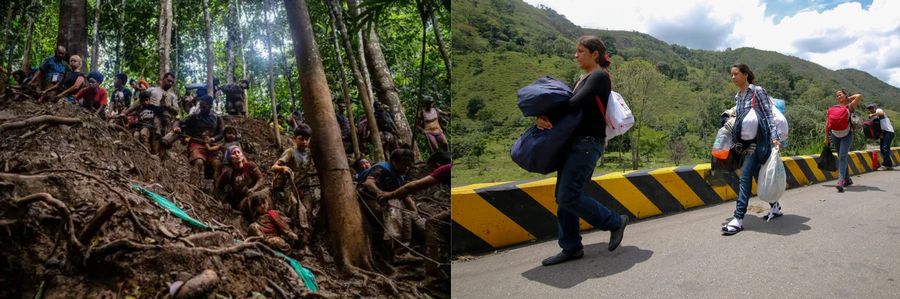
For Venezuelans, the last decade has seen a dramatic shift, where the decision to leave is no longer a choice, but a matter of survival. Millions find themselves faced with the heartbreaking reality that remaining at home is simply not an option, and while they embark on uncertain journeys toward new lives in foreign lands, the trauma of leaving everything behind still lingers.
The current Venezuelan emigration, specifically in the American continent, has been characterized by an unparalleled and arduous journey that sees Venezuelans walking thousands of miles in perilous conditions to get to safety. The Caminantes (walkers) phenomenon, which originated in neighboring Colombia, has extended its reach to more distant destinations, from Ecuador and Perú to even further places like the United States––a whooping 3000 (air) miles away.
This forced displacement highlights the physical and emotional burdens of migration, as Caminantes carry little more than the essentials for survival. The material belongings they bring with them are often a blend of practical and sentimental objects chosen with urgency and imbued with profound personal meaning.
As I reflected on the fact that our growing diaspora holds onto only a handful of personal belongings from home –if any at all– I began to contemplate the profound connections between memory, identity, and materiality. In Anthropology there’s the term «Material Culture,» but it felt incomplete, as it fails to fully capture the depth of what I was experiencing and observing. What we leave behind and the absence of those belongings form a kind of negative space that’s heavy of lives once lived but now suspended.
The prolonged pain of knowing we’ll never see or hold certain objects again: family photos, birthday cards, childhood toys, or keepsakes… prompted me to consider their deeper significance. I have come to refer to these as «Objects of Embodied Memories» (unpublished paper I presented at Cornell University’s Symposium (Re)thinking Venezuela: Movement, Transit, Displacement, 2023) because they do more than represent the past; they act as vessels, able to transport us back to moments and allowing us to relive the emotions and experiences tied to them. This concept underscores the tangible ways in which objects anchor us to our identities and histories, even when everything else has been displaced.
These reflections have led me to coincide complementarily with the proposal of the Critical Refugee Studies Collective, a group of interdisciplinary scholars and advocates whose vision of the topic, grounded in refugee histories and experiences, aims to expand perspectives and broaden vocabularies. An example of their theorization is the notion of Baggage/Luggage:
Baggage for the refugee carries material and symbolic meaning. Combined with the physical luggage that refugees put together in their haste to escape violence, baggage represents the different forms of content that people try to fill and carry. For example, war is a baggage that refugees always have to carry. The refugee also becomes baggage for the nation-state. Baggage also simultaneously functions as trauma and resilience/survival. To be sure, baggage is ephemeral; it can be lost through movement without the possibility of retrieval. Yet, traces of the baggage and its contents remain. The baggage does not have to be full in order for it to be loaded, or visible for its impact to be felt. Baggage is also culturally specific so that it may signal the “missingness” in history and knowledge formation or represent the presence of refugee epistemologies. (From the Critical Refugee Studies Collective)
Considering these concepts, I spotlight the powerful work of artists from the Venespora community who reclaim and reshape migration narratives. In some cases, I have had the privilege of curating their work, witnessing firsthand how they explore the deeply personal and collective experiences of displacement. These artists have skillfully created pieces from migrant objects, both visible and invisible, resignifying them in ways that transform them into profound representations of the trajectories and life stories of forced migrants.
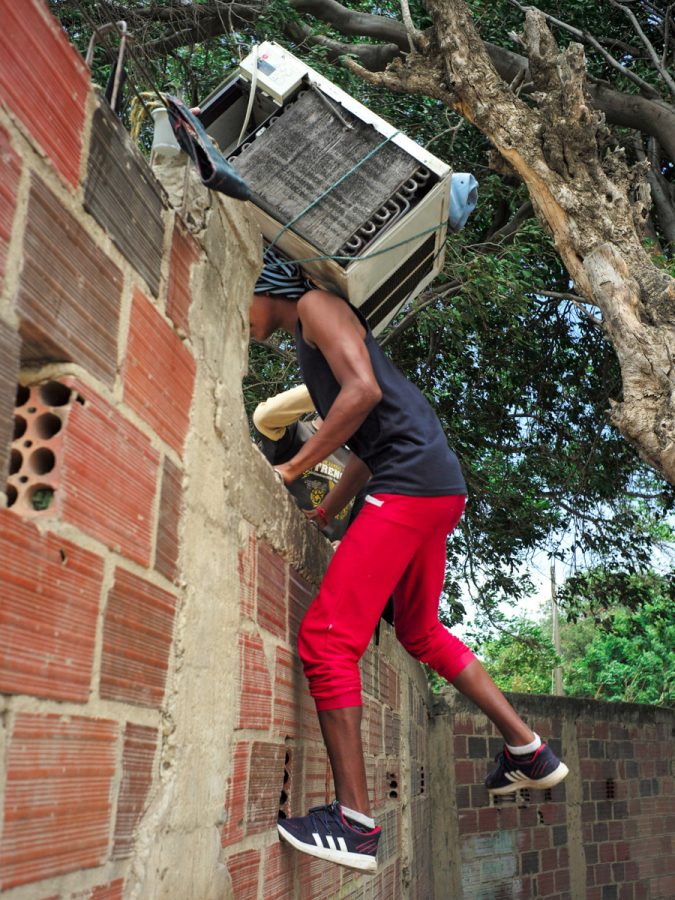

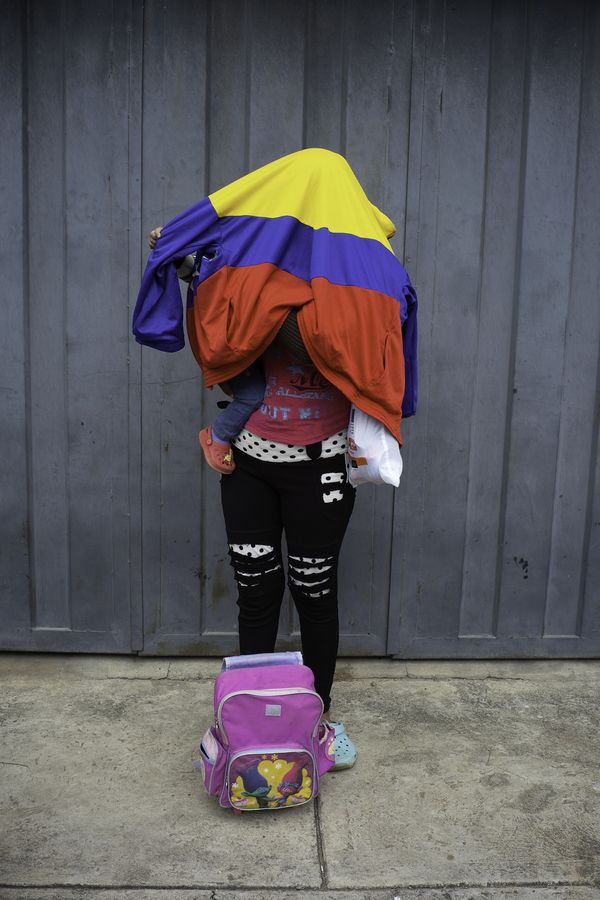
Ronald Pizzoferrato began his artistic research on Venezuelan migration in 2018 with a visit to Cútuca, Colombia. This was the beginning of a long-term commitment to understanding the experiences of migrants through his photo and publishing practice. Until 2021, his focus remained on southern migration journeys, documenting the pathways Venezuelans commonly traveled to Colombia, Ecuador, etc. But in 2022, his research expanded northward as migratory routes increasingly shifted toward the United States.
He ventured into the infamous Darién Gap, a stretch of dense jungle between Colombia and Panama known for its dangerous conditions and criminal activity. He followed in the footsteps of hundreds of thousands of people who risk everything every day for a better life creating photographic records so the journeys can be referenced and remembered. Pizzoferrato’s work documents, but it also engages with the physical and emotional strain endured by Caminantes, as well as the human connections and ingenuity that sparks through these agonizing crossings.
His photo-ethnographic works like El Camino de los Objetos (The Path of the Objects) or Memorabilia Migrante (Migrant Memorabilia) examine the malleable essence of everyday objects, which though initially created with utilitarian purposes, transform into profound agents of memory, familial ties, shared stories, and hidden struggles.
The warmth of a blanket or softness of a stuffed toy is both tangible and metaphorical; and discarding it, along with clothing, shoes, documents, medicines… all left behind to lighten the load or help carry someone else’s, become poignant artifacts to narrate migration. These objects not only chronicle material realities but emotional resonances that extend far beyond their physical presence –and absence–.


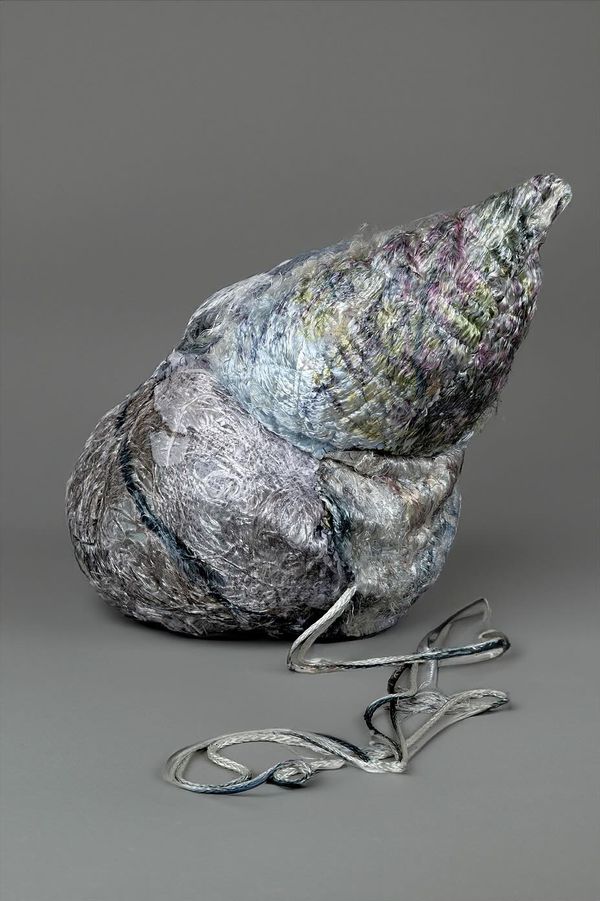
Within the Venezuelan diaspora lies a reservoir of stories to be told, marked by collective trauma, grief, and hopes. Many feel an urgent need to share their experiences, to vent (in Spanish desahogar, which literally means to undrown), and Cassandra Mayela Allen’s practice has grown into both material experimentation and social engagement. Her Maps of Displacement series as well as artworks like Chaleco or La Carga embody this duality. Centered on the storytelling power of textiles, Mayela Allen turns garments donated by Venezuelans migrants into threads that she later weaves together, forming interconnected, tactile narratives.
The process begins with profound empathy and vulnerability, as she actively invites donors and listens to their heartfelt stories. Meaningful conversations and detailed interviews with those who contribute a clothing artifact allow her to uncover the personal meanings behind each garment, which she records, preserving these stories in both text and textile.
Holding more than just material value, the donated wearables are charged with personal memories which, activated by the artist’s hand, infuse the works with an intangible character that breathes life into every thread, transcending the fabric’s’ materiality to stitch together an emotional tapestry that’s larger than the sum of its parts. (Excerpt from my essay for the apexart exhibition Build What We Hate. Destroy What We Love, 2024).
In this act of creation, there’s also a process of scarification ––both literal and figurative. Each cut and weave are a moment of emotional release and reclamation, using visual language that speaks of open wounds, attempts of healing, and ultimately unity among the fragments.
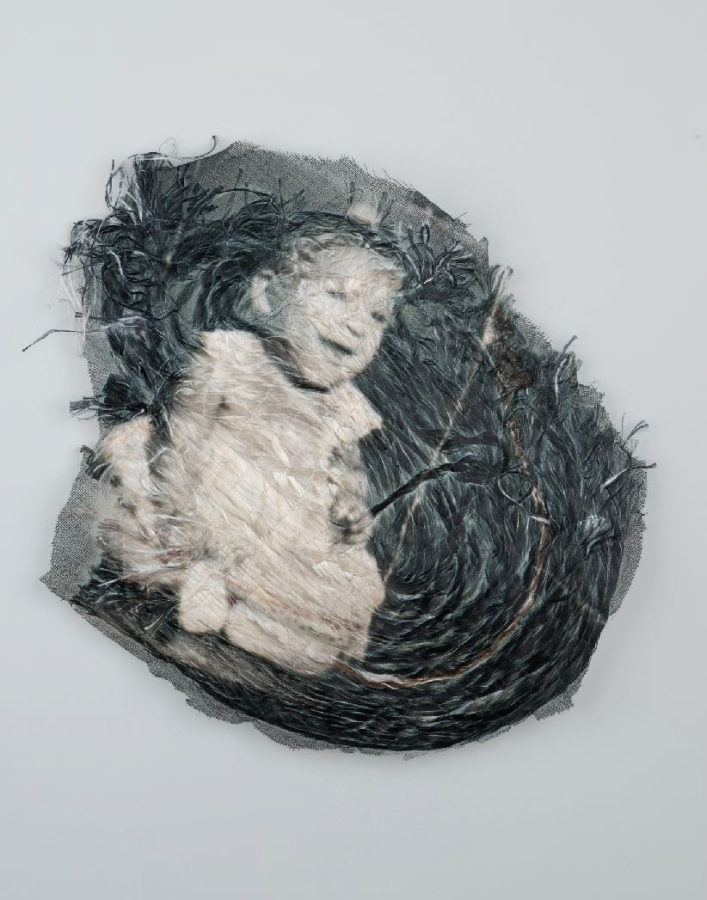
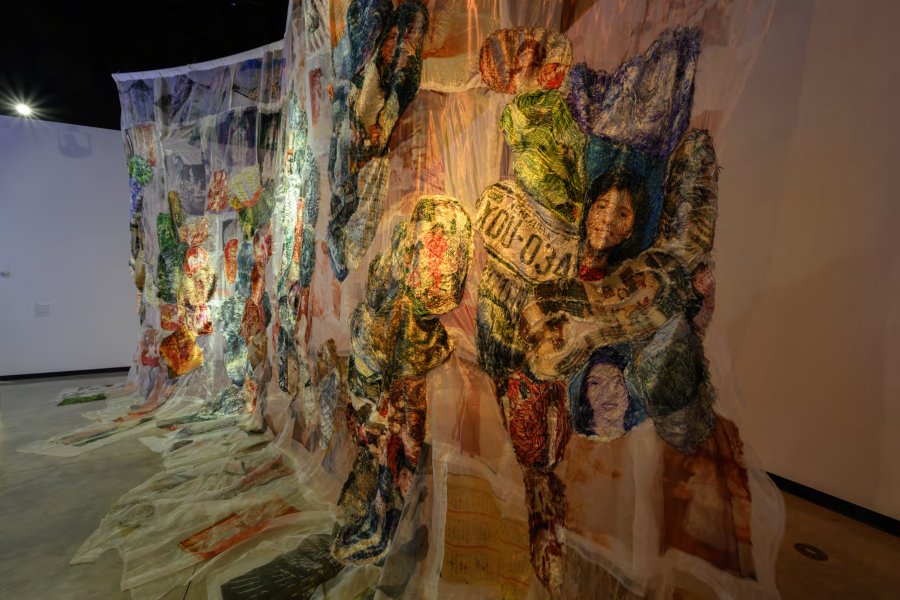
Like Mayela Allen, artist Lisu Vega utilizes the medium of textiles to examine themes of displacement and preservation of memory, though her approach brings a distinct visual and conceptual style. Her background in experimental engraving and printmaking has opened a way for her to recover traces of the past and transfer them onto fabrics, most notably childhood and family photos, transforming fleeting moments into lasting, tangible artifacts.
Her work is concerned with materializing ephemera, capturing the impermanence of memory through a labor-intensive process that echoes the emotional and physical weight carried by dislocated individuals. Through the repurposing of residual materials from her zero-waste practice –both in the sense of recycling and charging them with new purpose– Vega creates monumental works that embody the gravity of migration experiences, not only as a personal journey but as a collective narrative of survival, resilience, hope and futurity.
At the same time, Vega’s work resists dominant narratives surrounding Venezuelan refugitude (term coined by Dr. Khatharya Um, 2015), offering alternative, deeply personal counter-narratives that reaffirm refugees’ capacity to rebuild, and the essential human agency to tell one’s story. Take for example her piece A momentary whole, a 20 feet tall x 40ish feet long tapestry made of multiple interconnected panels, each one representing different memories. The piece evokes a web of neural networks and synapsis among them, not only connecting the stories embedded in them, but protecting cycles of physical memory: encoding, storing, recalling, fading, and perhaps even renewing over time.
Juan Diego Pérez La Cruz is another artist exploring the intersections of objects, memory, and loss. His work examines how fractured personal and collective histories can be reassembled in exile. Like many of us, forced out of our homes, he had to leave most possessions behind; among the hardest to lose were their family photo albums.
While rebuilding his life and artistic practice abroad, he stumbled upon old photos in secondhand shops: grandma’s portrait when she was younger, kids’ birthday parties, weddings, beach trips, backyard gatherings. They looked just like the ones he’d lost. These images revealed the larger commonalities across people and places. They could have easily been his own.
In his photo/video installation Lagunas Mentales (mental blanks), Pérez La Cruz manipulates these photographs that once belonged to strangers, degrading and affixing them to a red backdrop to serve as metaphors for the rupture caused by forced separation, and the fragility of memory itself. The photos in the videos appear still, but they flutter, tremble, and shift faintly at any given moment ––a reflection on memory’s attempts to stay alive.
The red-drenched environment heightens the emotional weight of the work, articulating not only the trauma and physicality of loss, but also the drive for renewal and adaptation. It highlights the urgency of creating new connections while revealing the emotional toll of exile, pushing us to confront the impermanence and fragility of our histories, and the fleeting nature of the memories we think define us.


Juan Diego Pérez La Cruz, Lagunas Mentales (Mental Gaps), 2023. Video stills. Courtesy of the artist.
The exploration of migrant journeys through these artworks powerfully conveys the idea proposed by artistic researcher Andrea Staid that “every visual work is a social work”. These works open a room where different expressions and life experiences can coexist; each one unique, even if shared. They’re not limited to representation, rather they express more than what is depicted. In this sense, these artworks –and artists– can be generators of knowledge.
Through diverse visual and tactile approaches, they craft languages to tell refugee stories, and in doing so, they foster a more humane understanding of migration and displacement, building connections across perspectives, and empathy towards those dislocated ––I say dislocated because the injury refers to a forced removal, but it’s still part of the body ––we’re still part of the body, we’re just a little stretched out.
Objects, often mundane like clothing or photographs, transcend their material form to become vessels of emotional and historical significance; and the artists, who aren’t foreign to the history they’re trying to reconstruct, create heartfelt narratives with the remains of our journeys. They ask us to reconsider the ways in which we regain agency, how we heal our country’s wounds, what happens when the past is no longer tangible, how do we hold on to what matters, even when we are forced to leave it behind. The paradox is that what we’re forced to abandon never leaves us.
I could not conclude without acknowledging the growing number of Venezuelan and Venesporan artists who, in their own ways, are pushing forward ideas and projects that explore our Venezuelanness, and the many forms it can take amidst a spilled country. Waleska Solórzano, Ana Isabel Orozco, Faride Mereb, Samoel González, Yarinés Suárez, Amalia Caputo, Maria Elena Pombo, Violette Bule, Juan Henríquez, Macjob Paravabis, Juan Carlos Urrutia, Francisca Sosa López, Brian De Jesús, Génesis Alayón, Gabriela García, Miguel Braceli, Felipe Jácome, Yuleancy Lobo, Bernadette Despujols, Yeison Pérez, Carola Bravo, and so many others that are part of this ongoing dialogue.

También te puede interesar
LOS RELATOS DE LOS RESTOS
A partir de residuos del anonimato, el proyecto “Build what we hate. Destroy what we love”, curado por Fabiola R. Delgado para apexart, Nueva York, se encarga de dar forma a una arqueología del...
Soto.vibrations 1950–1960
Renowned as art history’s leading kinetic artist, Jesús Rafael Soto (Venezuela, 1923-2005) explored the dematerialization, or ‘disintegration’ of the art object, breaking new ground while anticipating conceptual strategies to come. Hauser & Wirth in...
CRISTIÁN SALINEROS: THERE WERE NO LIMITS BEFORE THIS, ONLY TIME
Salineros works literally and symbolically with abjection: he uses the corpse or feces of migratory birds to invoke a series of borders—both physical and virtual—which are transgressed by the effect of time.