

GEORGE FEBRES: TRANSLATION, IRONY, AND LIBERATION. AN ECUADORIAN ARTIST IN THE DIASPORA
The life and work of George Febres (Guayaquil, 1943 – New Orleans, 1996) occupy an uneasy place in the history of Ecuadorian art. An artist like him is an anomaly within the local narrative. His work, clearly influenced by Pop Art, Neo-Surrealism, and the culture of the US South, marks a profound rupture with the experience of national art, which has been shaped by the political discourse of indigenism and class struggle.
As Febres incorporated his experience as a migrant and homosexual subject into his artistic practice — articulated through bilingualism and the ironic appropriation of tropical imagery — he built a body of work that is hybrid, irreverent, and sensorial, inscribed within the logic of the queer diaspora. Within this framework, his work does not merely insert itself into Ecuadorian art history; it actively interrogates and unsettles the assumptions of its official historiography.
Although my research on this figure allowed me to join the National Academy of History at the Palacio de La Circasiana, with a lecture titled Del Guayas al Mississippi. Biografía de Jorge Javier Febres-Cordero Icaza[1], it also raises a conceptual problem: can one be part of the Ecuadorian art canon if one produces outside its borders — geographic, moral, or sexual?
Ecuador has yet to fully recognize George Febres. Not a single work of his exists in national public collections, nor has any significant retrospective exhibition of his artistic output ever been mounted. This omission is not simple institutional indifference; it is part of a broader pattern of silencing and erasure of queer experiences from collective memory.
In this article, I propose a non-chronological analysis of the evolution of George Febres’s life and work, tracing the artist’s identity formation alongside its complexities and the visual language he arrived at before his death. That is, I will draw on biographical elements to provide a critical accompaniment to his work.

Artist’s autograph signature. Source: Nicolás Subía archive.
Before he was George, he was Jorge Javier, born in the 1940s in Guayaquil into a family of some significance to national history. He had a complex childhood and youth, marked by his father’s instability, the symbolic weight of his surname, and a lack of economic resources. From an early age he was acutely aware of his kinship with the man who would become Santo Hermano Miguel Febres-Cordero, the first male Catholic saint from Ecuador.
His life unfolded — if with fewer relative luxuries — much like that of others of his social class, between the Tennis Club and the Cathedral.
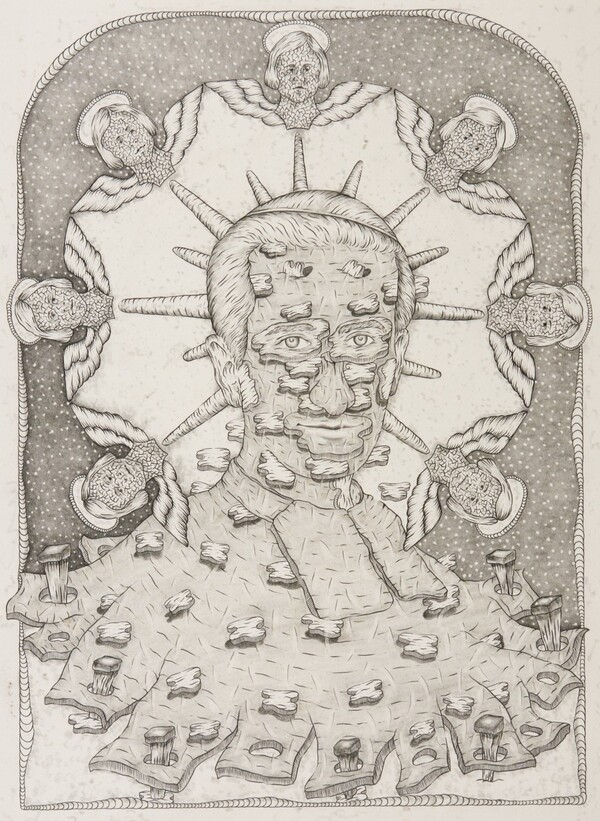
In Febres’s characteristic style, we see in this image a portrait of his kinsman rendered as a reinterpretation of a classic hagiographic image — the kind found in Catholic devotional prints. In Febres, personal mythology is inseparable from artistic production, encompassing his origins, his migration, and even the way he learned the language of his adoptive homeland. He first moved to Jackson, Mississippi, and then to New Orleans, Louisiana, where, by coincidence, a main thoroughfare bears the name Carondelet — in honor of the Baron de Carondelet, who governed both that territory and the Real Audiencia de Quito, present-day Ecuador — and it was in New Orleans that Febres would spend most of his life.
George was drafted into the United States military during the Vietnam War, at a time when the American government favored migrants to fill its ranks. When the conscription notice arrived, Febres faced a dilemma: either leave the United States and return to his life in Ecuador, or follow the uncertain path of arms.
Febres recounted that, once his duties at the base were done — sweeping the barracks — he would sit in the inner courtyard and paint with watercolors, as he often did. By chance, a sergeant passing by noticed his talent and reassigned him: from that point on, Febres was tasked with making signs, painting common areas, and producing invitations. He became a draftsman — and since he spoke no English, they gave him a native-speaking assistant.
It was in this way that Febres learned his adoptive language — visually — and that mode of acquisition left its mark on his artistic production, in which the objects he depicts function simultaneously as words or concepts. His is, in this sense, a body of work traversed by migration.
Each element of his work seems to carry the implicit imprint of displacement’s tension: the need to name the world in a language that is not entirely his own, yet one he has grown accustomed to inhabiting. What might be, in other artists, mere visual expression becomes in Febres a constant act of translation. Shapes become signifiers; colors acquire semantic weight — not as a burden, but as empowerment. His condition as a migrant is made transcendent through these visual puns.
Like many Latin Americans, Febres moved north in search of a better future — not only in material terms, but also in terms of individual freedom. His experience echoes that of another Ecuadorian artist who also migrated young to New York: Boris Torres.
Migration opens the door to reinvention, away from the (ever-watchful, ever-close, in Latin America) eyes of family and prior social ties. It opens the door to change and to the dissolution of what one once believed — within oneself — to be rigid and immovable.
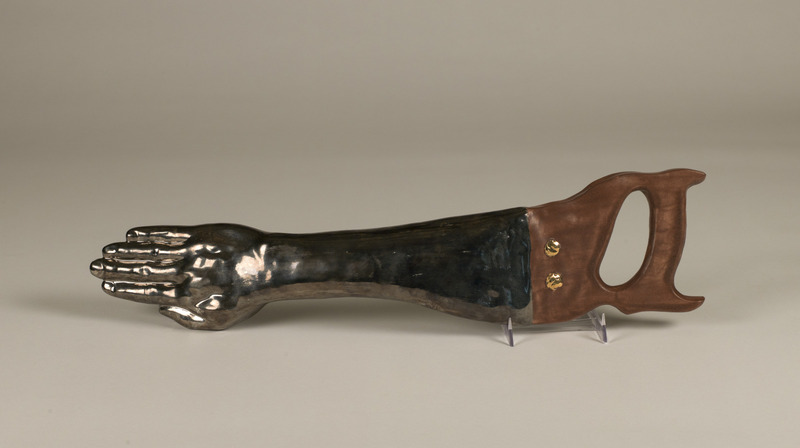
In New Orleans, he met the man who would become his partner for more than thirty years: Dr. Jerah Johnson, professor of African history and founder of the History Department at the University of New Orleans. Although the couple could never legally marry — it was illegal both in the United States and in Ecuador — they chose to be buried together in the city’s historic cemetery. In 1970, Febres became a naturalized American citizen.
In 1974, at the age of thirty-one, he completed a Master of Fine Arts degree at Louisiana State University. His thesis — titled Visual Metamorphosis: Six Paintings Exploring Biological Structure in a Syndrome Ranging from Natural Optics to Microscopic Examination, Based on Compositions by the Old European Masters — was produced under the influence of professor and artist Robert Warrens.
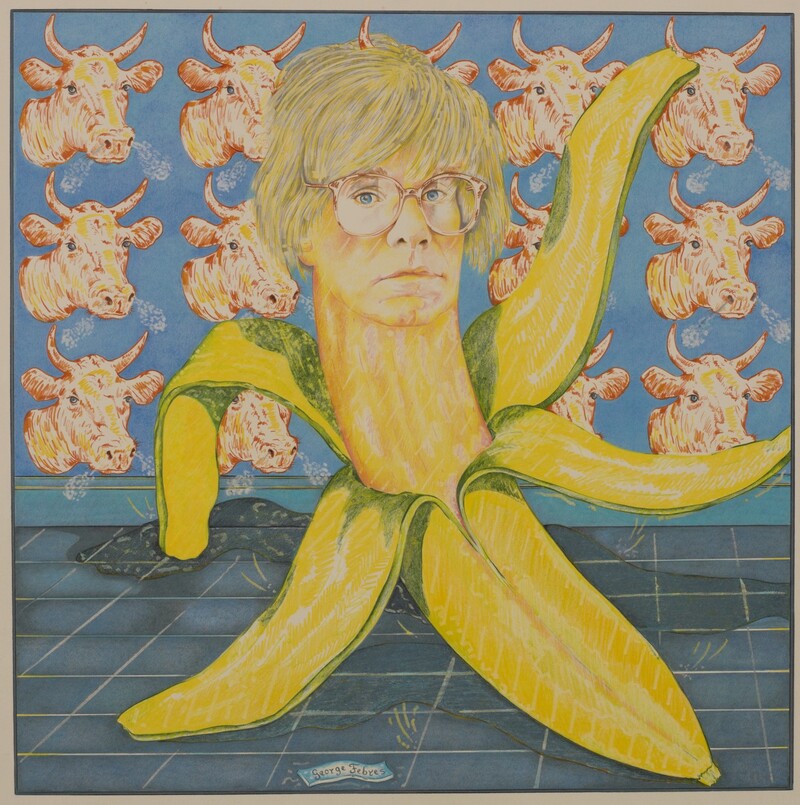
In New Orleans, he maintained close friendships with artists Robert Indiana and George Dureau, as well as with art collector Hazel Guggenheim, sister of Peggy. His relationship with Andy Warhol — whom he did meet in person — was more idealized than intimate, though Febres considered him an important reference. Particularly noteworthy is his lively and distinctive friendship with the Mexican artist Pedro Friedeberg, with whom an extensive correspondence survives in the archive, deserving a separate study in its own right.
He also ran his own gallery for four years (1981–1984), where several local artists associated with the artistic movement known as Visionary Imagism exhibited — a movement that never fully consolidated, and whose origins can be traced to 1981, when Febres himself curated the exhibition Visions at the Contemporary Arts Center of New Orleans.
Perhaps as a result of having a partner as embedded in academic life as Professor Johnson, we see in Febres — who initially arrived as a laborer unable to communicate properly — an exponential intellectual development. Within a few years, he published essays including Animal Symbolism in Goya’s Work; The Mad Potter of Biloxi — on the artist George Ohr, who had begun making surrealist ceramics nearly a century earlier — and The Forgotten Man in American Art: Robert Henri, among others. This facet of Febres as art critic and historian has yet to be explored, and I commit to publishing, in the not-too-distant future, an edition of his texts in both English and Spanish.
In 1982, the exhibition Brother Michael came to fruition: artists were invited to participate with a devotional print and a letter from Febres, encouraging them to create a work of art in relation to Brother Miguel — his kinsman, his «cousin.»
A document detailing the terms of the exhibition — which ran from November 20 to December 19 of that year — has the director of the Contemporary Arts Center writing to Febres: «I assume you want to hang the works yourself, according to your own specifications. I, naturally, trust your good judgment.» This allows us to infer Febres’s obsessive attention to detail.
It is especially significant that, running concurrently with the Brother Michael exhibition at the same Contemporary Arts Center, there was a show by Robert Mapplethorpe, a major artist whom Febres admired and to whom he was relatively close through George Dureau.

For the Brother Michael exhibition, Febres prepared a catalogue titled My Cousin the Saint, which contains an essay of his authorship, titled Of Artists and Saints and Brother Michael in Particular, in which Febres attempted to reconnect the seemingly separate worlds of religiosity and contemporary artistic production.
Brother Michael brought together forty works by various contemporary American artists around the image of the Ecuadorian saint Brother Miguel Febres-Cordero — one of the most ambitious exhibitions ever dedicated to a historical Ecuadorian figure.
The complete exhibition was offered for donation to Ecuador, but institutional indifference prevailed, and it has never reached its country of origin.
Turning now to his own artistic production, I would like to offer the reader one possible classification of his work into several thematic clusters, with the aim of deepening our understanding of Febres’s particular artistic sensibility.
A useful way of approaching his work is to group it thematically around three recurring — though by no means exclusive — nuclei: portraiture, sexuality, and religion. These three categories are in constant dialogue with one another and reveal the identity tensions at the heart of the artist’s practice. They are not isolated; they intersect continuously throughout Febres’s work.
In general — setting aside photographs, collages, and prints — Febres’s major works are the product of dedicated, meticulous labor. He worked in graphite and colored pencils with a singular attention to detail that could lead the viewer to believe the pieces were made using digital or industrial means. For this reason, Febres’s output is not vast in quantity — partly also due to the brevity of his life — and it is particularly interesting to analyze the spiritual and psychological dimension that runs transversally through his work.
It is impossible to read his work without considering his life; biographical elements are therefore essential — and perhaps only through them can we better understand the pop and surrealist art of this queer Ecuadorian migrant, who was simultaneously Catholic, burdened by the symbolic weight of a distinguished family name, and constrained by limited economic resources.

Portraiture
The self-portrait The Earthquake (1974) constructs the artist’s face from decomposed natural elements, in clear debt to Arcimboldo, suggesting that his identity emerges precisely from fracture and recomposition. With a surrealist influence, the work proposes a construction of the image — his own image — from the disaggregation of natural elements, as though attempting to tell us that his identity is born of destruction, of the earthquake, and that from this point a new identity — the true one, the one that constitutes his self — organically takes shape.
We also find a portrait of video and performance artist Adelle Badeaux, made in 1988 and titled Desire Under the Mangos — particularly rich in its content and Febresian symbolism, gathering many of his recurring motifs: the interior perspective of a room with a window, bananas, the movement around the sitter, the sensuality of the body, and more.
His portraits speak of his circle of acquaintances: his closeness to Hazel Guggenheim, of whom he made a portrait; or how he saw Jerah, whom he depicts with such intensity that the figure seems almost alive. He also produced a series of historical portraits, including, among others, Apollo the Greek god, Mick Jagger, and Hitler. Of Frida Kahlo there are at least four portraits by Febres, and of Pope John Paul II, two.
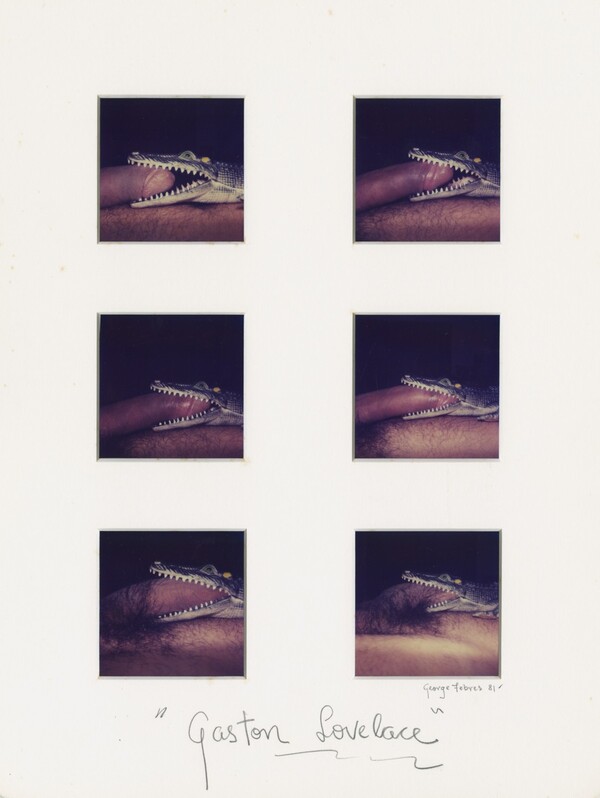
Sexuality
In the Guayaquil of the 1960s, living openly as a homosexual was unthinkable. Migration became — even if that had not been its initial intention, which was essentially economic — the path toward a freer life.
On February 26, 1965, he arrived in New Orleans for the first time — deliberately coinciding with the Mardi Gras celebrations. In an interview many years later, reflecting on that moment, he said: «In Guayaquil, Carnival is celebrated, but only in a minor way and almost exclusively by the lower class. And in any case, I had led a rather isolated life. The crowds astonished me, and the nudity was a shock. But once I got past my puritanical prejudices, I loved it. I remember thinking, in my innocence, that this must be what Disneyland is like.»
In this city, he quickly met Jerah and his circle of well-off gay men. It was the United States that allowed him to be himself.
During visits to The Historic New Orleans Collection to review the index of folders in the George Febres Papers, I noticed that one folder was never delivered to me and was not catalogued like the rest of the archive. In the management of archives lies memory; in their investigation, illumination.
The censorship of this part of George Febres’s life continued even after his death. Letters and any other testimony attesting to his homosexuality were set aside separately to prevent them from becoming public, and only now have those texts — sealed since 1993 — been made available for reading once more.
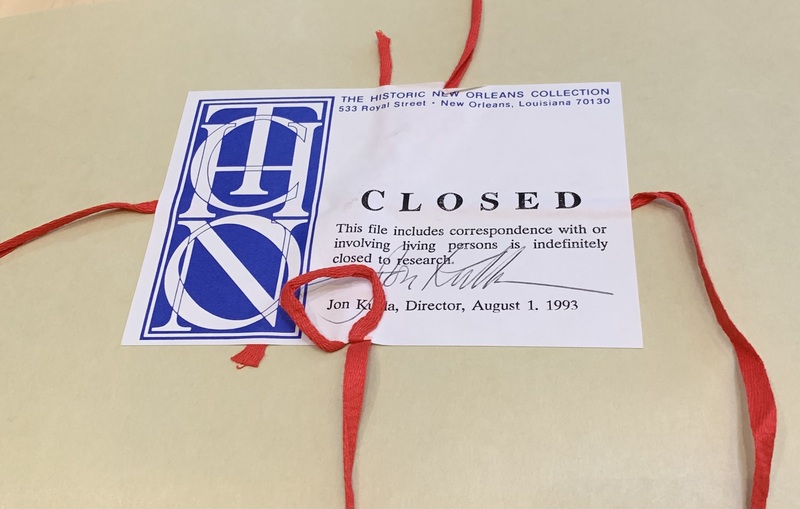
The folder remained closed indefinitely with the following notation: «CLOSED. This folder includes correspondence involving living persons and is closed to research indefinitely. John Kukla, Director, August 1, 1993.»
As Louisiana is a state within the American Deep South — with a deeply rooted Christian tradition, in New Orleans specifically Catholic in its French origin, and predominantly Republican — laws «against nature» were not abolished until the United States Supreme Court’s 2003 ruling in Lawrence v. Texas, which established that a consensual relationship cannot be contrary to law.
As was to be expected, the censored folder contained only correspondence with queer individuals; the rest of the letters had been freely available to researchers all along. And this censorship extended to a cousin of his who was a lesbian in Quito, as well as to other members of prominent Guayaquil families, and even to the Auxiliary Bishop of Los Angeles, California, Monsignor Juan Alfredo Arzube.
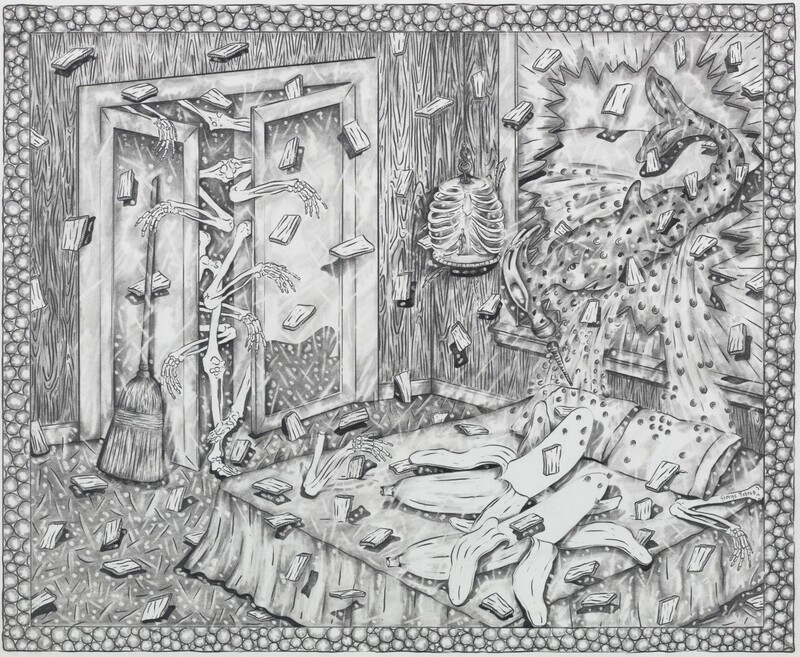
Febres’s homosexuality or bisexuality in this context is an open secret — which is precisely why I have chosen to include this work here. It makes direct reference to the phrase «skeletons in the closet,» meaning secrets kept hidden, while simultaneously evoking the act of being closeted. The visual and semantic play is direct, liberating, and typically Febresian.
The bananas — which can be read even as George and Jerah themselves — are a recurring motif in Febres’s work, and here they form a couple, upon which a hammerhead shark crashes in, shattering both the scene and the secrecy, such that the skeletons come flying out of the closet. It is a powerful work of liberation, one that Febres himself chose to feature in the only printed publication about his work that he ever released, a few years before his death.

Religion
George Febres was deeply religious. His family and school upbringing, together with the fact that he had not migrated to an evangelical part of the United States, allowed him to remain connected to Catholicism. This is evidenced by his devotion to honoring and promoting his kinsman Santo Hermano Miguel Febres-Cordero, and equally by the fact that he planned his own funeral at New Orleans Cathedral and maintained religious objects in his home throughout his life.
In La Madonna del Ecuador, the decomposition of a classical image — likely drawn from Italian Renaissance depictions of the Virgin with Child and saints — is reconstituted, through the artist’s hand, into a devotional icon for his banana republic, Ecuador. But it becomes more than that: it also becomes Febres’s personal Virgin, a Madonna who protects him as a son of the country that turned its back on him, as a queer artist who refuses to be severed from her.
As I have noted, when given the opportunity to speak about art and religion, Febres did so with great depth — and the same holds for his work. He worked with religious symbols and made them his own, profoundly his own. Febres elaborated on this collective identity from a disintegrated perspective, translating universal symbols into a personal language.

This work on Saint Sebastian — an enduring queer icon — is especially moving, because Febres worked on it through numerous preliminary sketches shortly before his death. As with other works of religious character, Febres returned to religion, possibly as he sensed the end approaching, in a final attempt to unify his identities: a last effort to seek redemption without erasing himself as an individual.
George Febres refuses to sever himself from his roots, and he reforms sacred iconography with irony and tenderness, tropicalizing the divine and infusing it with a devotion that is profoundly intimate, wounded, and irreverent.
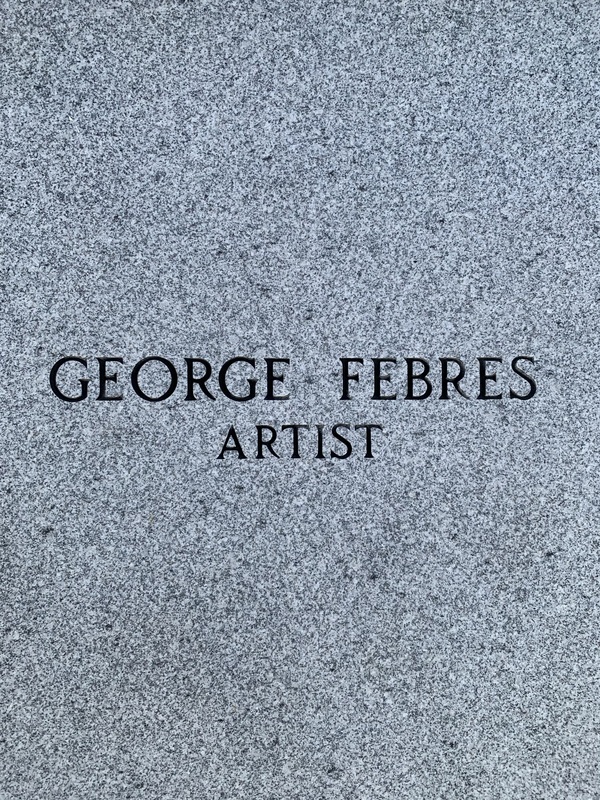
In 1993, Febres donated his entire archive, a large portion of his works, and a series of cassettes containing self-recorded interviews about episodes from his life to The Historic New Orleans Collection. He had previously purchased a plot in the city’s historic cemetery, and he personally designed his marble gravestone, bearing two names:
George Febres
Artist
Jerah Johnson
Historian
He was preparing for his death. He knew he had AIDS — as did his older brother — and in that era, unlike today, it was an assured death sentence.
One year later, in 1994, Febres published Jest for the Pun of It — included here — a work that gathers part of his experience and development as an artist over thirty years in the United States. It is the only publication Febres produced during his lifetime about himself. The title itself is a pun: replacing «just» with «jest» and «fun» with «pun.» He wanted to be remembered as a man who had lived fully and laughed a great deal.
Jorge Javier Febres-Cordero Icaza — George — died on May 21, 1996, at the age of fifty-two. A notice in the Friday, January 19, 1996 edition of The Times informs us that on January 27 of the same year he had an exhibition at the Contemporary Arts Center of New Orleans — his last — which ran until barely two months before his death.
The work of George Febres represents a fertile anomaly in the history of Ecuadorian art. He was an artist who translated his experience from the Guayas to the Mississippi. Far from being a peripheral exile, Febres challenges the national canon by demonstrating that Ecuadorian art is also constructed beyond its borders — in the tension between identity’s earthquake and the irreverent banana, between the family saint and the desired body. His legacy, today more vital than ever, invites us to rethink what it means to be Ecuadorian in art: not as a closed identity, but as an ongoing act of translation, irony, and liberation.
In Febres, Ecuadorianness ceases to be a geographic or essentialist category and becomes, instead, a mythology. His legacy does not ask to be artificially incorporated into the canon; it demands that the canon be reformulated from within its own fractures — the ruptures produced by sexual diversity, migration, and personal mythology.
To think about Febres today is not only to recover a forgotten artist; it is to accept that Ecuadorian art, if it is to be truly contemporary, must embrace the diasporas, remain unstable, diverse, and profoundly irreverent.
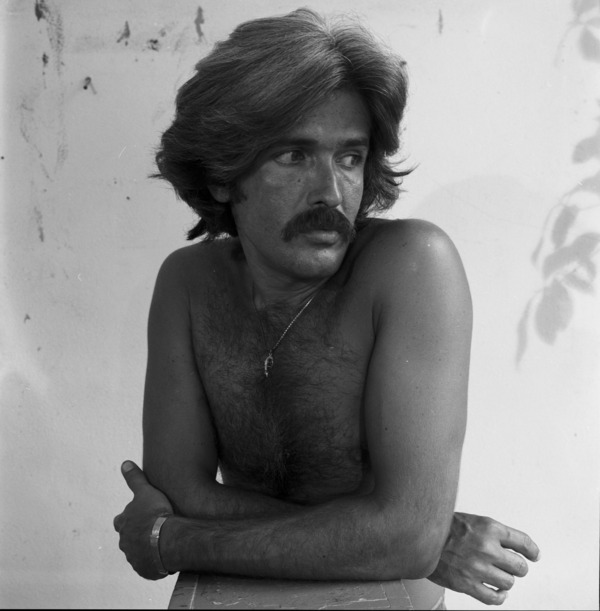
[1] I have dedicated more than five years of my life to studying his work and life, and I can also affirm that I am the private individual who holds the largest collection of his work, a process that has involved purchasing and repatriating pieces from various locations across the United States to Ecuador — possibly the country’s most significant contemporary repatriation effort.

También te puede interesar
OSCAR SANTILLÁN: A HEAVY HALO
Oscar Santillan's exhibition A Heavy Halo extends several points of enquiry to think about the ways we entangle the artificial and the organic in light of urgent ecological changes for sustainable interspecies futures.

GEORGE FEBRES: TRADUCCIÓN, IRONÍA Y LIBERACIÓN. UN ARTISTA ECUATORIANO EN LA DIÁSPORA
La vida y obra de George Febres (Guayaquil, 1943 – Nueva Orleans, 1996) ocupan un lugar incómodo en la historia del arte ecuatoriano. Un artista como él es una anomalía dentro del relato local....
ELYLA: YA-BUNANMA-M-A-TA-TA
Taking traditional cockfights in Nicaragua and Indonesia as their starting point, the works included in the exhibition explore transnational and transoceanic South-South connections, seeking to articulate, in the artist’s words: “a pathway for trans-border...