

IVÁN NAVARRO: CYCLOPS – THE THUNDER, THE LIGHTNING AND THE GLARE
It is trivial to say, «Those eyes have faced death».
However, those eyes exist and men possess them.
Jean Genet
In October 1975, architect Gordon Matta-Clark completed the perforation of the walls that, through a series of circular and elliptical openings, gave shape to Conical Intersect, the monumental work he created for that year’s Paris Biennale. Saw and hammer in hand, the «disconcerting perforator of spaces» revealed the thickness between walls—with all its masonry, secret life, and strangeness—a dimension generally hidden from view in buildings. Over the course of two weeks, he cut into the walls of two residential buildings that had stood side by side at 27 and 29 rue Beaubourg since 1690. His conical sequence of cuts progressed from inside to outside and from smaller to larger. To complete the cucurucho—or cone—that ran through the fourth-floor apartments, he devised a huge circular opening, four meters in diameter, in the façade: a large eye gazing out onto Les Halles.
In her essay Views of the Impossible, Jane Martin wrote that, through that hole, Parisians saw—for the first time in three hundred years—how the people who had inhabited those apartments lived. The truth is that the irruption of domestic life into the public sphere provoked a minor scandal, prompting the newspaper L’Humanité, organ of the French Communist Party, to publish a front-page editorial dismissing Matta-Clark’s gesture as frivolous and instead advocating for the construction of social housing for workers. But these “dissected buildings,” as poet Frances Richard notes in her essay Gordon Matta-Clark and the Politics of Shared Space, were beyond rescue, as they had already been condemned to demolition under the pretext of redeveloping and “modernizing” the Les Halles/Plateau Beaubourg district.
While Matta-Clark was fine-tuning his work, the Centre national d’art et de culture Georges-Pompidou—designed by Renzo Piano and Richard Rogers—was being constructed just a few meters away. Soon after, the building would also be criticized for exposing its «constructive viscera» to public view. Yet Matta-Clark’s eye turned its back on the Pompidou, pointing instead toward a portion of the old market district that had not yet been “modernized.” Like the end of a periscope or a giant peephole, the large circular cut in the façade connected inside and outside (here and there, domestic and urban…). But above all, it unsettled the context of so-called “urban renewal,” asking what it means to “remodel” the existing when that very thing is on the verge of disappearing.
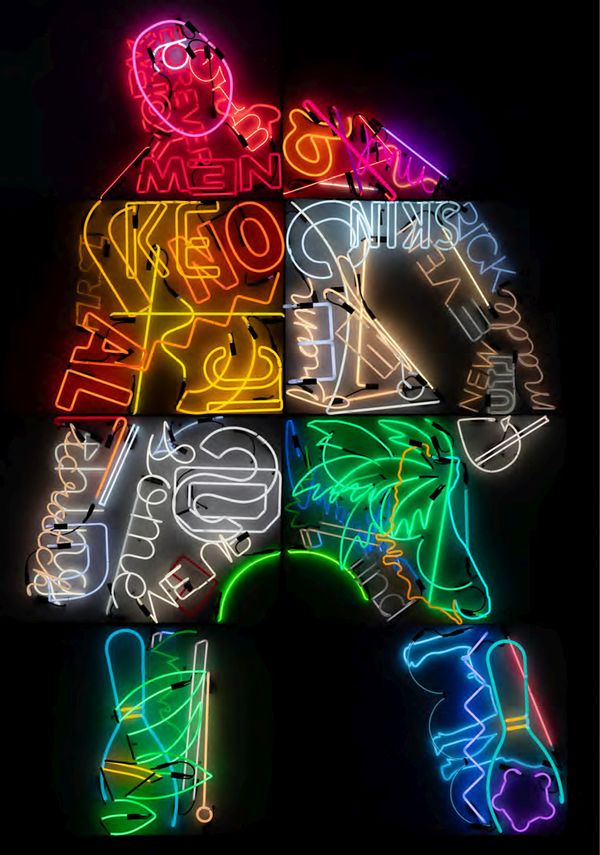
Today, fifty years after Conical Intersect, Chilean artist Iván Navarro presents his most recent exhibition in Paris: Cyclops, named after the giants of Greek mythology who bore a single eye between their eyebrows. But the entire exhibition also winks—not only at those beings of Homeric epic and Hesiodic theogony—but at Matta-Clark’s Parisian intervention of 1975 Under the glow of neon lights and infused with Navarro’s persistent political-poetic experimentation, Conical Intersect reemerges, half a century after its execution, mirrored in Cyclops—both in time (marking its fiftieth anniversary) and in space (as the two works face each other, just meters apart, near the original site). In this layered interplay of confrontation, reflection, and reverberation, the commemorative force of the date is amplified, and the bond between the two artists—and their respective works—becomes a dialogue in the present tense. One could say that Iván picks up a question posed decades ago, rearticulates it, and returns it transformed.
Over the past twenty years, Navarro—born in Santiago and currently based in New York—has exhibited on several occasions at Templon Paris, a gallery located near the spot where the eye of «Mr. and Mrs. Beaubourg» (as Matta-Clark baptized the pair of buildings he perforated) once gazed. Throughout this trajectory, Navarro has explored various formal and conceptual avenues: in Planetarium (2021), he painted his one-way mirrors with splashes of color, transforming LED lights into explosions and celestial phenomena; in Fanfare (2017), he staged a provocative exploration of light, sound, and language with neon sculptures and mirrors incorporating drums and cymbals; and in Where is the Next War? (2013), he plunged the gallery into total darkness, installing a series of light sculptures in the form of windows—an homage to Josef Albers’s square—into which he inserted phrases from Goya’s Disasters of War. In this work, the superimposition of words, subjected to luminous flickers within an infinite sequence of mirrored frames, evoked the intermediate space between the abstraction of one and the literalness of the other.
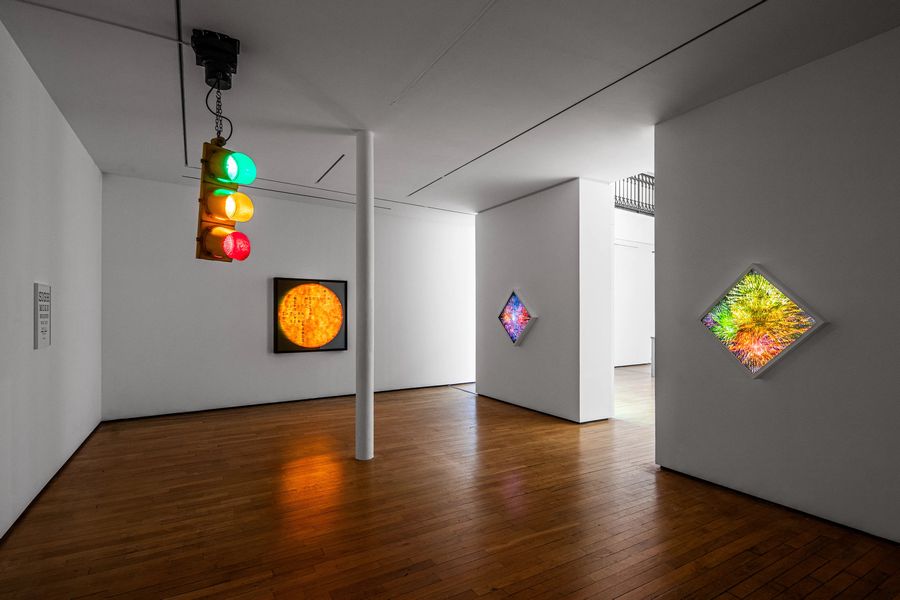
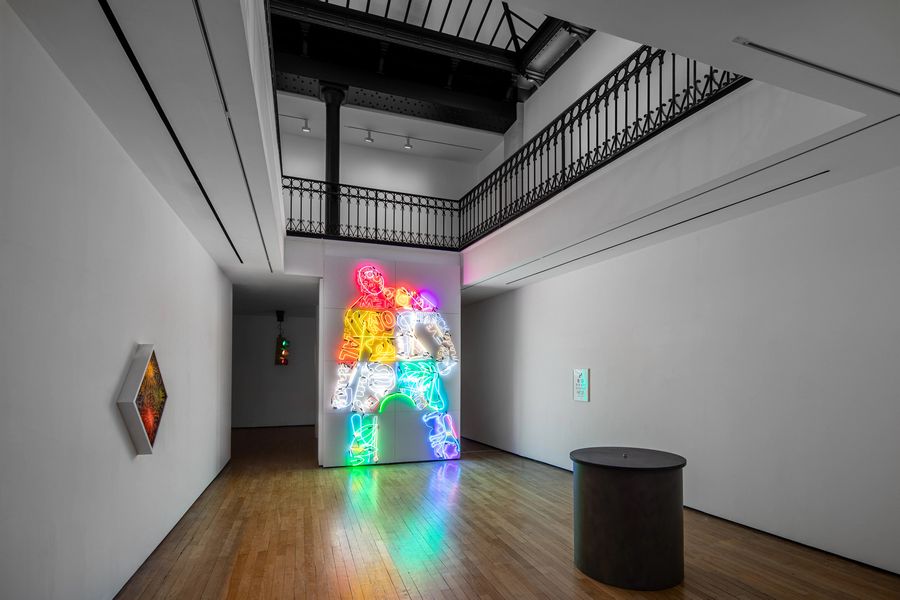
The truth is that no single exhibition among those mentioned engages more directly with Cyclops than another; rather, taken together, they form an entry point—a luminous passage—that reverberates through the new works Iván Navarro presents today at Templon. In this sense, each project serves as both an antecedent and an augury of the current exhibition. The metaphors of evasion and disappearance that Navarro explored over the past decades are here expanded to a scale where the body emerges as a central figure. In that regard, the new pieces return the gaze—quite literally and conceptually—to the attentive, revealing eye that Matta-Clark opened fifty years ago. What we see, then, is a vast and resonant “in-between.”
Broadly speaking, what Navarro proposes is a vertiginous journey that oscillates between blindness and vision, between past and present, and pursues a clear purpose: in ordinary terms, to become aware; in more transcendental ones, to become conscious. To this end, he proposes a tentative progression in which the body—led primarily by the eye—inevitably crosses paths with another eye. And it is precisely in this brutal encounter between openings that a surge is released. And finally, a recognition.
Navarro’s surge is electric, certainly—but it is also sensory, emotional, and political. He suggests that when things collide, they unleash a jolt that reverberates through perception, as it does between bodies and eyes. Although Iván previously worked with human silhouettes in Nowhere Man (2009), this time he moves beyond a series of generic, anonymous figures. Instead, he has chosen a specific being—one that embodies, entitles, and problematizes the very scope of the exhibition: a Cyclops.
This mythological giant embodies immoderation, radical otherness, and technical mastery. The poet Hesiod portrays the Cyclopes as forgers of lightning, describing them as immense beings who wielded the raw energy that, in turn, empowered the gods of Olympus. Always poised on a threshold, they symbolize technique without necessarily embodying moral conscience; they are allies of the cosmic order, yet simultaneously unpredictable and potentially dangerous.
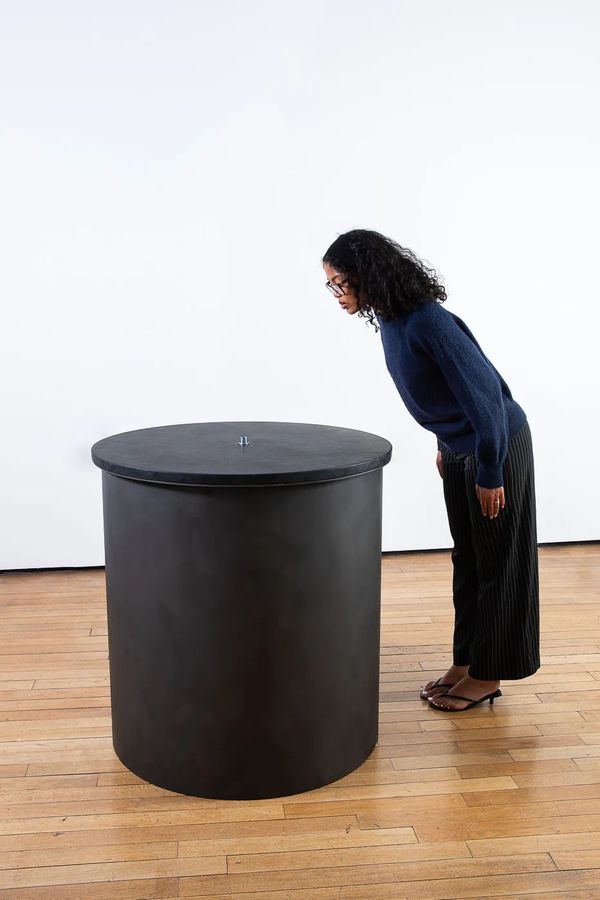

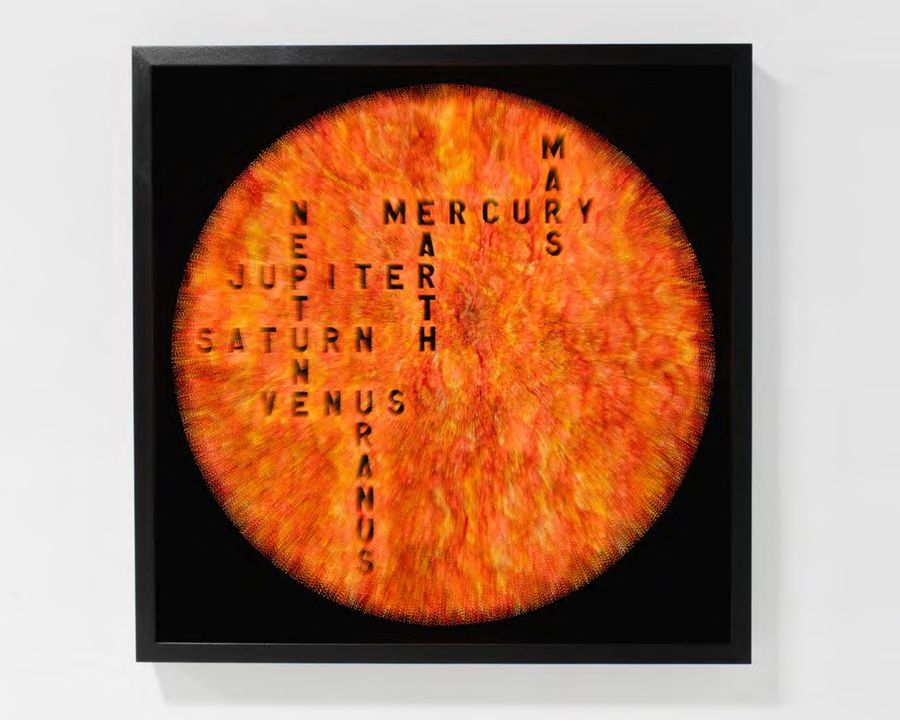
Iván Navarro, The Observatory, 2025. LED light, granite, steel tank, timer, acrylic, door view and electric energy, 91.44 diam x 93.98 cm. Unique Piece.
Iván intentionally employs this double meaning—choosing an ambivalent protagonist to stage his statement. During one of his most recent trips to Chile, we met in a café in Santiago that, at first glance, resembled a Parisian bistro, with a terrace overlooking the street, wicker chairs, retractable canopies, and an interior sheltered by beveled windows. We chose it for convenience and settled on one of the cushioned stools inside, where the atmosphere was intimate and tinged with nostalgia.
Before saying a word, we studied the mirrors on the walls, which reflected both the café’s interior and ourselves—duplicated and inverted within that space. I opened my notebook while Iván sketched a plan of the gallery. With arrows, he traced the route from the entrance, passing through the various corners and moments of the exhibition. He drew The Cyclops (2025), more than two meters tall, and the barrel beside it.
When I asked him how The Observatory (2025)—the sculpture from which it is possible to observe an eclipse—felt to the touch, he replied that it was porous and ice-cold at the same time. I remember how that description made my skin crawl.
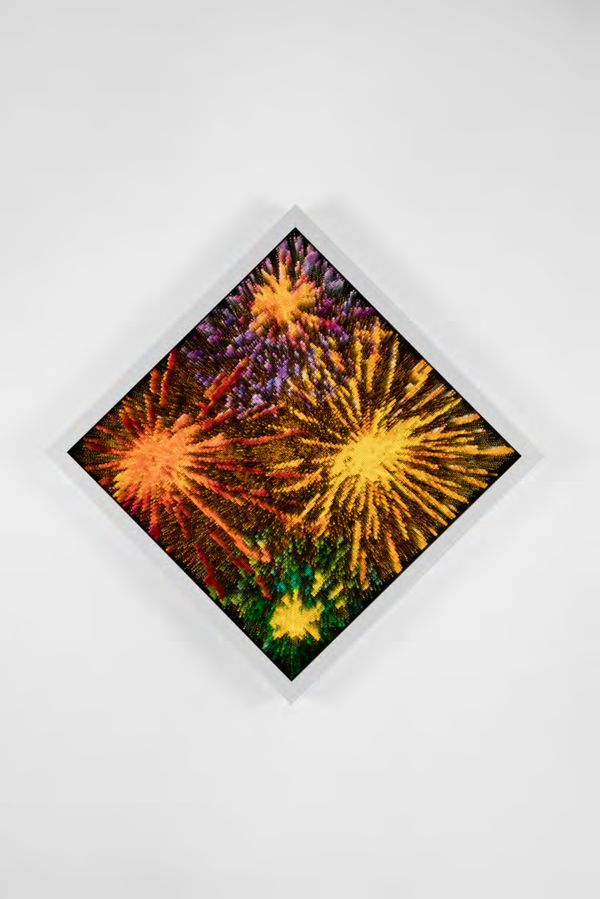
Then he made a miniature of Sun Traffic (2025), the semaphore that hangs behind the giant eye, and wrote the letters S, U, and N, which blink inside the tricolor circles. He showed me on his phone the details of the paintings splashed with paint on mirrors, collectively titled the Shell Shock series (2025). When I saw them, they simultaneously evoked a solar landscape, a close-up of an iris, crystallized fireworks, and a crime scene—all fragmented by a kaleidoscopic array of mirrors.
When I asked him what the exhibition was going to be called, he admitted he still didn’t know (it was two months before the opening), but it would probably be Cyclops in French. When he looked up the exact translation on Google, he laughed—apparently, cyclops is also slang for penis in French.
I didn’t know that. But I pointed out that the eye is not the only genital nickname, and that in Chile it is also called chino tuerto and ojo de carne, both alluding to the opening of the glans—the urethral meatus. This amused Iván, though the truth is he didn’t really mind. He already understood that the Cyclops is constituted by a constellation of associated meanings that mirror, distort, and trigger one another.
More importantly, this “monstrous” idea of the one-eyed being opens up a broader symbolic field, beyond the genital and the masculine, as it traces a problematic and permeable border between civilization and barbarism. The Cyclops is a complex figure: he possesses strength and knowledge but is also grotesque and threatening. Above all, he often exceeds the human order, though he is never entirely outside of it. And that is what interests me.
Therefore, the asymmetry of having only one eye should not be read simply as a projection of phallic anxiety, but rather as evoking an absence or bodily alteration—an element that Navarro uses to denounce recent acts of violence perpetrated not during the dictatorship, but in democracy. During the estallido social in Chile (2019–2020), an unprecedented number of eye injuries caused by buckshot and pellet shots fired by police forces toward demonstrators’ eyes were documented. According to data from the National Institute of Human Rights (INDH), at least 460 people suffered eye trauma, several of whom lost all or part of their sight.
Thus, the surviving eye, the destroyed eye, and the metaphor of blindness became powerful symbols of the revolt and its repression during the Chilean social uprising.
The opening of Iván Navarro’s exhibition coincided with the recent release of seven videos recorded by the body camera of a former Carabineros lieutenant colonel. The Centro de Investigación Periodística (CIPER), a Chilean non-profit investigative foundation, published footage showing Claudio Crespo and his Special Forces team confronting the “front line” of the social outbreak, facing attacks with Molotov cocktails, stones, and fireworks. These recordings—used as evidence in the trial for the injuries that blinded the young psychologist Gustavo Gatica—were captured in downtown Santiago between November 8 and December 6, 2019. In one chilling moment, the carabinero carrying the camera, while giving orders, threatens a detainee, saying, “We’re going to remove your eyes.”
I close my eyes and imagine Iván Navarro as a child in Santiago, amid the dictatorship. I try to decipher what he must have felt when widespread blackouts swallowed everything—the light, the images, the city itself. I think of the night and the black holes: what disappears by force, and what becomes invisible over time. I recall the sound of the radio he used to listen to at home during those blackouts. Then, I picture him in his school uniform, leaving classes at Colegio Los Sagrados Corazones de la Alameda, stepping out into the streets of downtown, surrounded by manifestantes and marchas. I see him among those being repressed by the police with tear gas bombs.
I know that Iván left Chile for the first time in 1993, after the return to democracy. At that moment, his father—who had been imprisoned for several months during the Pinochet dictatorship—received a small reparations payment and used it to buy Iván’s airfare to France. His brother Mario was already living there, and together they toured Paris, including a visit to the Templon gallery, where they saw an exhibition by Venezuelan artist Meyer Vaisman. “That trip shaped me as a person and as an artist,” Iván recalls. Indeed, he, his work, and his visual language have been shaped over the years by the cumulative impact of these experiences: what he saw and lived as a child, a young man, and a student; but also by what he did not see—what no one has seen—because it has vanished.
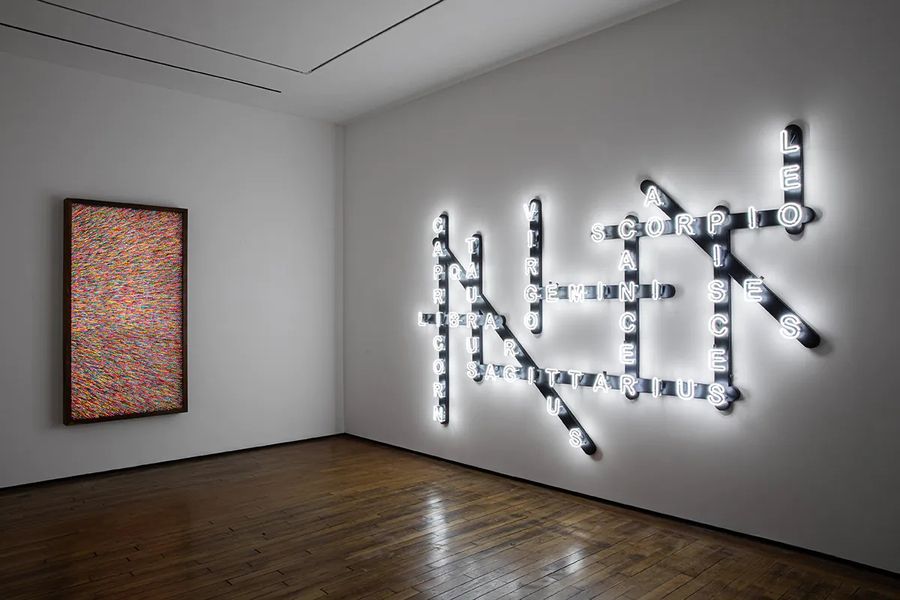
After graduating from university in Santiago, Iván settled in New York, where he worked as an antiques restorer. This background is no coincidence. I say this because in the pieces he now exhibits at Templon, one senses the meticulous craftsmanship of a carpenter and master electrician. When Iván showed me previews of Cyclops on his phone, I was drawn irresistibly to The Eye (2025), with its solitary cornea, iris, and pupil sculpted from neon tubing found on the streets of Manhattan. There was something both beautiful and heartbreaking about the exposed wires and their endings—something simultaneously rescued and abandoned. I couldn’t help but read a poem between the lines; I couldn’t stop gazing at that eye, which, more than resembling a glans, suggested a vulva with a circle at its center. (“The same that is there, is here,” say the Upanishads about the vulva—the inside and the outside.)
While the single eye is commonly associated with insight, intelligence, and reason, the eyes that Iván created for his Paris exhibition possess a nocturnal vision, connected to a darker, more elusive consciousness. Now I understand that in his most recent work, these eyes do more than challenge the binaries of inside and outside, light and blindness, past and present. Perhaps, in fact, the pieces are subversive precisely because they resist being confined to any binary opposition. The works gathered in Cyclops unsettle the boundaries between the human and the monstrous, revealing the density of the in-between—the undefined, or even what is yet to be defined. I refer here to the question of where the monstrous dwells.
It is well known that the Cyclopes were children of Gaia and Uranus, associated with thunder, lightning, and glare. When I reflect on this triad, it unfolds as a sequence that bursts forward through time and space, reminding us that there is no monstrosity more terrible than the human one—because it is deliberate. Nor is there violence more brutal than that which is inflicted between peers. The researcher Richard Caldwell suggests that the Cyclops symbolizes an inner residue: “that unconscious totality at the beginning of mental development, which is full of life and possesses the potential of consciousness but is as cruel and as savage as nature itself.”
This year, for the first time since he began working with the Templon gallery, Iván is exhibiting at 28 rue Grenier Saint-Lazare, rather than at 30 rue Beaubourg. That is, not on the same side where Conical Intersect once stood, but precisely where the eye of that piece used to gaze. And the truth is, a dialogue emerges between the two. In Iván’s pieces, language becomes an “illuminated manifestation of consciousness,” a flicker that gestures toward double meanings and the painful abysses separating appearance from truth—and its concealments. This notion forms yet another link between Matta-Clark’s work and Navarro’s: in both, words are access points, potential portals that transform perception and reconfigure reality.
However randomly chosen they may seem, none of them are accidental. First, there are the layers of meaning that crawl along with the cyclops, and then the literal words that emerge—shaped in neon light—such as man and skin (to name just two). Then: oppression and revolt. And then come the words we assign to what we see: discharge, force, anger—a flare, a spot of light. I think of Julio Cortázar’s description upon first seeing a Jackson Pollock painting in 1955: “a kind of jungle of colors in which the eyes go for a walk and take hours to return.” I think of Matta-Clark, who in 1975 spent his days cutting through the walls of two old Parisian buildings, and his nights caring for John Sebastian, his schizophrenic brother, who was also in Paris at the time. A year later, his twin took his own life, and to endure the grief, Gordon began digging a hole in Yvon Lambert’s gallery—shovel in hand, day after day, for weeks.
I think of mourning, of the desaparecidos, of the names of constellations, of those stars once discovered without instruments—seen only with the naked eye—that Iván redeemed in his Paris Metro project: a great hole in the ground, a final floor for humans, where sunlight never reaches. It takes hours to return, Cortázar said. I think of catacombs, and of Matta-Clark’s note: In the night you hear-see all. I think of the depths of that giant Parisian pit, and the deliberate use of the word fosa in Spanish, with all its horror and political resonance under the Chilean dictatorship. I think of the openings through which light enters, and the promise of reaching the sky—or at least, the visible. But before continuing, I pause.
I go back and step aside: in an improbable gesture, the lightning flash retreats into thunder. Neither sound nor light have yet erupted. Day slips back into night, though not entirely dark. And only then, in full anticipation, I see the one-eyed giant—monstrous and human. The artificer, the forger, in his cave, in his workshop. He is carving a lightning bolt and longing for others to see and hear. He wants those who have disappeared to be part of that radiance already on its way. He knows he can make us feel something—even in the fleeting instant of a flash.

También te puede interesar
ENRIQUE RAMÍREZ: UN HOMBRE QUE CAMINA
"Un hombre que camina", película de Enrique Ramírez (Chile, 1979), se terminó de filmar en 2012 y se editó en 2014. Pero no fue sino hasta el 2017 cuando debutó remasterizado en el marco...
PABLO JANSANA: ADORMECER A LOS FELICES (O LA FICCIÓN DE LOS MUNDOS POSIBLES)
A través de sus recientes pinturas, Pablo Jansana (1976) nos propone un recorrido y un relato de los últimos 30 años de la historia político-cultural y afectiva de Chile. Así, mediante gramáticas visuales polifónicas...
N3t0:andariego
N3T0 nos invita aquí a reflexionar sobre las migraciones de ideas, la multiplicidad de las lenguas y la historia del arte del continente latinoamericano, bajo la premisa que el ser humano es esencialmente un...